
3D Printing News Unpeeled: $3.4m for Soil & Concrete 3D Printing, Sensor Insoles & Embedded Encoders

The University of Arkansas has gotten $3.4 million in funding to improve concrete 3D printing. The money comes from Applied Research Associates which is distributing it on behalf of the $12m it got from the US Army’s Engineer Research and Development Center. The research has to do with horizontal structures such as culverts, t-walls and jersey barriers. But, I’m pretty sure were talking about silos, bunkers and other things like that too. The money goes to Professors Michelle Barry, Cameron Murray, Wenchao Zhou. Zhou is also the founder of AMBOTS a swarm robotics startup. Obviously this indicates that they want to air drop swarm robots to autonomously build bases and the like in contested areas. What is known is that the work will look at using local materials in concrete, CAD to tool path planning, structural testing and more. The applications here for the military and disaster relief are considerable.
3D Printed insoles made using DIW by team from ETH Zurich, Empa and EPFL are meant to measure real world walking performance, gait and more. This could let people improve their athletic performance or walk more comfortably. It could also be used for more comfortable prosthetics, orthotics or more. The research is published in Nature and was done by Gilberto Siqueira, Marco R. Binelli, Ryan van Dommelen, Yannick Nagel and more.
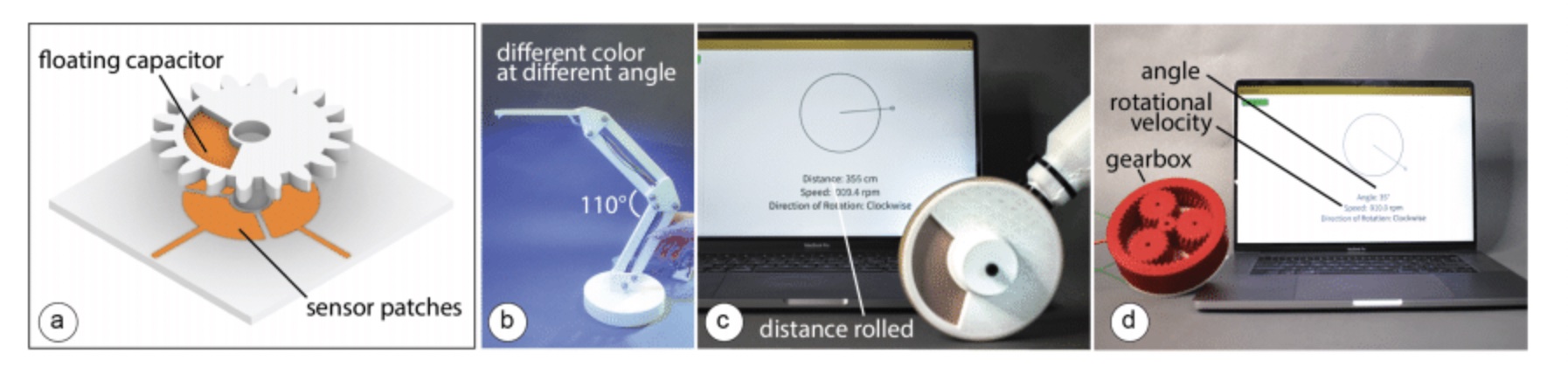
MechSense, is an innovation by an MIT team that showcases the embedded 3D printed sensors. Made on a multi material 3D printing in one pass these rotary encoders can tell us about the performance of gears, moving components, hinges and more. Applications abound in sensors, security, IoT, machinery and many more areas. The work was done by Marwa AlAlawi, Michael Wessely and Stefanie Mueller.
Optomec has new software called KEWB for high volume IC packaging and other electronics manufacturing using AerosolJet. This is a portend of a world where billions of electronic devices are made, in part, through 3D Printing.
Subscribe to Our Email Newsletter
Stay up-to-date on all the latest news from the 3D printing industry and receive information and offers from third party vendors.
Print Services
Upload your 3D Models and get them printed quickly and efficiently.













You May Also Like
South Korea’s Lincsolution Lands Hanwha Defense Deal as Hanwha Invests Billions in US
I recently wrote about how the South Korean additive manufacturing (AM) firm Lincsolution is building an aerospace and defense hub, part of the company’s construction of “the largest AM facility in...
Bambu Lab and SUSAN FANG 3D Print for London Fashion Week
At London Fashion Week, some of the more unusual pieces on the runway came from 3D printers. Chinese fashion designer SUSAN FANG presented her Spring/Summer 2027 Air-Illusion collection at the...
Why Cross-Border 3D Printing Is Closing the Speed Gap with Local Manufacturing
The fastest 3D printing supplier in your shortlist may no longer be the one closest to your office. That sounds unlikely to many engineers. For years, overseas 3D printing carried...
Arridex Expands 3D Printing Network to Ghana
Nigeria-based Arridex has deep experience in oil and gas additive manufacturing. Previously known as RusselSmith, the firm has in-house metal and polymer additive technology. The company is making 3D printed...























































