Zymergen Polyimide 3D Printing Filament Shows High Isotropy and Strength

The bane of 3D printing, particularly fused deposition modeling (FDM), has typically been the lack of isotropic strength between layers. Now, a group of firms—Zymergen (Nasdaq: ZY), Hexagon (Nasdaq Stockholm: HEXA B), 3D4Makers, and AON3D—have worked together to demonstrate high isotropy and strength in a new polyimide formulation. In tests by supported by The Royal Netherlands Navy’s Expertise Centre Additive Manufacturing (ECAM), a part made from Zymergen’s Z2 Polyimide filament was able to withstand 432 kg of load before failure.
Not to be confused with polyamide (Nylon), polyimide is a much stronger thermoplastic, in this case, manufactured by Zymergen. The company’s role in AM is worth noting, as the publicly traded company has reportedly had issues commercializing products before it was acquired by Ginko Bioworks this year.
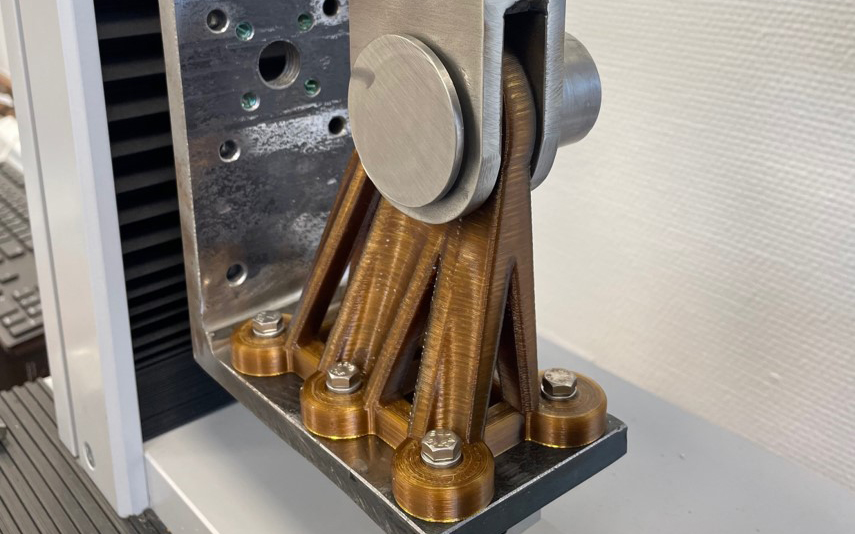
A tie-down bracket for military cargo planes was 3D printed with 100 percent infill from Z2 Polyimide on an AON M2+ high-temperature 3D printer. The material is said to demonstrate similar tensile modulus to ULTEM 9085, a SABIC 3D printing material widely used in aerospace. However, Zymergen’s filament additionally exhibits better strength and elongation at break, potentially signifying overall enhanced interlayer weld strength and part isotropy than ULTEM.
Before conducting tests with the ECAM, the team simulated the performance of the component in Hexagon’s Digimat AM software. The tool predicted a fracture across multiple layers, rather than a single layer. In physical testing, the part withstood a 432 kg load before fracturing through multiple layers in two locations, just as Digimat had predicted. Because the component broke due to stress across the overall structure rather than just inter-layer welds, the team was able to validate that Z2 Polyimide demonstrates extreme isotropy for FDM polymer parts.
As it stands, ULTEM is the most widely used polymer for 3D printing high-performance aerospace parts, due to the fact that it has passed the necessary certification requirements. However, once Z2 Polyimide passes the ongoing tests for UL94 V0 and FAR 25.853 flammability requirements, it could be used as an ULTEM alternative.
According to its Polymer Parts Produced: AM Applications Market Analysis report, SmarTech Analysis estimates that the market for 3D printed polymer components will be worth $26 billion by 2030. The same report suggests that the aerospace segment will grow from representing 6.4 percent of the total in 2021 to 11.5 percent by 2030. A key driver in this growth will be the improved varieties of plastics that enter the market. After all, try to imagine just how much adoption of 3D printing could increase in aerospace if the sector were limited to ULTEM alone.
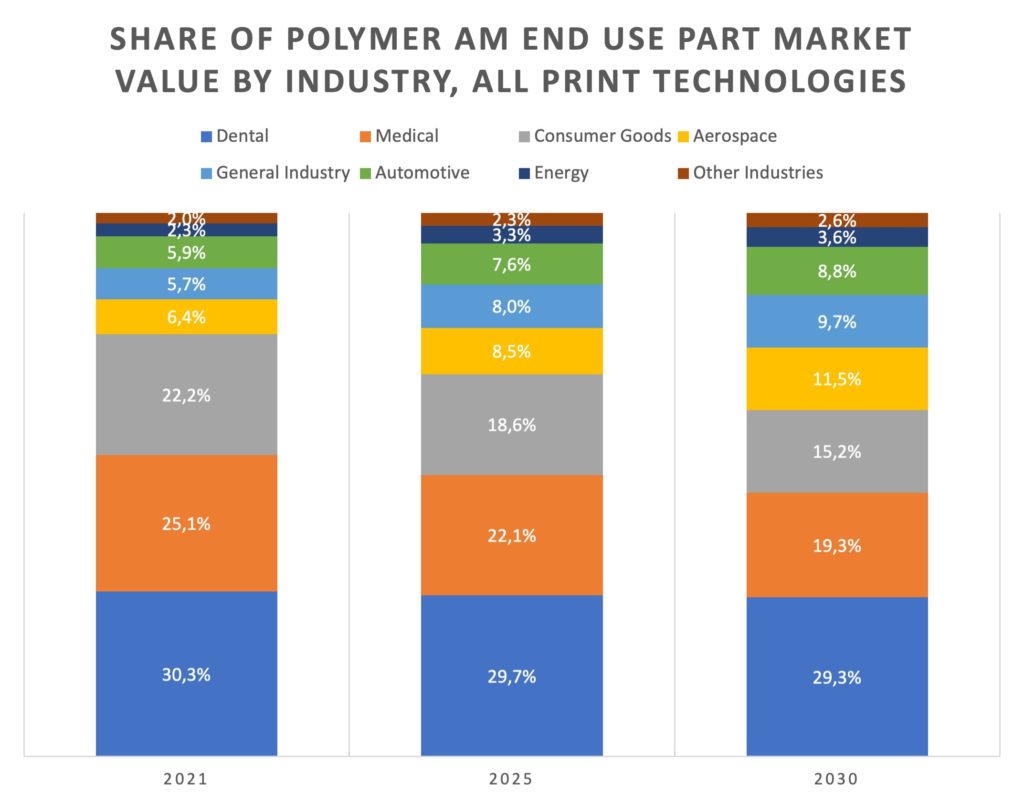
Image courtesy of SmarTech Analysis.
Importantly, Saudi Oil Minister Prince Abdulaziz bin Salman said in March that the world is “running out of energy capacity at all levels.” More recently, Saudi Aramco CEO Amin Nasser claimed that the world’s capacity for oil is “extremely low.” As oil becomes increasingly difficult to come by, thus increasing its overall cost, the price of ULTEM and other fossil fuel-based polymers will also increase. Because Z2 Polyimide is said to be “bio-inspired” and made via “bioengineering”, suggesting that, though fossil fuels may still play a role, the materials may have some biopolymer basis. If Z2 can be made as a pure biopolymer, it will not only be less expensive than ULTEM, but better for the environment as well.
3DPrint.com and SmarTech Analysis are hosting Additive Manufacturing Strategies in New York City on February 7-9, 2023. Register for the event here to learn from and network with the most exciting companies and individuals in AM.
Subscribe to Our Email Newsletter
Stay up-to-date on all the latest news from the 3D printing industry and receive information and offers from third party vendors.
Print Services
Upload your 3D Models and get them printed quickly and efficiently.











You May Also Like
Inside Xometry’s 2026 Outlook: Why AM Is Becoming Essential — and What’s Still Holding It Back
In the first part of this series, we spoke with Xometry’s Senior Vice President of Marketplace Operations, Mike Cavalieri, about how manufacturers are reshoring, diversifying their suppliers, and building more...
Top 10 Moonshot Ideas for 3D Printing’s Future
As the year comes to a close, it’s clear that additive manufacturing (AM) is entering a new phase. Costs are falling, supply chains are changing, government spending is rising, and...
3D Printing News Briefs, December 31, 2025: Frenzy Engine, Adaptive Slicing, & More
It’s the last 3D Printing News Briefs of the year! On this New Year’s Eve, we’re focusing on Beehive’s completed Frenzy Engine, adaptive slicing for binder jetting, medical 3D printing...
3D Printing Predictions for 2026: Scaling AM Through Software
For several years, we have seen additive manufacturing software play a more central role in our industry. LPBF machines achieve higher yields and can produce thinner-walled parts thanks to the...