Big 3D Printing Announcements from Dyndrite at Formnext

Dyndrite, a provider of the GPU-accelerated computation engine used to create next-gen digital manufacturing hardware and software, made an abundance of announcements at Formnext 2022. Over the course of the four-day event, Dyndrite is demonstrating a series of software updates and products expected to provide more capabilities than many manufacturers currently use. All new announcements reinforce the company’s mission to affect how geometry is created, transformed, and transmitted on a computer.
Here are the three big announcements made at Formnext 2022 in Frankfurt, Germany:
New Software for LPBF Metal 3D Printers
A new materials and process development software for laser powder bed fusion (LPBF) machines is now available through the company’s Early Adopter Program, a white-glove service offered to a limited number of customers. The new software provides off-the-shelf support for the leading LPBF machines, including Aconity3D, AddUp, EOS, Farsoon, Renishaw, SLM Solutions, and Trumpf.
Taking advantage of the powerful features within the company’s Accelerated Computation Engine (ACE), Dyndrite’s technology gives LPBF engineers unprecedented power and control over their geometry, build specific tool pathing and laser parameters, opening the door to new alloys, build rate strategies, and methods for printing previously unprintable parts. In addition, according to the company, the software enables the detection of upskins, downskins, inskins, and characteristic features typically missed by 2.5D layer-by-layer-based solutions.

Dyndrite showcases new products at its Formnext booth in Germany. Image courtesy of Sarah Saunders/3DPrint.com.
Eager to deploy the new software, Dyndrite’s Head of Product Development, Steve Walton, said industries like aerospace previously didn’t have the software needed to “rationally explore the opportunities provided by LPBF processes.”
After working at Blue Origin for more than 11 years, Walton, a propulsion engineer and AM director has plenty of experience developing and testing rocket systems for the spaceflight services company. However, he commented that users could not efficiently investigate new materials, new build strategies, or even new machine architectures before this software was created.
“Dyndrite changes this. This new software provides a flexible new approach, a new data model, innovative and performant APIs, and complete access to toolpath geometry for those who want or need to go further,” said Walton. “After 12 years at a large rocket manufacturer leading the assembly of one of the world’s most advanced AM factories, the Dyndrite engineers and I have been hard at work creating the tool that I wish I had in my prior role,”
Inkjet 3D Printing Software Meteoryte
After six months of collaboration, Dyndrite and Meteor Inkjet demonstrated the first showing of its Meteoryte software for building and commercializing jetting printers. Then, at Formnext 2022, the partners showcased their development collaboration, a 3D software tool built using the Dyndrite Application Development Kit (ADK), which the company says makes developing and exposing advanced inkjet printhead capabilities simple, easy and commercially viable for additive manufacturing machine builders.
According to the firms, the new Meteoryte software powered by Dyndrite offers machine developers an easy-to-use 3D geometry manipulation interface and imaging features to take full advantage of jetting print heads, generating droplets accurately and as quickly as possible. In addition, features like easy geometry manipulation and slicing at up to 1200 dpi help jetting machine builders tackle the challenges of developing new machines, materials, and software.
Empowering SCANLAB’s LPBF Metal 3D Printers
A new combined effort between Dyndrite, SCANLAB, and the Fraunhofer-Institute for Laser Technology (ILT) is expected to unlock the inherent power and capabilities of SCANLAB-based machines. Focused on reversing the “hardware is outpacing software” trend in AM, the trio is creating software “that exceeds the demands of today’s hardware and provides a springboard for the next generation,” says Dyndrite CEO Harshil Goel.
“SCANLAB hardware has more capabilities than many manufacturers are currently using. Our joint effort aims to unlock what’s possible, from both ends of the problem, marrying software that is finally capable of unleashing the power of SCANLAB lasers,” points out Goel.
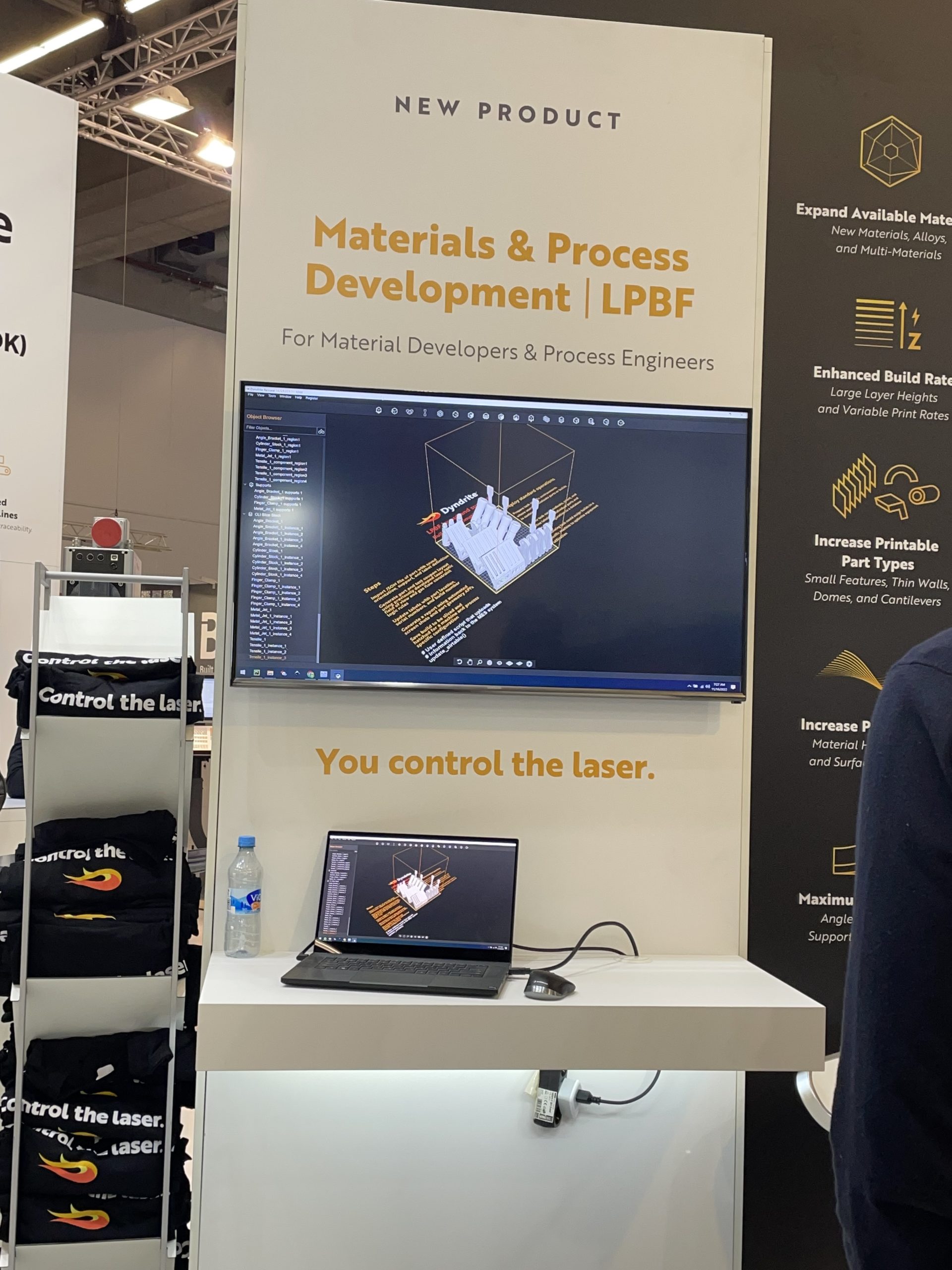
Dyndrite showcases new products at its Formnext booth in Germany. Image courtesy of Sarah Saunders/3DPrint.com.
The collaboration will leverage Dyndrite’s toolpath API to calculate, create, and assign sophisticated laser process parameters based on volumetric analysis of 3D part geometry, resulting in high-resolution data capable of driving SCANLAB-based LPBF machines to their highest potential.
Expert researchers at Fraunhofer ILT will use their process knowledge and know-how in machine software design to demonstrate the use cases and applications of the Dyndrite and SCANLAB integration. The resulting work is expected to yield better part quality, with less distortion and targeted mechanical properties for LPBF users. The results of the company’s efforts will be reflected in the Dyndrite ADK and recently introduced Materials & Process Development for LPBF software.
Formnext visitors can stop by Dyndrite’s booth C61 in Hall 11 at the ongoing Formnext event to learn more about the new SCANLAB collaboration, watch the Materials and Process Development for LPBF software in action, and a demonstration of the Meteoryte.
Subscribe to Our Email Newsletter
Stay up-to-date on all the latest news from the 3D printing industry and receive information and offers from third party vendors.
Print Services
Upload your 3D Models and get them printed quickly and efficiently.













You May Also Like
UniFormation S10 Heads to Kickstarter with an Integrated Resin Printing and Post-Processing System
UniFormation will launch its S10 desktop resin 3D printer on Kickstarter on October 22, 2026, with pledges starting at $999. The S10 integrates printing, washing, and drying, allowing a print...
Creality Goes Pro with Sermoon P1S 3D Scanner
From making millions of value-engineered Prusa clones, Creality really has aggressively pivoted to more complex machines. The company has made strides forward in software, and the Ender’s of yore is...
Stratasys Showcases 3D Printed Automotive Applications & New Printer at IMTS 2026
Just ahead of last week’s International Manufacturing Technology Show (IMTS) in Chicago, Stratasys launched the F870, a new large-format, production-grade FDM 3D printing platform designed to drive industrial manufacturing at...
Creality Launches SPARKX i8 on Indiegogo, Bringing Fastest, No-Purge-Waste Printing
Creality announces the launch of the multi-color 3D printer SPARKX i8 on Indiegogo, at an early-bird price of $309 (MSRP $399) starting from Sept. 21. Designed for ultimate user experience,...