3D Systems First Company to Market New Copper-Nickel Alloy for Laser PBF 3D Printing


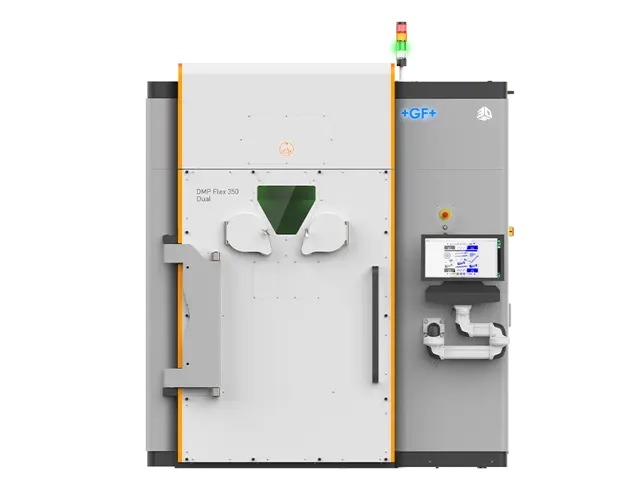
3D Systems, the South Carolina-based additive manufacturing (AM) pioneer, announced that the company is the first to market in the AM sector with a powder-based version of CuNi30, a copper-nickel alloy. 3D Systems co-developed the new CuNi30 powder with Huntington Ingalls Industries (HII), the US’s largest military shipbuilding company, for use with 3D Systems’ DMP Flex 350 metal printer, a laser powder bed fusion (LBPF) platform.
HII was formed in 2011, as a spin-off of defense giant Northrop Grumman, which recently joined the Biden administration’s AM Forward initiative. Specifically, 3D Systems developed the new material in collaboration with HII’s Newport News Shipbuilding Division, headquartered in Newport News, Virginia. HII also has a shipbuilding division in Mississippi (Ingalls Shipbuilding), as well as a division for more general defense and industrial technologies, including nuclear energy and oil & gas.
In a press release, Dr. Michael Shepard, VP of defense & aerospace at 3D Systems, commented, “We’ve had a decades-long relationship with the US Navy which has helped drive innovation for a variety of applications including aircraft parts and submersible components. …[This latest project] yielded a copper-nickel alloy…that results in better part density and mechanical properties as compared to traditional casting.” Newport News Shipbuilding’s VP of engineering and design, David Bolcar, added, “We’re looking forward to continuing to expand our parameter development efforts with 3D Systems into other alloys of interest.”
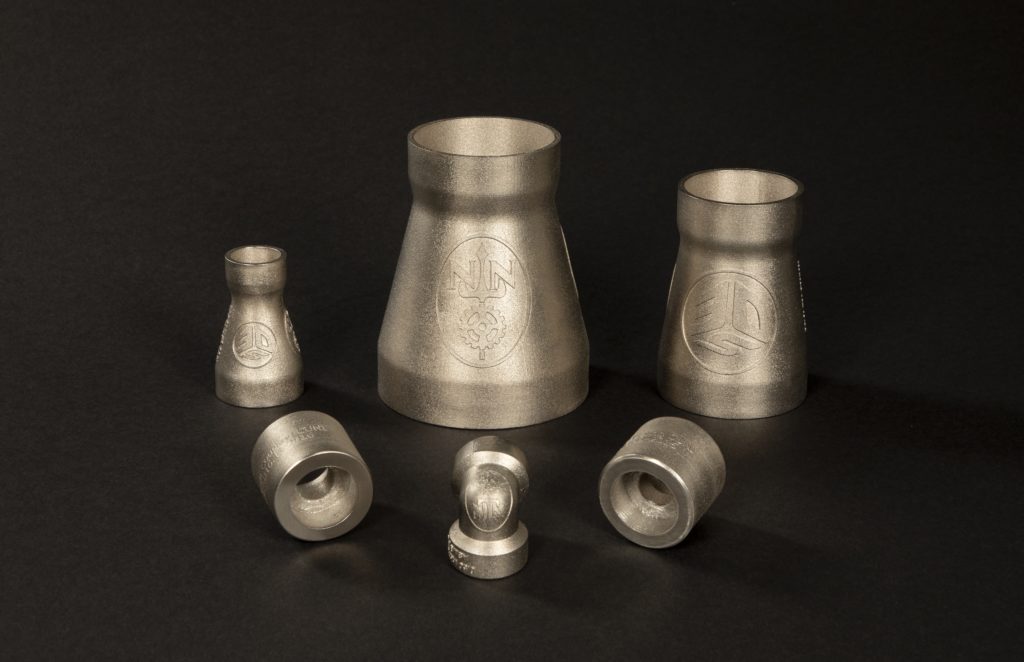
Among other advantages when compared with conventional casting techniques, including a savings in inventory costs, printing with CuNi30 can be expected to result in a reduction of lead times of up to 75 percent. 3D Systems expects to release the new copper-nickel powder to the general market sometime in Q4 of this year.
Due to its having such high reflectivity, pure copper is extremely difficult to work with on laser-based AM platforms. CuNi30 is composed of 30 percent nickel, in the lower range for copper content for typically available copper-nickel alloys. It’s possible this could give it an advantage among all copper-nickel powders used for laser-based platforms, which, in turn, means it is especially advantageous to 3D Systems to be first to market in this case, in particular.
In addition to ship-building, copper-nickel alloys are useful in essentially all other sectors where resistance to corrosion is a concern, such as nuclear energy and oil & gas. Along with being the other sectors that HII is involved in, these are also sectors that are starting to significantly increase their adoption of AM lately. Joining seemingly the the rest of the entire range of basic materials you can think of, the supplies of both copper and nickel are increasingly volatile and seem likely to stay that way. Against that context, the growing availability of options for printing with copper-nickel alloys is yet one more signal suggesting that AM is poised to make more and more of an impact on all energy-related sectors.
Subscribe to Our Email Newsletter
Stay up-to-date on all the latest news from the 3D printing industry and receive information and offers from third party vendors.
Print Services
Upload your 3D Models and get them printed quickly and efficiently.













You May Also Like
HeyGears Reflex RS Turbo Sets a New Standard for Resin 3D Printing
When creating highly detailed resin prints, speed only matters if the finished result still captures the details that made the model worth printing in the first place. The HeyGears Reflex...
IFA 2026 Shows Where Multicolor 3D Printing Is Headed
Innovation For All (IFA) is best known for televisions, appliances, and consumer electronics. But this year’s show in Berlin also gave 3D printing companies plenty of room to show where...
3D Printing News Briefs, September 12, 2026: Rebranding, Cybersecurity, Project Call, & More
We’ve got a lot of business news from ATLIX to start off this weekend’s 3D Printing News Briefs, with a new identify for its additive manufacturing (AM) portfolio and some...
Quickparts Builds a Four-Country 3D Printing Network for Space and Defense
For manufacturers trying to win more space and defense work, adding 3D printers is only part of the challenge. They also need to make the same parts to the same...