America Makes and AM Coalition Announce Strategic 3D Printing Partnership

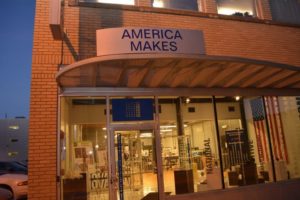
At its annual Members Meeting and Exchange last week, America Makes, the nonprofit additive manufacturing (AM) center headquartered in Youngstown, Ohio, announced a strategic partnership with the AM Coalition. The latter organization is a Washington, D.C.-based, 501(c)(6) tax-exempt business association, which advises the federal government on issues related to the AM sector.
Among other details of the collaboration, America Makes plans to help sponsor and otherwise facilitate AM Coalition educational programs, as well as other industry-related events. Additionally, AM Coalition will help America Makes formulate communication strategies so that America Makes can maximize its outreach to potential commercial and governmental partners.
According to a press release, the primary aim of the partnership is to coordinate information concerning the industry, in order to also synchronize advisory efforts made to the government on behalf of the sector’s major stakeholders. Of course, that consideration will become increasingly important to industry leaders going forward. After nearly a decade of gradually building up its interest in the technology, the US federal government has only continued to increase, and broaden, its support of AM this year.
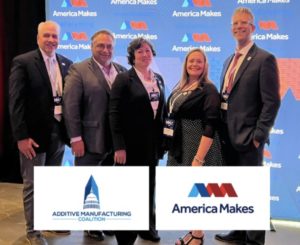
In addition to the Biden administration’s oft-mentioned AM Forward initiative, a range of US government agencies, from military branches to the Department of Energy (DOE), seem to have been funneling more public money than ever into the industry in 2022. In that sense, it can be expected that there will be more resource-sharing amongst nonprofits and the like, such as the partnership announced by America Makes and the AM Coalition. And, although it didn’t happen in this case, it’s likely that there will also be more mergers between research and advisory institutions, etc, parallel to the mergers happening in the industry, itself.
Similarly to the AM Forward initiative, which both of the institutions mentioned in the present post are vocal proponents of, news of this type of partnership can be taken as yet another signal that the sector is not only scaling up, but standardizing. Once it truly start to take shape, the sector’s standardization will likely happen increasingly quickly, as standardization related to anything digital seems to be something of a self-replicating process. This means that organizations such as America Makes and the AM Coalition are positioned to disproportionately benefit from the first big scale-up for the sector, simply from being so early to the party.
Images courtesy of America Makes
Subscribe to Our Email Newsletter
Stay up-to-date on all the latest news from the 3D printing industry and receive information and offers from third party vendors.
You May Also Like
3D Printing Unpeeled: New Arkema Material for HP, Saddle and Macro MEMS
A new Arkema material for MJF is said to reduce costs per part by up to 25% and have an 85% reusability ratio. HP 3D HR PA 12 S has been...
3D Printing News Briefs, January 20, 2024: FDM, LPBF, Underwater 3D Printer, Racing, & More
We’re starting off with a process certification in today’s 3D Printing News Briefs, and then moving on to research about solute trapping, laser powder bed fusion, and then moving on...
3D Printing Webinar and Event Roundup: December 3, 2023
We’ve got plenty of events and webinars coming up for you this week! Quickparts is having a Manufacturing Roadshow, America Makes is holding a Member Town Hall, Stratafest makes two...
Formnext 2023 Day Three: Slam Dunk
I’m high—high on trade show. I’ve met numerous new faces and reconnected with old friends, creating an absolutely wonderful atmosphere. The excitement is palpable over several emerging developments. The high...