$43M to Drive Tiny 3D Printing Tech for Boston Micro Fabrication

Boston Micro Fabrication (BMF) has closed a Series C round of funding totaling $43 million, led by Shenzhen Capital Group Co., Ltd. (SCGC). This large infusion of capital will allow the startup to continue expanding its micro 3D printing technology.
Micro 3D Printing
Founded in 2016, BMF focused on building 3D printers that rely on Projection Micro Stereolithography (PµSL) for millimeter-scale parts with micron-level tolerances. With systems of varying levels of resolution, ranging from 25 all the way down to 2 microns, the Boston startup’s microArch 3D printers are already used in a variety of sectors, including medical device and electronics manufacturing.
In the past year alone, BMF doubled its install base and now has machines installed at over 200 customer locations globally. It also expanded its operations in Greater Boston; Shenzhen and Chongqing, China; and Tokyo, Japan. With the new funding, the startup will drive its product development, sales and marketing, and customer support.
“Our business has scaled strongly, and we plan to use new capital to further expand our capability,” said John Kawola, CEO of BMF. “Our global reach has been appreciated and valued by our customers, and our systems are now being used all over the world to both prototype parts that previously could not be 3D printed and drive end-use part production where conventional methods are difficult.”
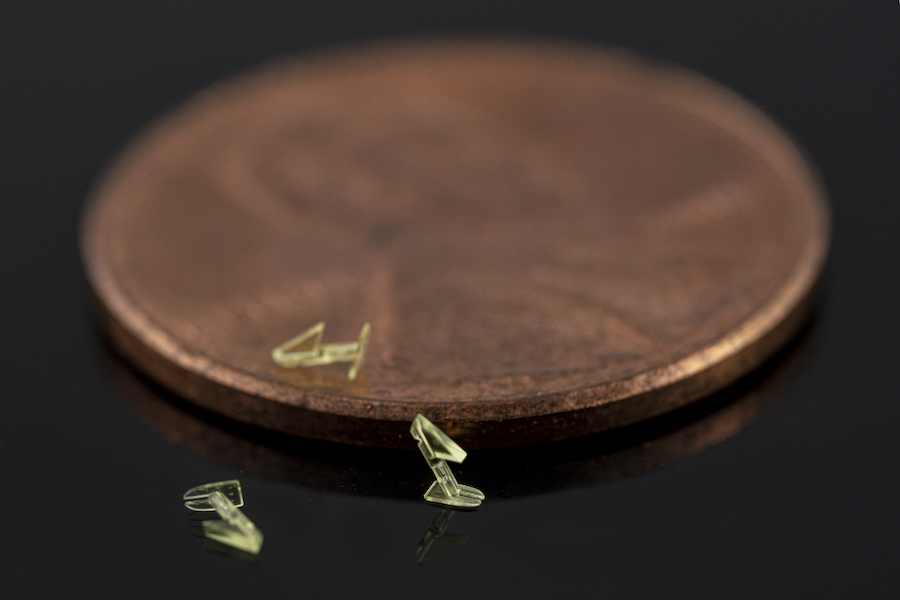
3D printed glaucoma stents, meant to be inserted into a patient’s eye to treat glaucoma. Image courtesy of BMF.
BMF’s Micro 3D Printing Competition
The world of 3D printing tiny things is growing in size. In addition to BMF, there are such firms as Cubicure, UpNano, SwissLitho AG, Microlight3D, Nano Dimension’s Fabrica, and Nanoscribe. This last company was acquired by bioprinting firm BICO. UpNano and Nanoscribe are currently competing to scale these processes in order to mass produce tiny, 3D printed parts.
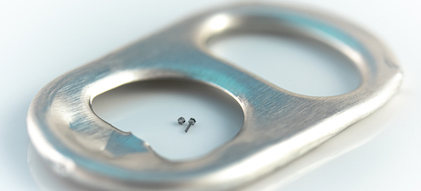
Microscopic screws. Image courtesy of BMF.
The technologies offered by these firms could potentially revolutionize the fields in which they’re used. They could lead to much smaller surgical devices, such as new drug delivery mechanisms or uniquely shaped laparoscopic instruments, or new types of lab testing equipment via microfluidics. In the realm of electronics, there’s the possibility of photonic computing and more densely packed, geometrically optimized circuit boards, an application that Nano Dimension is specifically focused.
Obviously, SCGC believes in the technology, which is a substantial endorsement, given the company’s 490 investments and 85 exits. Established by the Shenzhen government, this venture capital firm previously put money into Formlabs and Desktop Metal. Interestingly, all three startups are based in the area. Could Shenzen be making a play for the New England 3D printing scene?
Subscribe to Our Email Newsletter
Stay up-to-date on all the latest news from the 3D printing industry and receive information and offers from third party vendors.
Print Services
Upload your 3D Models and get them printed quickly and efficiently.













You May Also Like
The Money Behind AM: What to Watch at AM Investment Strategies 2026
For years, simply being a 3D printing company could attract attention from investors. New machines, new materials, faster speeds, and the promise of mass production were often enough to get...
3D Printed Football Helmets Are Amazing Business. They’re Also So Much More
NFL football is by far the most popular sport in the US, followed by college football (a state-of-affairs oddly similar to the fact that the world’s largest air force is...
Continuous Composites Wins Navy SBIR for 3D Printed UAVs
In a diversification effort, Continuous Composites has decided to seek work outside of the courtroom. The company that has been successful in defending its patent portfolio in composite 3D printing...
When Data Becomes the Differentiator: Qualified Material Data is Changing the Future of Structural Additive Manufacturing
For years, additive manufacturing has promised engineers greater design freedom. The challenge wasn’t printing the part—it was proving the part belonged on an aircraft. Designing a lightweight bracket or consolidating...