
Mosquito Dreams Part 1: Thonet, A World History

As a child, I lived in Kenya for a while. When we went to Mombasa, wafting breezes, crunchy white powder that sounds like snow underfoot, beaches bordered by many unseen blues, we had to take malaria medication. Beneath the gauzy beige of my mosquito net, I hallucinated. Sweat baubles on my body, I saw purple planets, star storms, surfed over seas of mercury and plunged into black holes. The next day I went scuba diving for the first time; I was nine. Beneath the hollow, thudding, dull echoes of the ocean, bubbles hurried upward; color explosions in fish darted; bright pink-hued sea anemones swayed as morays poked out their inquisitive gorgon heads. This was a real world, far, far stranger than my malaria med hallucinations ever were.
Ever once in a while, the reality layer of the world peels back to expose dreams, imagined universes, and other paths, radically different from the current reality. The De Havilland Mosquito is one such moment. The other is a series of chairs. To call the Mosquito an invention or radical or something with far-reaching consequences is a complete understatement. It’s also not an important invention like the lightbulb. It’s a completely radically different way of seeing the world, unsurmountably different. It is something that can not be unseen. The lightbulb is important, but it was logical, expected even. Implications understood, but far-reaching. The Mosquito buzzed in and out, leaving a new world in its wake.
And, like I was back then, it let people conceive a completely different way of seeing. Not only in the construction of aircraft, but the system by which they were made and by whom would be influenced by the Mosquito. But the Mosquito fever dream also changed how the aircraft industry works and how many other things are made. The Mosquito dream can not be unseen. And once you see it, so much will become clearer.
Why did the military get a F-35C and a F-35B? Why all the fuss about composites? Why did Boeing outsource much of its critical manufacturing? Why are Airbus parts made all over Europe and flown around? Why was there a Panavia Tornado? Why was there not one Panavia Tornado? Why was the 787 Dreamliner made of composites? Why do F1 cars and hypercars burn so satisfyingly to a crisp while your Corolla won’t? Why are all the Tour de France bikes made of plastic, and why do they cost $10,000?
Composites today are found in wind turbine blades, bikes, boats, construction panels, and make up most of Formula 1 cars. Composite materials may have originated 9,000 years ago in straw and clay bricks. And whereas there are many composite-like materials in nature and many things that could be classed as composites, I’d argue that composites as a technology first had its ¨aha¨ moment with the creation of the Mosquito. Before, people may have incidentally used composites, but here people understood them as a technology and a new class of materials. Composites may have existed before, but the idea that a class of materials could be constructed to form differently was born with the Mosquito.
World War I planes were essentially tents or bridges, with tensioned wire and fabric making wings, and wood and metal used only when absolutely necessary. The aircraft industry’s weight allergy was built in; early plane designers had only two problems: getting aloft and crashing. It was binary; you had either one or the other problem. Staying aloft has become an added concern for later plane engineers. Landing coherently was solved on the fly. World War II planes are aluminum skins combined with steel for mounting components. Rivets held aloft by engines, united by Reynolds wrap.
But the De Havilland Mosquito was made of “Alaskan spruce, English ash, Canadian birch and fir, and Ecuadorian balsa glued and screwed together.” The resulting wood-and-glue sandwich was covered in fabric. The entire fuselage was made in two parts, and they added wiring before joining the parts. The fuselage was molded, much like Thonet chairs.
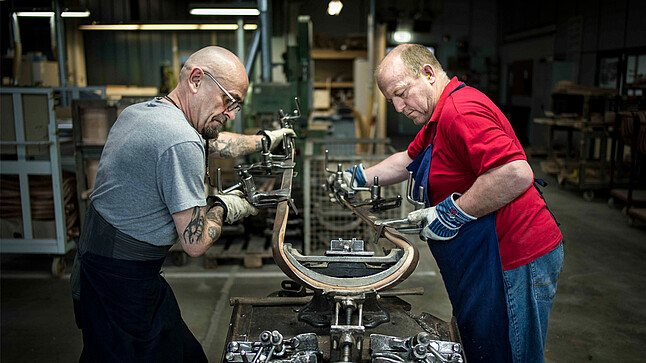
Thonet craftspeople bending steamed beech wood into shape using a traditional bending mould. Image courtesy of Thonet.
The iconic bistro chairs and stools were made by steam bending wood. The Thonet family pioneered the assembly line and a distributed manufacturing approach with a production line of task-specialized workers making individual parts. Formed wood and the assembly line helped them produce 10,000 chairs in 1857 and 45 million furniture pieces in 1903. When Henry Ford supposedly “invented” the assembly line in 1913, Thonet was making 1.8 million chairs a year on its assembly lines. Thonet had used it to furnish cafes around the world with durable, affordable furniture.
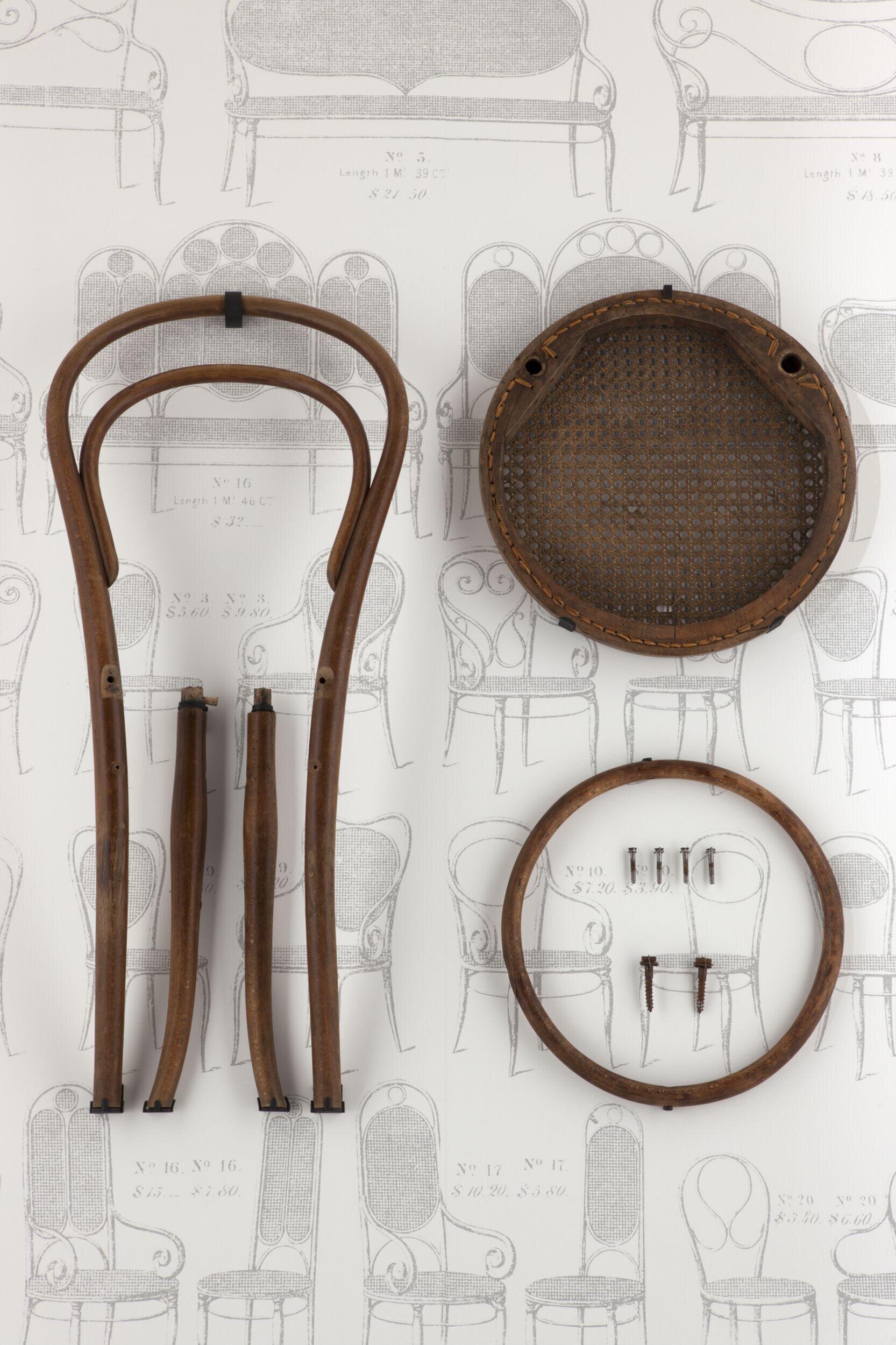
The furniture made by Thonet Brothers (the firm named in 1853 for the sons of the firm’s founder, Michael Thonet) was the first to have been both mass-produced and shipped knocked-down. Image Courtesy of the V&A.
But the firm is also known for another innovation—flat-pack furniture. With modular construction, the firm could assemble, repair, and fit chairs in discrete parts, so shipping them in parts made sense. In 1859, the company began shipping its chairs in packs of 36, each flat-packed, with 6 pieces of wood and 12 fasteners per chair. The waiter at your cafe would assemble their chairs.
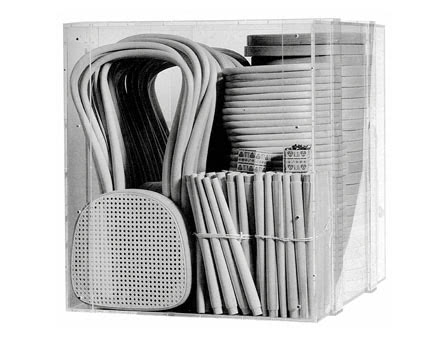
Bentwood chair components prepared for assembly. Image courtesy of Thonet.
In 1859, Thonet started selling through catalogs. It standardized its products and produced them across several countries, shipping worldwide to over 100 nations.
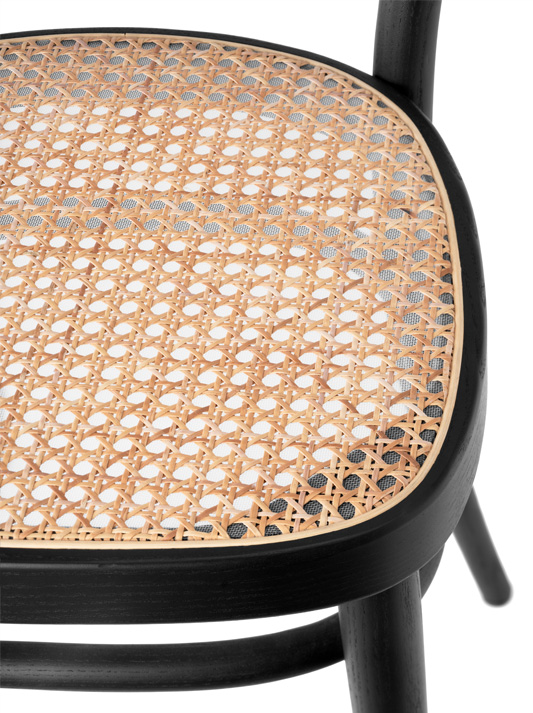
Detail of the traditional woven cane seat used on Thonet’s No.14 bentwood chair. Image courtesy of Thonet.
Further innovation appears in the seats. On the iconic No. 14 chair, for example, a round beechwood ring was steamed and bent to create uniform tension, holding woven cane work into a comfortable, durable seat. By bending a single piece of solid beechwood into a perfect circle, they created a frame with uniform tension. This tension supported the cane weave rattan. This rattan, sourced from Asia, was mounted wet, drying to contract and form the seat. Breathable and easy to maintain, this also made the chair much cheaper than alternatives. By using bent wood and a tension seat, the chair replaced leather-cushioned chairs that were much heavier, with many more parts and much more wood. It was lightweight, which paid dividends every day during cleaning and when putting them inside. An early example of lightweighting and using engineering and process to replace heavier or more expensive materials and processes.
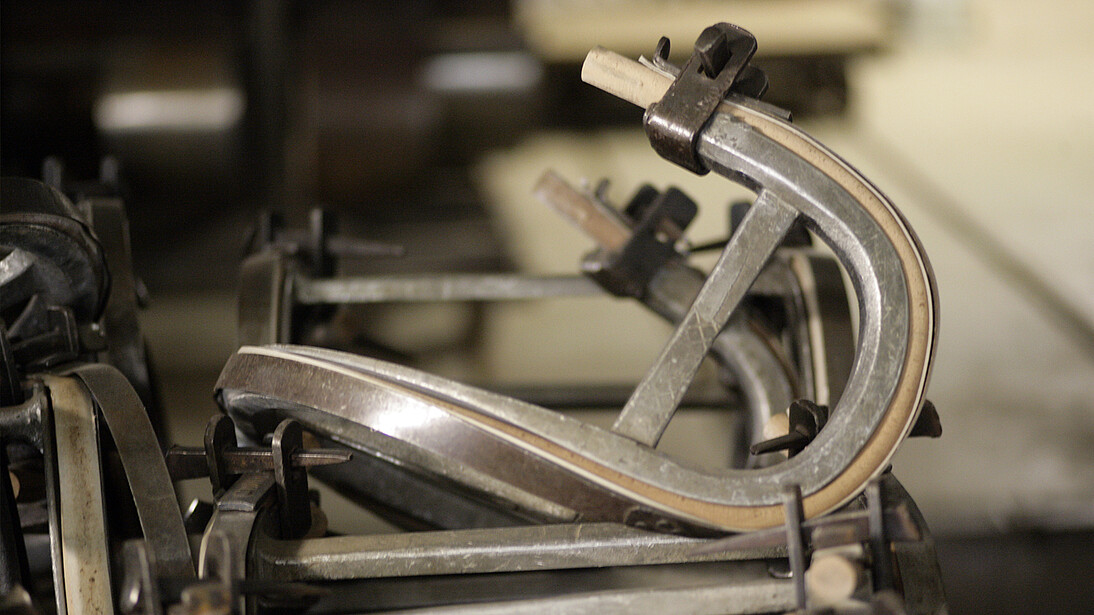
Beech wood held in a metal mould during Thonet’s traditional bending process. Image courtesy of Thonet.
If we look deeper into how the bent wood was made, we need to consider the ring’s bending stress: the wood undergoes tensile stress while the inner bend is under compressive stress. Wood is anisotropic, with fibers providing great tensile strength along them but poor shear strength across them. One common failure mode is what we could call delamination, when the wood splits along the grain. During bending, the chair is held in place by a tension strap and metal mold (with extra splints for different parts); this puts the whole loop under balanced compression, which lets the loop form while maintaining mechanical properties and avoiding cracking. Cracking is the major problem when bending wood, and they partly solved it by managing these stresses through steam, the wood mold, and the tension strap. Pinch me, or is this not exactly what our daily lives are dealing with in additive manufacturing today?
In 1836, the Thonets experimented with bent plywood for the loop legs of their Boppard chair. This was an early example, and perhaps the earliest mass-produced example, of composites in a manufactured product (excluding, of course, ancient bricks). Veneers held together layers of laminated wood. In 1876, an American firm inspired the Thonets to work in molded plywood, another innovation that would conquer the world.
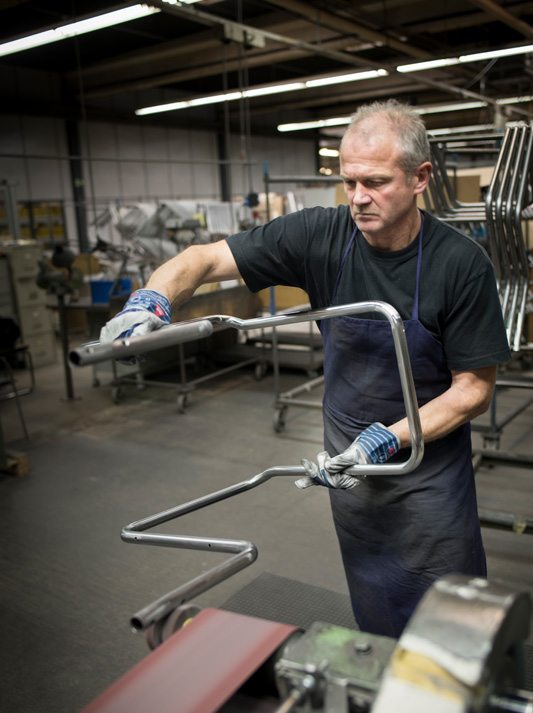
A Thonet craftsman working with tubular steel at the company’s production facility. Image courtesy of Thonet.
Later, in the 1920s, the firm pressed into mass production the Wassily chair, which used aircraft-derived steel tubes, made in a Junkers factory, to form the chair’s chassis. The Wassily and other tubular steel furniture helped to define much of the design, furniture, and architecture world after the Second World War. But Marcel Breuer’s chairs and those by Ludwig Mies van der Rohe, who, together with Mart Stam, came up with tubular furniture in the first place, were but one part of Thonet’s gift to the world. If you see one of the No. 14 chairs in a cafe or a beautiful plywood Eames chair in an office or a tubular leather creation at the airport, it’s all through Thonet. Other innovators existed, but by bringing bent wood, plywood, tubular furniture, modular construction, the assembly line, and cantilevered chairs to life, Thonet shaped the world we live in. It is hard to imagine today without Thonet.
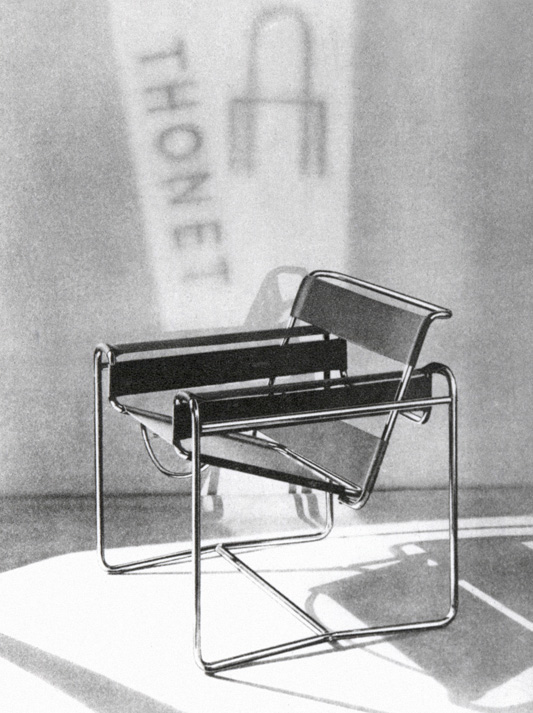
A classic Thonet tubular steel chair. Image courtesy of Thonet.
One other thing that can be argued is that the Thonet family of chairs had a design language, a grammar. A way of making forms consistently that later showed up in a lot of design, graphic design, and engineering. We’re more on a limb here, but we could say that these designs were parametric. That is less sure.
But more certain is the idea of something not being an object cut from wood into a final form by hand. It’s not made from a single material. It’s not a thing made of one material at one place. Entropy in materials and processes coupled with modularity is a defining characteristic of the modern globalized world. Beechwood was from European forests; rattan was from Asia. Thonet started in Boppard, Germany, moved to Vienna to scale up its operations, and manufactured in the Czech Republic. The company had factories in Vienna, the Czech Republic, Slovakia, Poland, and Germany. By the 1879’s it had offices in Barcelona, Brussels, Rome, New York, and Chicago. Through serialization, modularity, catalogs, factories everywhere, and stable processes, the company could ship products worldwide. Thonet and a few other firms pioneered the globalized system we live in today.
By combining the assembly line, discrete tasks, specialized workers, modular parts, flat pack, tubular construction, cantilevered construction, bent wood, and plywood into tens of millions of affordable items with iconic designs, the case can be made that Thonet, in part, invented the modern world. But the bite of the Mosquito and the mosquito dreams would provide an additional fever dream that helps explain the future of the world too.
Subscribe to Our Email Newsletter
Stay up-to-date on all the latest news from the 3D printing industry and receive information and offers from third party vendors.
Print Services
Upload your 3D Models and get them printed quickly and efficiently.













You May Also Like
Arridex Buys and Installs CEAD Unit
Lagos-based Arridex has purchased and installed a CEAD Flexcube LFAM system at its Omnifactory. Previously, oil and gas MRO firm Arridex expanded its network to Ghana, worked with BLT, got...
3D Printing News Briefs, September 5, 2026: Electronic Skin, Cartilage, Cookies, & More
We’re starting with standards in this weekend’s 3D Printing News Briefs, as ASTM has re-launched its Advanced Manufacturing Division as the Critical and Emerging Technologies (CET) Division. Then we’ll move...
Lufthansa Technik Uses 3D Printed Titanium Latch for Aircraft MRO
Maintenance and interiors aircraft giant Lufthansa Technik is exploring 3D printing at greater depths, hoping to take its customers to the heights they’re accustomed to. A team at Lufthansa Technik...
Malping Wants to Offer FGF PEEK as a Service
Germany-based Malping, located in Neuhausen auf den Fildern, is moving into more high performance materials for Material Extrusion. The service operates FGF and FDM high-temperature material printers, and offers parts,...























































