Seurat Plans to Multiply Metal 3D Printing Workforce Tenfold by 2025


Seurat, a metal additive manufacturing (AM) technology and services startup, has announced an ambitious plan to increase its number of employees from 100 to 1,000 by 2025. In a press release announcing this goal, the well-funded Massachusetts-based firm cited the doubling of its workforce over the past year as a primary point in favor of the feasibility of its expansion plan. It also referenced recent news of the Biden administration’s allocation of $7 million from the Department of Energy (DOE) to the Industrial Assessment Center (IAC) program.
This is only the beginning of the expansion of the IAC program planned for this decade. The administration has set aside a total of $550 million more in funding for IAC-related initiatives over the next five years, which includes $400 million in grants for manufacturers who implement projects recommended by IAC or another similar assessor. The IAC program, established in 1976, works via 31 assessment centers — each at a participating U.S. public university — that release no-cost analyses aimed at helping small and medium businesses increase the energy efficiency of their industrial processes.
The $7 million just allocated, in addition to creating IACs at five more universities, will also be used to create workforce training programs to familiarize students, as well as apprentice and existing workers, with new technologies and more efficient practices. With an additional amount of funding 80 times the size of this being devoted to the IAC program over the next five years, it doesn’t seem unreasonable to think that it could help add thousands of emerging technologies (including AM) workers to the economy by 2030.
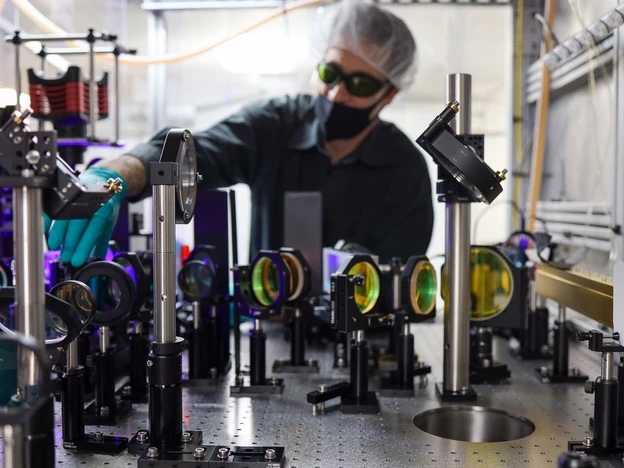
Beyond the potential of that funding for the labor pool in the AM sector as a whole, Seurat is ideally positioned to attract a talented workforce simply from its being headquartered in New England in general, and the Boston area, specifically. Along with the sheer abundance of world-class higher education, it’s hard to imagine an environment with a greater concentration of metal AM activity. And, even with that in mind, Seurat stands out owing to its unique Area Print technology, which utilizes a system of two million tiny points of laser light to print much larger areas of a layer simultaneously than is possible with other laser powder bed fusion (LPBF) machines.
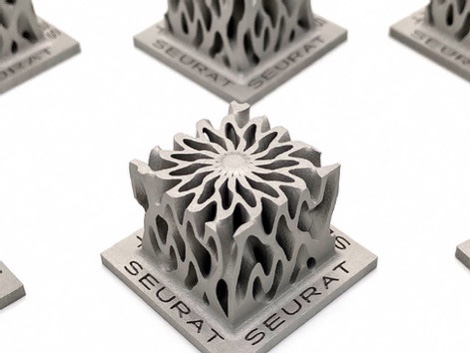
Moreover, in its most recent round of funding, led by the investment arm of Xerox, Seurat gained $21 million, bringing the company’s total investments at this point to about $80 million. One of the other investors included the holding company that owns Porsche, which is extremely bullish on AM. In this vein, Seurat could be an excellent fit for engineers and technicians hoping to work on the series production scale, and to work towards eventual implementation of mass customization.
Finally, the company is also fairly unique in terms of its position as a developer of its own tech that nonetheless operates as a service bureau instead of as an original equipment manufacturer (OEM). Thus, working at Seurat could allow employees to work on a much wider diversity of products than at a manufacturer/distributor of machines and/or materials.
The company would have to do slightly better than it did the past year, over the next three years, for it to reach its goal. This is obviously lofty, but certainly not impossible, especially given the combination of factors described above. However it turns out, Seurat is astute to focus on the entire industry’s need to push for more workforce training, and I would think that focus will pay off in terms of its likelihood to reach 1,000 employees.
Images courtesy of Seurat
Subscribe to Our Email Newsletter
Stay up-to-date on all the latest news from the 3D printing industry and receive information and offers from third party vendors.
Print Services
Upload your 3D Models and get them printed quickly and efficiently.













You May Also Like
Apple Opens New US Advanced Manufacturing Center for Second Year in a Row
The US added 5,000 manufacturing jobs in July, although in its article on the subject, Wall Street Journal notes that there are still (slightly) fewer manufacturing workers in the US...
Kupros Launches Cu29 V2, Announces Process for Embedded Electronics from Desktop FFF & FDM
In addition to its more traditional uses, the centrality of copper to an unusually large number of high-growth industries has led more than a few observers to argue that it...
DEVCOM Armaments Center Demonstrates Remote 3D Printing of Electronics at Valiant Shield 2026
The US Army’s DEVCOM Armaments Center, headquartered at Picatinny Arsenal in New Jersey, has become one of the US military’s most important hubs for drone R&D. At the recent Valiant...
Polish Electronics 3D Printing OEM XTPL Sells 10 More Printhead Modules to First Chinese Customer
Smartphones, laptops, and all other such devices are only getting more expensive. As evidenced by Apple’s cautioning of higher prices for this year’s new iPhone line, the problem is largely...