
Materialise CO-AM Unites 3D Printing Software in the Cloud

Materialise (Nasdaq: MTLS) aims to cement its software leadership through its new CO-AM Platform, an open software tool that integrates the offerings of different cloud-based software vendors. The platform enables this variety of software packages to communicate with another, in turn allowing them to be used by large firms to industrialize additive manufacturing.
“This is an important milestone in our history. CO‑AM offers new opportunities for AM users to innovate at unprecedented levels with their preferred software solutions. This open platform will allow the AM community to co-develop solutions that create competitive advantages for individual companies and empower entire industries. At the same time, this business model generates new revenue streams for hardware and software partners,” said Bart Van der Schueren, CTO of Materialise.
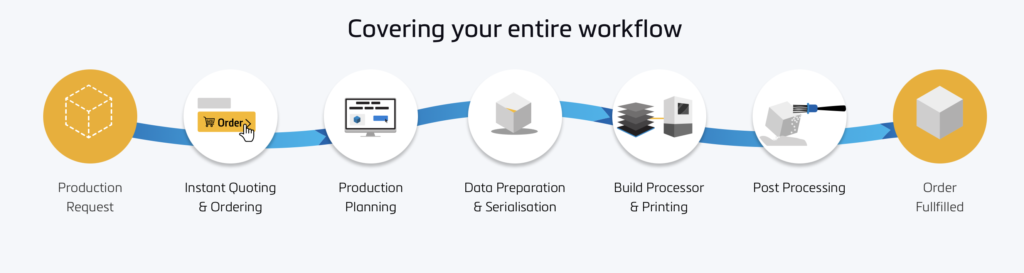
CO-AM features a data lake that centralizes all of the information from production assets. This information can be utilized by clients to improve their manufacturing workflows, further enhanced through the use of artificial intelligence and machine learning. The company hopes to integrate into CO-AM planning, quality assurance, and print software, both from its own software division and programs from other developers. Materialise has already put its Build Processors alongside 25 other apps into CO-AM, including tools from AM Flow and Castor.
“The next step for change in the AM Industry is automation. There are many digital dots to connect to create a full automation value chain. Teaming up with other solution providers of this chain is a prerequisite for the growth and scalability of Additive Manufacturing production. AM-Flow is very excited to be one of the first partners of the Materialise CO‑AM platform,” said Stefan Rink, CEO of AM-Flow.
“CASTOR is joining forces with Materialise to capture and deliver the full potential of AM to manufacturers. By integrating our solutions on a unified CO‑AM platform, we can offer a unique combination of engineering intelligence and automation, identify suitable candidates for additive manufacturing amongst thousands of parts and go all the way to the final product within one solution, seamlessly,” said Omer Blaier, CEO of CASTOR.
- On the one hand, this will be a standard that allows disparate 3D printing software, sensors, and machines to talk to one another. So, this is good news.
- On the other hand, by launching this, Materialise essentially solidifies its competition in Aspic, while maintaining control of the market and its development. This may be good news for Materialise, but perhaps not for everyone else.
For Materialise, this is wonderful because the company is mainly active with desktop 3D printing software. Now, it can harness the collective innovation of its cloud-based competitors. At the same time, it can collate value from disparate vendors in the space by centralizing their communication and sharing of information with clients. This will definitely help companies monitor and analyze their production assets better and will probably help them better manage production overall.
Materialise provides partners with an SDK, APIs, and a staging environment. If this strategy works well, balances the efforts and rewards to customers, it will be a very exciting development. But, will software firms trust Materialise enough to develop and direct their efforts sufficiently to this platform? Will the firm be able to dangle enough revenue before their eyes to get them enthusiastic?
Images courtesy of Materialise.
Subscribe to Our Email Newsletter
Stay up-to-date on all the latest news from the 3D printing industry and receive information and offers from third party vendors.
Print Services
Upload your 3D Models and get them printed quickly and efficiently.













You May Also Like
Why the AM Industry Should Pay Attention to Schneider Electric’s $22.6B PTC Acquisition
By late 2024, there was already enough signaling of the additive manufacturing (AM) industry opportunity in the data center infrastructure market for AM Research to write a report on the...
How Does Nike’s 3D Printing Approach Fit Into Its Restructuring Plan?
Shares of Nike stock hit all-time highs in late 2021 but have cratered in the years following, with the company losing nearly 80 percent of its market cap since peaking....
3D Printing News Briefs, October 1, 2026: Defense, Enclosures, & More
In today’s 3D Printing News Briefs, we’re starting with defense news, first from Massivit and then from AML3D. Then we’ll move on to U.S. manufacturing of a new large-format LPBF...
South Korea’s Lincsolution Lands Hanwha Defense Deal as Hanwha Invests Billions in US
I recently wrote about how the South Korean additive manufacturing (AM) firm Lincsolution is building an aerospace and defense hub, part of the company’s construction of “the largest AM facility in...
























































