AMS Speaker Spotlight: Advancing the Adoption of Additive Manufacturing with Pioneering Technology


Uniformity Labs CEO Adam Hopkins will be participating in Additive Manufacturing Strategies 2022, Talk 2: Addressing the Binder Jetting Challenge with Pioneering Technology.
Fremont California-based Uniformity Labs develops breakthrough feedstock material and software solutions that accelerate and expand the global commercial, industrial 3D printing, additive manufacturing (AM) market. The company’s pioneering technology enables significant cost savings, speed, and quality improvements across all mainstream AM printers in binder jetting and laser powder bed fusion. This dramatically impacts the AM value chain by increasing the reliability and efficiency of printing with difficult materials or large parts that require high density and low shrinkage.
“Our ultra-dense powder technology solves the problem of particle size segregation while retaining low viscosity,” said Uniformity Labs founder and CEO Adam Hopkins. Uniformity powder delivers 1000 times more contact points between particles than standard powder and spreads in more uniform thin layers across the build bed. “These properties result in higher productivity allowing for more green parts in the build envelope and shorter sintering cycles. This greatly increases production throughput while retaining high part density and strength,” Hopkins continued.
Materials
Uniformity bridges the gap for highly desirable parts made from difficult to process materials. It recently announced a breakthrough in aluminum sintering for binder jetting with its fully dense, sinterable Al6061 aluminum with better than wrought strength, developed in collaboration with Desktop Metal. “The introduction of lightweight metals to binder jetting opens the door to a wide variety of thermal and structural applications across industries,” Hopkins added. “This innovation is a key step towards the adoption of mass-produced printed aluminum parts.”
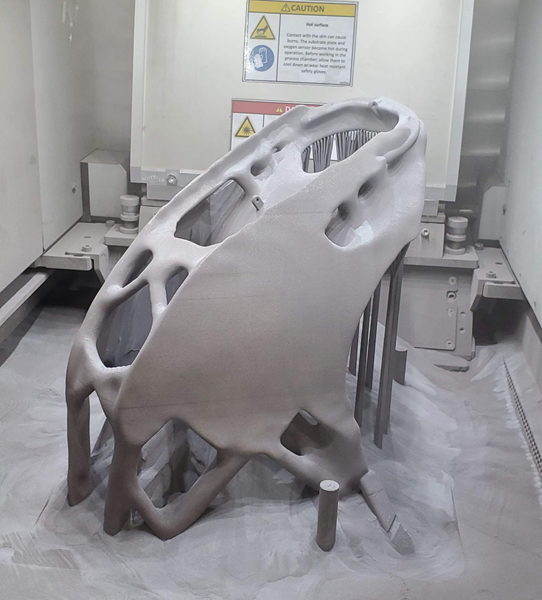
A 3D printed roll cage made with Uniformity Labs powder. Image courtesy of Uniformity Labs.
The company has a growing list of materials ready for production, including 17-4 PH and 316L stainless steel, ASTM F75 (CoCrMo), superalloys and tool steels nearing release, and materials such as ultra-hard composites, titanium, and copper in the works. Uniformity has an in-house production capability and anticipates shipping more than 200 tons of additive manufacturing powders in 2022. Production level systems will only increase this growth rate as more products and parts are qualified and ramp-up.
Advancements in Binder Jetting
At the end of 2021, Uniformity Labs and Desktop Metal formed a partnership to qualify and deliver ultra-low porosity binder jetting powders that exhibit exceptional sintered part density and mechanical properties paired with Desktop Metal’s AM 2.0 binder jetting solutions.
The partnership leverages Desktop Metal’s pioneering high-speed binder jetting systems and processes with Uniformity Labs’ innovative capabilities in metal powder processing to create industry-leading integrated solutions that make it easier for businesses to adopt binder jetting for producing end-use metal parts at scale.
Uniformity delivers Design for Additive Manufacturing to reduce weight and material volume, BOM consolidation to reduce assembly cost, and faster development cycles with reduced supply chain risk.
The company’s materials and processes enable flexible manufacturing, including combining assemblies with different geometries into single parts with peak mechanical properties within required geometric tolerance. It also enables cost-effective printing of low and medium-volume batches of complex parts due to the elimination of tooling and ultimately the production of hundreds or even thousands of merged assemblies every day with dramatically reduced labor costs and expanded geometric flexibility.
Subscribe to Our Email Newsletter
Stay up-to-date on all the latest news from the 3D printing industry and receive information and offers from third party vendors.
Print Services
Upload your 3D Models and get them printed quickly and efficiently.













You May Also Like
Stratasys Showcases 3D Printed Automotive Applications & New Printer at IMTS 2026
Just ahead of last week’s International Manufacturing Technology Show (IMTS) in Chicago, Stratasys launched the F870, a new large-format, production-grade FDM 3D printing platform designed to drive industrial manufacturing at...
3D Printing Financials: $28M in China, U.S. Deals and a Metal AM Comeback
Money continues to go into additive manufacturing (AM). From a $30 million raise for a Chinese metal 3D printing company to new funding for naval AM and a European company...
Stratasys Wins $27.6M in Patent Case Against Bambu Lab; Bambu Challenges Verdict
Update, September 21, 2026: This article has been updated with a statement from Bambu Lab responding to the verdict, along with additional information about the company’s ongoing patent challenges against...
AMAsia Pulse: AM Investment Picks Up Across Asia-Pacific
The first half of September brought fresh investment and expansion activity across Asia-Pacific’s additive manufacturing sector. China’s Xinjinghe secured funding for an aerospace AM hub, South Korea’s Lincsolution outlined plans...