
World’s First 3D Printed Prosthetic Eye Implant Heralds Vision for the Future of Medicine

There are multiple reasons why a person would wear a prosthetic eye, from the eye not developing normally to cancer or an accident. According to the Moorfields Eye Hospital NHS Foundation Trust, about 0.1% of the population in England need a prosthesis for their eye, which then has to be replaced about every five years. Patients often need surgery first, which leaves behind scar tissue, and after six weeks of healing, are given a temporary prosthetic, which does not precisely match their natural eye. Then, they have to wait another four to five months for a two-hour appointment to mold the eye socket for the permanent prosthetic, which is a pretty invasive process. Then, the acrylic prosthetic has to be manufactured and hand-painted, and the patient has to go back again at a later date for a fitting. Needless to say, the process is a lengthy one.
Using 3D printing to fabricate a prosthetic eye takes a lot less time, is less invasive, and results in a more realistic prosthetic, with more natural depth and clearer definition. Recently, a patient from Moorfields received a fully 3D printed prosthetic eye, with the hospital stating that “this will be the first time any patient has ever used a 3D printed eye as their sole prosthetic.”
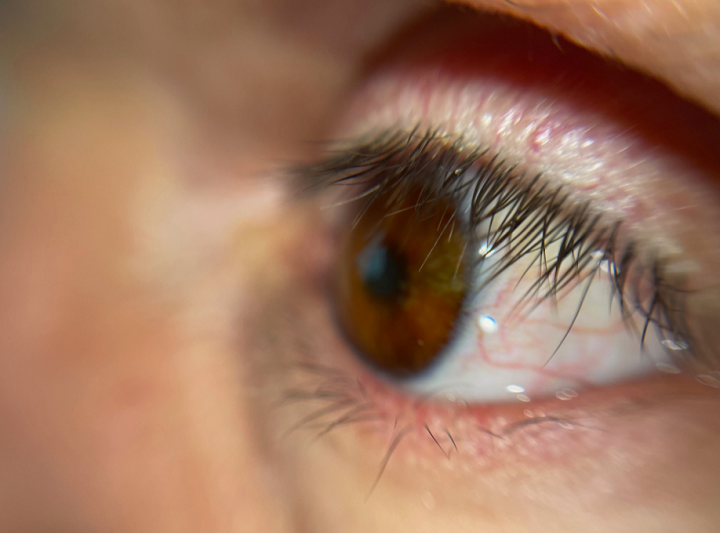
Image courtesy of Fraunhofer IGD
“I’ve needed a prosthetic since I was 20, and I’ve always felt self-conscious about it. When I leave my home I often take a second glance in the mirror, and I’ve not liked what I’ve seen,” said 40-year-old engineer Steve Verze. “This new eye looks fantastic and, being based on 3D digital printing technology, it’s only going to be better and better.”
While I’m not certain this is the first time a patient has relied entirely on a 3D printed ocular prosthetic, I do know that the production process for making the eye was much faster than it would have been with traditional fabrication. Rather than having to mold the eye socket, it’s scanned, which both takes less time and is far less invasive.
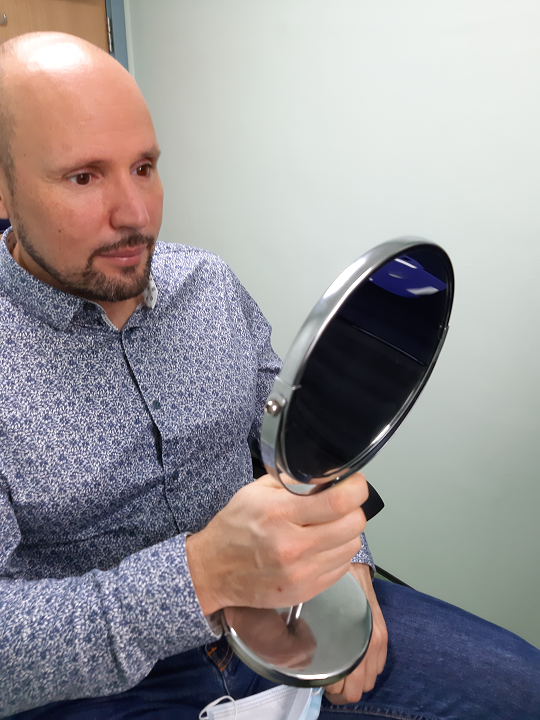
Steve Verze looking at his new 3D printed prosthetic eye in the mirror
Moorfields, which will be starting a clinical trial for its 3D printed prosthetic eyes soon, collaborated with Ocupeye Ltd and Fraunhofer IGD on the software for this project, and with Fit AG in Germany for the actual printing.
“We are excited about the potential for this fully digital prosthetic eye,” said Professor Mandeep Sagoo, consultant ophthalmologist at Moorfields and professor of ophthalmology at the NIHR Biomedical Research Centre at Moorfields Eye Hospital UCL and Institute of Ophthalmology. “We hope the forthcoming clinical trial will provide us with robust evidence about the value of this new technology, showing what a difference it makes for patients. It clearly has the potential to reduce waiting lists.”

Professor Mandeep Sagoo
Verze tried a traditional acrylic prosthetic eye and the new 3D printed version in the same visit, and the latter seems to have been a much better option. Moorfields says the 3D printed prosthetic is much more realistic than the other option and “a true biomimetic.” Current prosthetics feature a black disc, embedded in the eye, with a hand-painted iris, which doesn’t let light penetrate the eye’s full depth. But according to the hospital, the way the light travels through the 3D printed one is much more natural.
The workflow for the 3D printed prosthetic eye is also much shorter than it is for traditional ones; in fact, Moorfields says the manufacturing time for it is “cut in half.” In a brief thirty-minute appointment, both of the patient’s eyes are scanned, in order to get a perfect match, and a 3D model of the socket is created via Fraunhofer’s Cuttlefish:Eye, before the files are transferred to the Fit AG printer in Germany. It takes about two and a half hours to print the prosthetic, which is then to sent an ocularist for finishing, polishing, and fitting. All in all, the process takes only about two to three weeks.
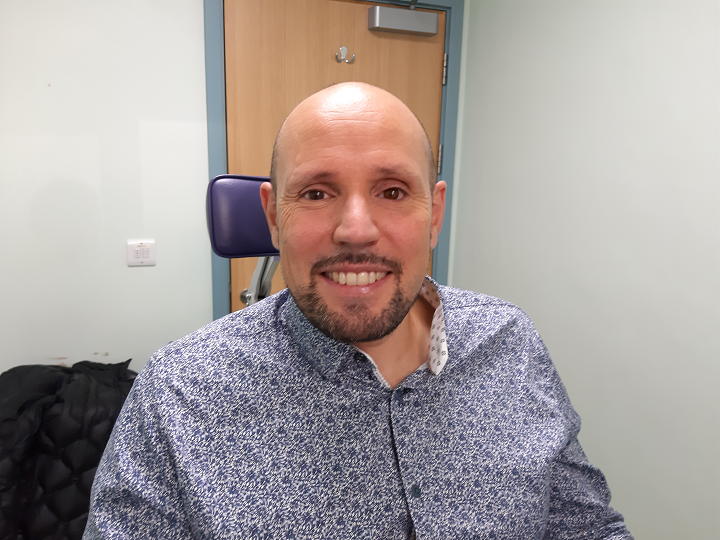
This 3D printed prosthetic eye project was supported by the NIHR Moorfields Biomedical Research Centre, as well as Moorfields Eye Charity, which is the main fundraising and grant-making arm for the hospital and its UCL Institute of Ophthalmology, through the Drayson Foundation.
(Images courtesy of Moorfields Eye Hospital unless otherwise noted)
Subscribe to Our Email Newsletter
Stay up-to-date on all the latest news from the 3D printing industry and receive information and offers from third party vendors.
Print Services
Upload your 3D Models and get them printed quickly and efficiently.













You May Also Like
Solid Rocket Motors: the First Big Scaling Test for AM in the US Defense Sector
The additive manufacturing (AM) industry has become obsessed with the opportunity for drones, and there’s certainly good reason for that. But before drones, the big focal point in AM for...
UK Sight Loss Charity 3D Printing Ultrasounds for Visually Impaired Parents-to-Be
The Guide Dogs for the Blind Association, more commonly known as Guide Dogs, is the UK’s top sight loss charity, working to help people with vision loss “live the life...
Savannah River National Laboratory & 3D Systems Sign Nuclear CRADA
Cooperative Research and Development Agreements (CRADAs) are deals between US federal organizations and other entities. The latter group most often includes private companies, as the primary purpose of CRADAs is...
3D Printing News Briefs, August 29, 2026: Prosthetics, Pelvic Implants, Capillaries, & More
In this weekend’s 3D Printing News Briefs, America Makes announced the winner of its GOTHAAM Project Call. Then it’s all about healthcare 3D printing news, with Stratasys and Limbitless Solutions...

























































