MakerBot Simplifies ABS 3D Printing with RapidRinse & ABS-R Materials


After working to make its METHOD and METHOD X 3D printers safer with the launch of its smart HEPA filtration system, Stratasys subsidiary MakerBot is now focused on making its ABS 3D printing workflow simpler with the new RapidRinse and ABS-R materials, which essentially streamline the steps in the workflow for more efficient industrial 3D printing. By adding these two new materials, the company is helping its ever-expanding portfolio of advanced engineering-grade materials grow even stronger.
“Our goal with METHOD has always been to make industrial 3D printing easy, reliable, and accurate on a desktop 3D printer,” stated MakerBot CEO Nadav Goshen. “With RapidRinse and ABS-R, we are continuing to deliver on that promise. METHOD is the only desktop 3D printer in its price class with a heated chamber that can print a range of advanced polymers, composites, and metal—all on one machine. Further, RapidRinse is another step we are taking with Stratasys in our ongoing efforts to support sustainable manufacturing practices and industry safety standards.”
With a 6-in-1 modular extruder platform and “unique environmental control features,” MakerBot’s METHOD printers were designed for non-stop printing with over 15 patented Stratasys technologies and multiple material groups, focused on creating complex assemblies, prototypes, and manufacturing aids with improved dimensional accuracy and strength. These new materials were developed specifically for high-performance, industrial applications on the MakerBot METHOD X and METHOD X Carbon Fiber 3D printers, in order to help users save on additional costs and equipment.
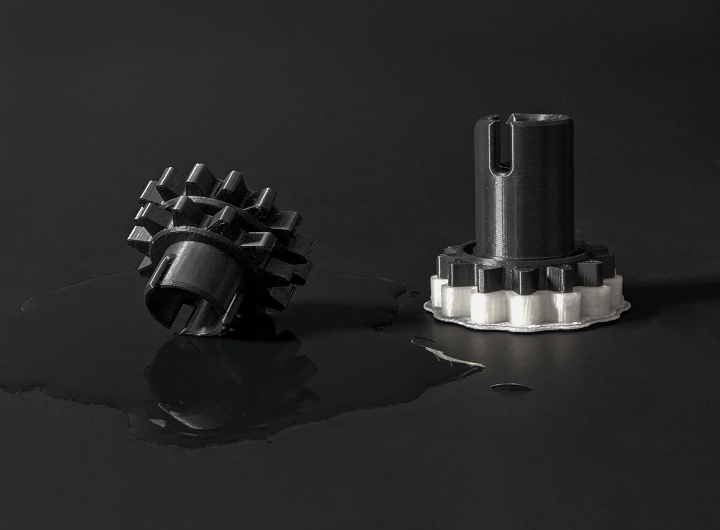
According to MakerBot, its patent-pending, fast-dissolving support material RapidRinse is able to dissolve much more quickly than other high-temperature soluble supports in just warm tap water, without the need for any caustic chemicals. The material’s water soluble properties are said to make RapidRinse a safer, easier support material, with little residue left behind, and because solvents aren’t necessary, engineers won’t need to waste money buying additional post-processing equipment.
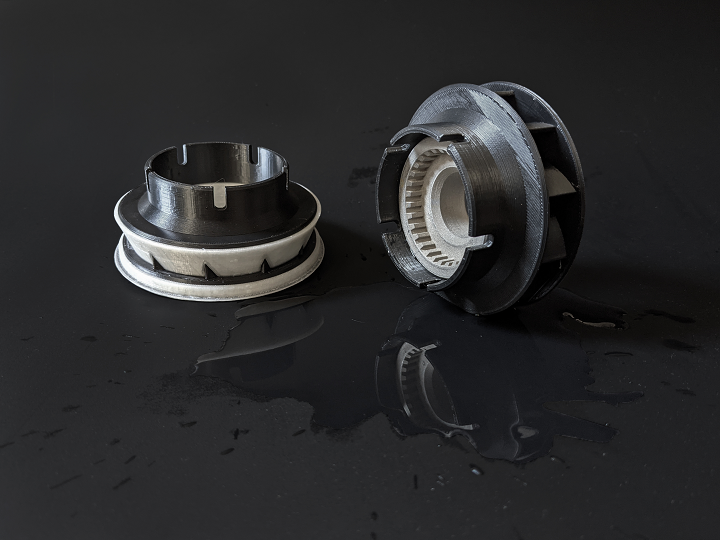
Because of its tendency to crack, curl, shrink, or warp if the absolute correct conditions aren’t met, ABS, while highly in-demand, is a difficult material to use with desktop 3D printers. That’s why MakerBot developed its new ABS-R formulation, optimized to work with the new RapidRinse in order to offer users an excellent experience and print quality. According to the company, ABS-R enables better performance and reliability for repeatable 3D printed ABS parts, tools, and prototypes.
The METHOD X has a heated chamber with patented VECT (Variable Environmental Controlled Temperature) 110 Technology, which, when combined with its proprietary RapidRinse supports, is said to make printing ABS parts as easy as printing with PLA, but with much better material properties. In addition, the company says that by printing parts on the METHOD X with its RapidRinse, engineers can achieve dimensionally accurate ABS parts of ±0.2mm.
MakerBot expects to start shipping its new RapidRinse and ABS-R materials in December of 2021.
Subscribe to Our Email Newsletter
Stay up-to-date on all the latest news from the 3D printing industry and receive information and offers from third party vendors.
Print Services
Upload your 3D Models and get them printed quickly and efficiently.













You May Also Like
SWISSto12 Closes $70 Million Series C Round
Swiss satellite manufacturer SWISSto12 has closed a $70 million Series C round. This follows $84.8 million that the company received from ESA and ESA member states, and previous rounds that...
Rocket Lab Buys Iridium in $8 Billion Deal, Creating a New SpaceX Rival
Rocket Lab is buying Iridium for $8 billion in a cash-and-stock deal worth $54 per share. Shareholders will receive $27 in cash plus additional Rocket Lab common stock. The company...
SWISSto12 and HPS/LSS Build Unfurling Antenna for Next-Gen Satellite
SWISSto12 is to work with HPS/LSS. High Performance Space Structure Systems and Large Space Structures are two separate firms that work together on large antenna reflectors. The two will work...
Japan’s Space Compass Corporation Buys a SWISSto12 Satellite
Japanese firm Space Compass Corporation has agreed to buy a SWISSTo12 GEO optical data relay satellite. The compact Hummingsat will be used for Space Compass’ optical data relay service. Space...