PrintDry’s Vacuum Sealed Filament Container is the Smartest Yet

Quality 3D printing often relies on the quality of your filament. If left out in a room, moisture can seep into the material and cause issues with the printing process such as nozzle clogging, imperfect layers, stringing, and failed prints. 3D printing enthusiasts often struggle with this issue and have tried to make their own filament dehydrators. The team at PrintDry has been working on solutions to this problem since 2016. Their latest iteration is the smartest one yet. PrintDry has developed the Vacuum Filament Container, with features that were not available in previous devices.
In 2016, PrintDry introduced its first Filament Dryer. The system allowed you to dry and feed filament while printing. Then, in 2017, a single filament container was introduced to keep individual spools safe from humidity.
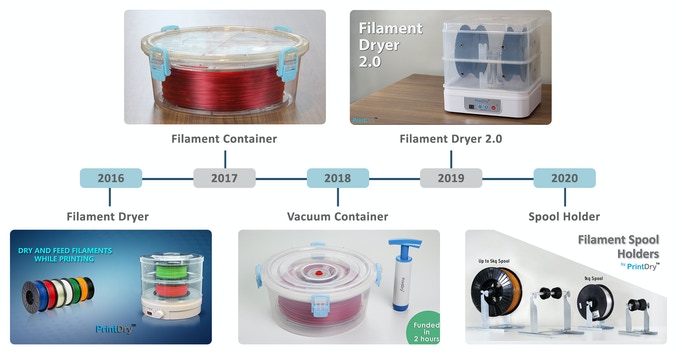
The first version of PrintDry’s Vacuum Sealed Filament Containers, that come along in 2018, required users to manually pump air out of the device to ensure the filament was vacuum sealed. Moisture was prevented from getting into the container due to the seal created by the pump. There was also a vacuum indicator to ensure it was properly sealed. However, there was no sensor to detect whether there was leakage over time. As a result, moisture could slowly be absorbed by the filament and affect the quality of prints once again.
2019 brought along the Filament Dryer 2.0. This machine dries out filament in less than 48 hours and allows you to feed filament while printing. It has both a temp- and a time-gauge built into it. You can easily adjust the temperature with five presets. The Filament Dryer 2.0 is a double-walled structure, and even holds two spools of filament. This is a nice step up compared to manually pumping the filament in the first Vacuum Sealed Filament Containers.
PrintDry expanded its range of products in 2020 into the realm of accessories. They now offer filament Spool Holders and well as a filament respool station.
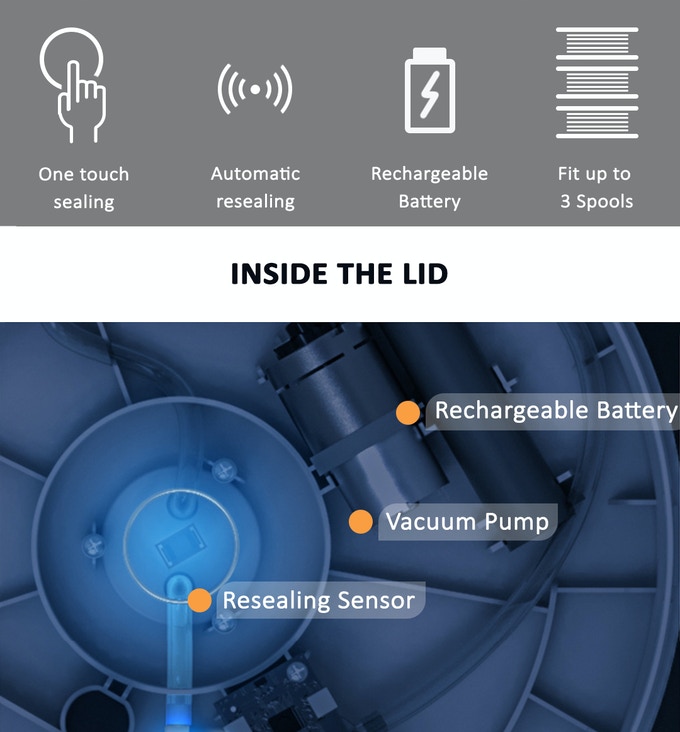
All of these products have led to the creation of the latest generation of PrintDry’s Vacuum Sealed Filament Container. It is not only a solution, but a smart solution. There is no longer the need for manual pumping. The push of just one button activates the built-in vacuum pump and rechargeable battery, vacuum sealing the filament container. It also constantly monitors the seal level, and the integrated re-sealing sensor will activate the vacuum pump if the level drops. This prevents any leakage that might occur over time. If the power is turned on and the battery needs charging, the LED indicator turns on and notifies you.
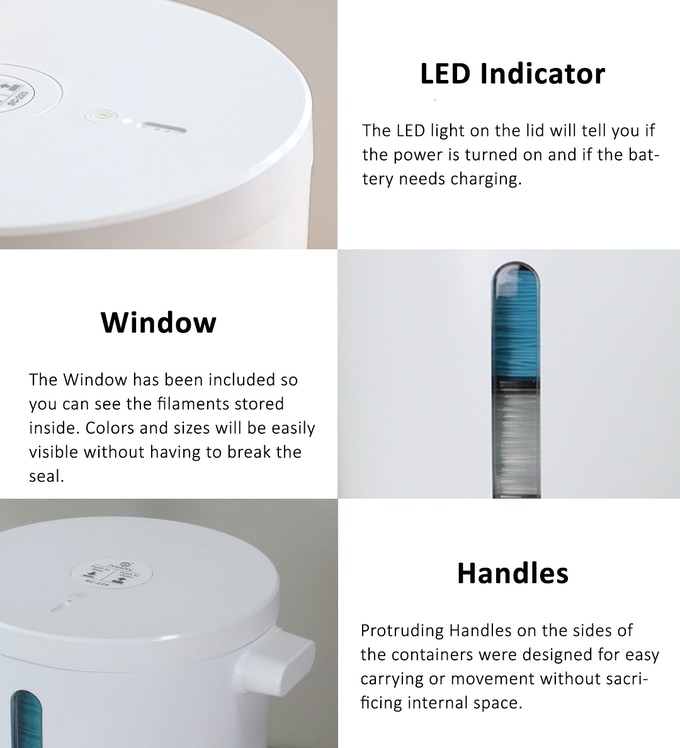
PrintDry’s Vacuum Sealed Filament Container is the first to fit up to three spools of filament. Another feature that is included is a window, where you can see the colors and amount of filament that is left in the container. Internal space is at a premium, so handles were added to the outside, designed for easy carrying or moving the container.

The SMART Vacuum Filament Container is currently live on Kickstarter, with a host of backing options, full specifications for the filament container, and PrintDry’s stretch goals. It ends on Monday July 26, 2021, so interested customers take note.
Subscribe to Our Email Newsletter
Stay up-to-date on all the latest news from the 3D printing industry and receive information and offers from third party vendors.
Print Services
Upload your 3D Models and get them printed quickly and efficiently.













You May Also Like
South Korea’s Lincsolution Lands Hanwha Defense Deal as Hanwha Invests Billions in US
I recently wrote about how the South Korean additive manufacturing (AM) firm Lincsolution is building an aerospace and defense hub, part of the company’s construction of “the largest AM facility in...
Bambu Lab and SUSAN FANG 3D Print for London Fashion Week
At London Fashion Week, some of the more unusual pieces on the runway came from 3D printers. Chinese fashion designer SUSAN FANG presented her Spring/Summer 2027 Air-Illusion collection at the...
Why Cross-Border 3D Printing Is Closing the Speed Gap with Local Manufacturing
The fastest 3D printing supplier in your shortlist may no longer be the one closest to your office. That sounds unlikely to many engineers. For years, overseas 3D printing carried...
Arridex Expands 3D Printing Network to Ghana
Nigeria-based Arridex has deep experience in oil and gas additive manufacturing. Previously known as RusselSmith, the firm has in-house metal and polymer additive technology. The company is making 3D printed...