Clearing Hurdles for Metal AM


Riven’s James Page will be speaking at 3DPrint.com’s upcoming AMS online industry summit (Feb 9-10, 2021). Register here.
Metal AM has made incredible advances in recent years and global brands are contemplating series production AM parts for flagship products. Yet a bottleneck remains – often unacknowledged – one that if left unaddressed will fundamentally limit the speed, reach and growth rate of the industry: The black box that is the new product introduction (NPI) process. It is not uncommon to spend weeks or even months iterating the complex, murky steps that lie between design and shipping of complex metal AM parts.
Heavy bets are being placed on advances in build simulation software as a primary remedy. And this strategy has begun to pay off by increasing success rate – particularly for powder bed fusion which got a head start due to its highest-end applications. Metal binder jetting, which is poised to take on new and larger markets, is also progressing but simulation has a way to go. And while we anticipate continued build sim/prep progress to be made for all AM processes, the many separate steps and potential sources of defects, including post-processing, secondary ops and finishing, means that checking the integrity of first articles, adjusting parameters and iterating all sub-processes remains a serious bottleneck.
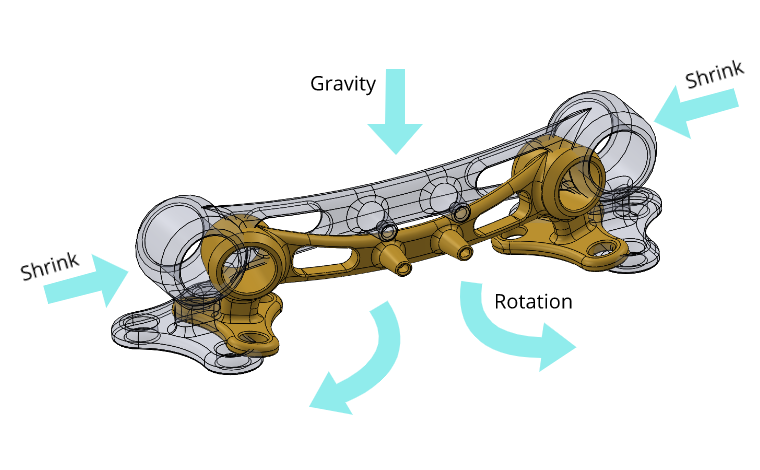
Metal AM parts warp during sintering – without complete data they can take many iterations to perfect
The challenge is due largely to the difficulty in understanding the nuances of as-manufactured part shape – whether for green part defects, warping during sintering, assessing fixtures, machining or a host of other post-processing steps. Engineers are faced with either the limits of error-prone hand tools like calipers, or waiting days for technician time and programming of a coordinate measuring machine (CMM). Either way, they are still forced to make rough guesses based on sparse point measurements and so the iterations pile up and ship dates get pushed out.
But all is not lost – in true engineering spirit, this problem has spurred innovation and a new way is emerging that is far more efficient. Accurate 3D capture has now become push-button simple and so cost-effective that it can be used at every engineer’s desk and coupled with every AM system. Cloud-based software has become smart enough to automatically show at-a-glance exactly what needs to be adjusted. 3D visualization of deviation from the design tells the whole story so engineers can catch problems early, take decisive action and save iterations.
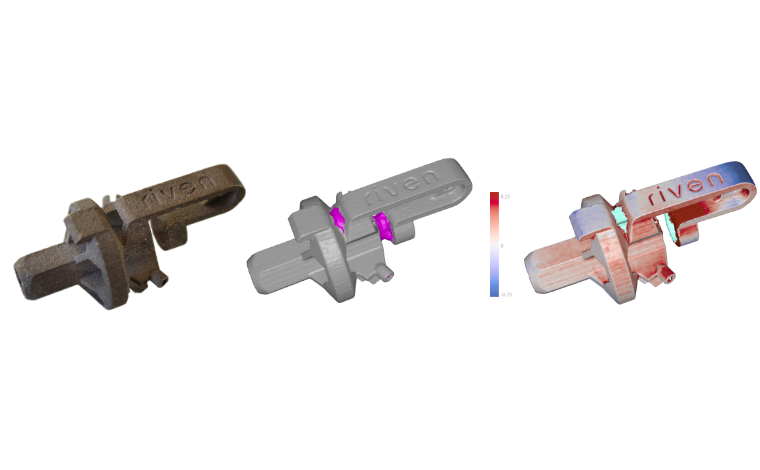
A metal binder-jet part (left), push-button 3D capture (center) and automatic CAD-compare (right)
While current practices for metal binder jetting (and similarly bound metal deposition) may require many attempts to produce a tricky part with tight specs, engineers with access to easy, accurate 3D scan data and cad-compare are often able to run just a single test print before getting to a build of shippable parts.
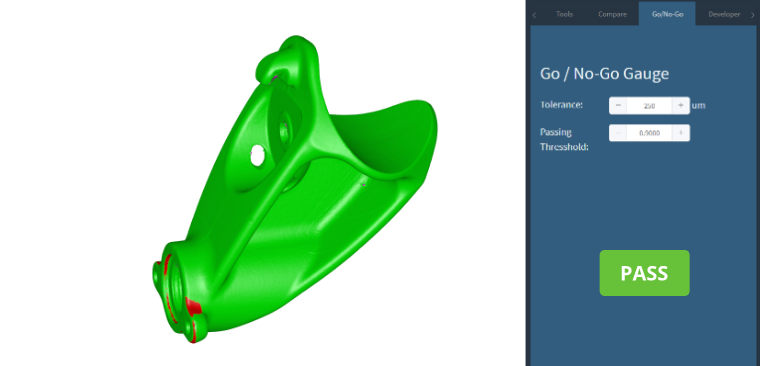
Complete 3D capture of as-manufactured shape enables automatic go/no-go decisions at-a-glance
Riven has worked hand-in-hand with leaders in metal AM, MIM and other advanced manufacturing methods for years to understand their specific NPI challenges and to hone an integrated system with cost-effective 3D capture sensors and easy software that makes the NPI process far simpler. We believe that rapid visualization and team communication using complete as-manufactured 3D shape data is the key to accelerating NPI and scaling operations – especially for complex, multi-step metal AM products.

Riven Software (left) accepts data from any 3D scanner. An integrated sensor (right) is available as part of the package.
New forms of data analytics and automation applying this 3D data will drive advancements in metal AM. The next exciting chapter is now unfolding with APIs that enable shape and vector-displacement data to be automatically captured from every build and coupled with build-process software and additive manufacturing execution systems (AMES) including machine learning. This will finally close process loops to achieve a new level of efficiency. Easy, cost-effective 3D capture and data collaboration will accelerate the NPI process. And 3D data APIs supporting advanced applications will be a crucial tool for those building the future with metal AM.
Subscribe to Our Email Newsletter
Stay up-to-date on all the latest news from the 3D printing industry and receive information and offers from third party vendors.
Print Services
Upload your 3D Models and get them printed quickly and efficiently.













You May Also Like
3D Printing News Briefs, October 10, 2026: Drones, WAAM, Ceramics, & More
We have a packed 3D Printing News Briefs for you this weekend! First, America Makes celebrated the recent National Manufacturing Day with 3D printed drones, and then it’s on to...
10 Years of Multi Jet Fusion: Onsite at HP’s Vancouver, Washington Facility
At this year’s RAPID event in Boston, HP Additive Manufacturing Solutions celebrated ten years in the additive manufacturing (AM) market. The company ushered in the milestone with several innovations, including...
PharmaTher Plans U.S. Network to 3D Print Medicines on Demand
3D printing medicines has often been tied to the idea of personalization, basically making a pill in the right dose, shape, or drug combination for a patient. PharmaTher is now...
3D Printing News Briefs, September 17, 2026: 3D Printed Boat, UAS Development, & More
We’ll start with maritime manufacturing in this week’s 3D Printing News Briefs, and continue on to defense 3D printing. We’ll end with funding for Tripo AI. Read on for all...