
Austrian 3D Printed Drone Startup DropForce is Selling Distributed Production

Investors couldn’t stop throwing money at the drone market in 2025, with total investments in the industry setting a record, coming in at just under $4 billion. If anything, though, it seems like drone investments in 2026 could easily set a new record for the second year in a row, as investments this year, in the first two months alone, reportedly reached $1.7 billion.
Given that, it might be easy to ignore the news that a startup in Austria, DropForce Systems, just landed a six-figure angel round from BarnVentures (also of Austria), which took a 20 percent stake, and a German firm, LNX GmbH. But the value proposition that DropForce Systems is offering shouldn’t be ignored, because it captures the exact evolution of the drone market that has made investors start to pay such close attention to the business opportunity.
It’s such a well thought-out differentiator, in fact, that the release on the Dealroom database sums it up in a half-sentence: “Distributed, on-site manufacturing reframes drones as a consumable rather than a durable asset…”
Now, other companies are doing this as well, most namely Firestorm Labs, which sells the containerized xCell systems for drone production, used thus far mostly by the US military. DropForce Systems sells containerized systems too, along with self-driving vans with integrated production cells. But in my opinion, by far the most interesting offering from DropForce is the Tactical Case, a ruggedized case designed to be carried by a single person.
This takes the idea of AM-enabled distributed production to its logical extreme, which is the direction where everything appears to be headed. It’s fitting that DropForce has been founded in Europe, as it’s about as close a product-market fit as can be imagined for the demand conditions created by Russia’s war in Ukraine. The company’s founders, CEO Jakub Hamdard and CTO Christian Mühl, both previously worked at Diamond Aircraft, an Austrian company that makes gliders, in addition to working elsewhere with both satellites and drones.
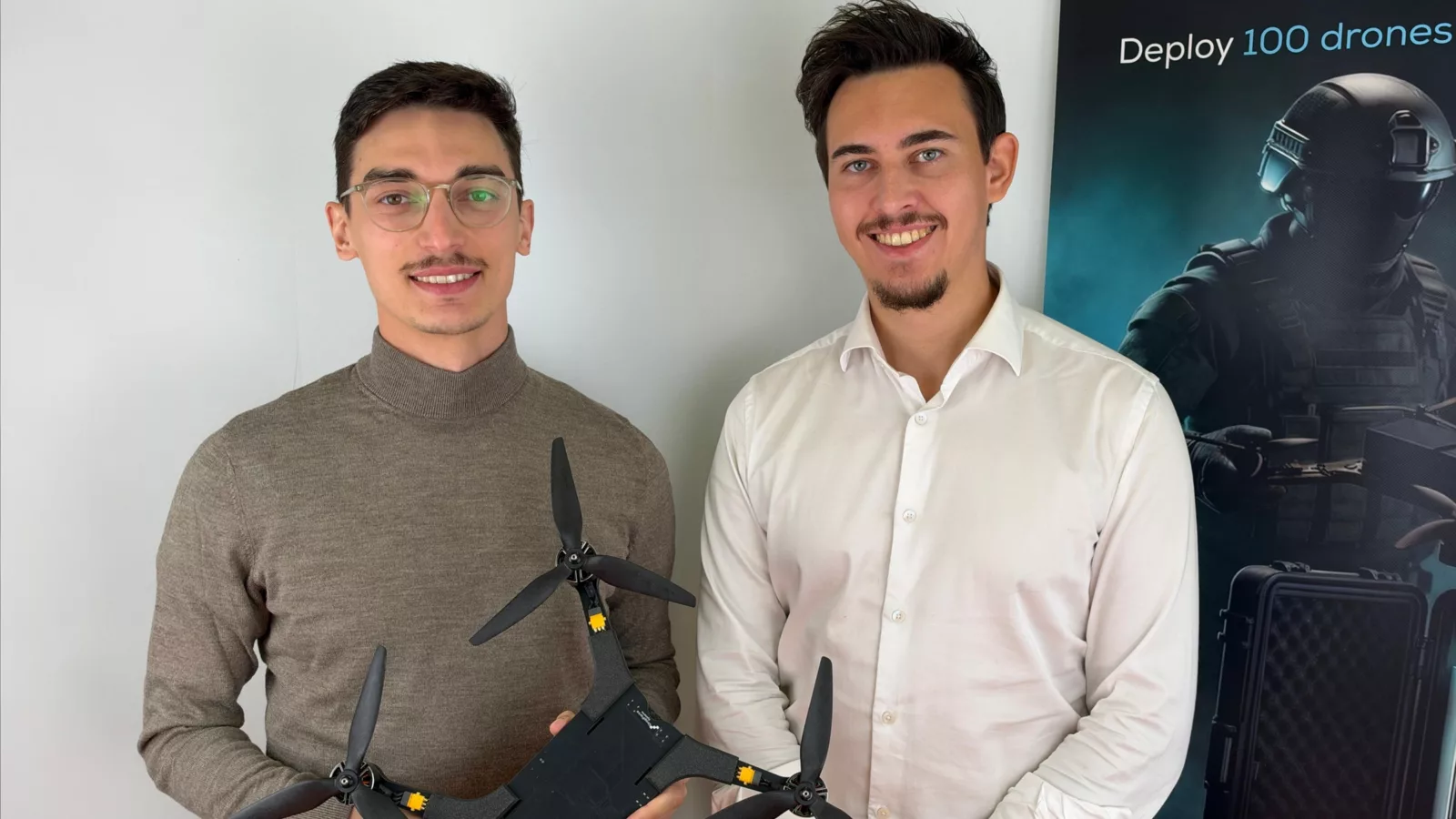
Of course, you can’t print the entire drone — an FPV system called the STURM 01 — and this is what accounts for the core of DropForce’s business model. The company does also plan to sell finished drones, but the real revenue-generator seems to be everything that can’t be 3D printed, above all the electronics components. DropForce notes that, like pretty much everyone else, the company can’t avoid sourcing certain electronics and materials (rare earths) from China, but it’s focused on sourcing as many components as possible from within the EU. That includes circuit boards, which DropForce designs itself.
The company would seem to be an ideal partner for a company like Unusual Machines, based in Orlando, the CEO of which I interviewed last year. Unusual Machines is a 3D printing user itself, but the company also focuses on selling all the components that can’t be printed to drone users who finish the builds themselves with AM.
DropForce is currently in the process of developing its own firmware, which will likely be a key factor in determining the success of an enterprise revolving around the maintenance of a distributed production network. That consideration is particularly important in the context of the “20 minutes per drone” selling point that the company is aiming to deliver on.
This is an unbelievably tricky market to navigate and even more difficult to compete in, and many of the companies they’re up against, at least currently, obviously have much larger investments attached to them. But could that smaller level of funding potentially be a selling point, in itself? DropForce has the luxury of being in an excellent position to exceed expectations, and it’s not tied down in any way to capital that’s already been devoted to a market that looked completely different as recently as a couple of years ago. Very strange things are happening in the defense startup space, so I wouldn’t be surprised to see this company succeed.
Images courtesy of DropForce Systems
Subscribe to Our Email Newsletter
Stay up-to-date on all the latest news from the 3D printing industry and receive information and offers from third party vendors.
Print Services
Upload your 3D Models and get them printed quickly and efficiently.













You May Also Like
Stratasys vs. Bambu Lab: Why Europe and the U.S. Reached Different Results, Part II
Editor’s note: This is Part 2 of a two-part series by Xu Fanglei examining the technology and patent issues behind the Stratasys-Bambu Lab dispute. Part 1 looked at the $27.6...
Bambu Lab & 7 Accessibility Organizations Launch Design Challenge for 3D Printed Assistive Devices
In 2023, Chinese 3D printer OEM Bambu Lab launched MakerWorld, its collaborative 3D model platform. By early 2026, the platform had about 10 million monthly active users and started to...
Stratasys vs. Bambu Lab: What’s Really Behind the $27.6M Patent Verdict?
Editor’s note: This is Part 1 of a two-part series by Xu Fanglei examining the technology and patent issues behind the Stratasys-Bambu Lab dispute. Part 1 looks at the U.S....
The Part Is Only Half the Story: Why 3D Printing Needs a Digital Thread
A 3D printed part can generate a lot of information. The challenge is keeping track of it. Manufacturers need to know which design was used, what material went into the...

























































