“Major US Healthcare Manufacturer” to Use Electronics 3D Printing to Produce Diagnostic Medical Device

Likely the most successful example of electronics 3D printing on the market is that of Optomec, whose Aerosol Jet Printing (AJP) technology is now being used not only for prototyping and research in electronics development, but production as well. The latest example is an unnamed “major US healthcare manufacturer”, which has just received an AJP 3D printer that it will use for “volume production of a leading diagnostic medical device.”
Optomec’s AJP process was developed out of a Defense Advanced Research Program Agency (DARPA) project launched in the 1990s. The resulting direct writing technology made it possible to 3D print materials onto curved surfaces. AJP involves the atomization of a material into a mist that is focused and deposited through a thin nozzle onto a substrate. The range of printable materials with the process is large, including metals, resistor materials, nonmetallic conductors, dielectrics, adhesives, semiconductors, DNA and proteins. For final curing of many metal inks, 3D printed objects must be heated in an oven.
For the healthcare manufacture, the AJP system is part of a $1 million contract that also includes the delivery of software and production processes (or “recipes”). The printer will deployed to 3D print multi-layer circuitry onto structural parts, rather than manually incorporate flexible circuits into the devices. In turn, it is believed that costs will be cut and throughput and flexibility are increased. After initial use of the system, Optomec believes the customer will follow up with additional machine purchases.
“Device manufacturers have asked us for a way to eliminate the use of traditional circuit boards and flex circuitry,” said Bryan Germann, Optomec Product Manager. “This opens up a whole new set of design possibilities for wearables and implantables. By printing circuit components directly onto the device, we can reduce the size by 50% while making the device more comfortable to wear, not to mention reducing manufacturing cost.”
According to Optomec, medical devices now represent 20 percent of the company’s business, including continuous glucose monitors, functionalized catheters, surgical needles and drug discovery assays. Most recently, researchers at Carnegie Mellon began using AJP to create a home rapid testing solution for COVID-19. The team were able to fabricate miniature gold electrodes that, through an electrochemical reaction within the 3D printed structure, detect two antibodies of the SARS-CoV-2 virus even at low concentrations.
Outside of medical applications, AJP is being used in such sectors as consumer electronics. Lite-On Mobile Mechanical SBG uses the Aerosol Jet 5X five-axis machine at its facility in Guangzhou, China to 3D print electronics onto millions of consumer electronics. The company sprays smartphone and tablet form-factors with electronic materials, running 24/7. In 2019, Samsung purchased a 5X machine for the production of consumer electronics, as well.
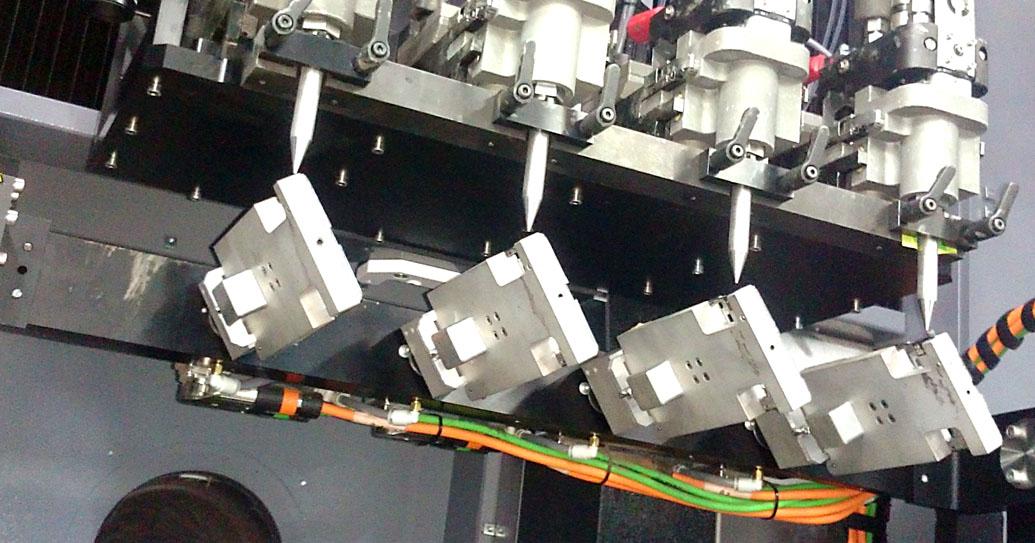
LITE-ON Mobile’s setup for 3D printing electronics onto devices.
Reaching the Holy Grail of fabricating entire complex objects within a single build process is a slow journey toward a potentially impossible goal, but Optomec’s AJP technology is demonstrating a crucial step along the way: additive production of electronics onto end parts. It may only be a matter of time before such a technique is found in production lines worldwide.
Subscribe to Our Email Newsletter
Stay up-to-date on all the latest news from the 3D printing industry and receive information and offers from third party vendors.
Print Services
Upload your 3D Models and get them printed quickly and efficiently.













You May Also Like
10 Years of Multi Jet Fusion: Onsite at HP’s Vancouver, Washington Facility
At this year’s RAPID event in Boston, HP Additive Manufacturing Solutions celebrated ten years in the additive manufacturing (AM) market. The company ushered in the milestone with several innovations, including...
These 3D Printed Lattices Can Sense Damage Before Failure
A new paper, “Full-Field Damage Monitoring in Architected Lattices Using In situ Electrical Impedance Tomography,” points to lattices being able to detect damage. This could really help composites in critical...
3D Printing News Briefs, October 3, 2026: Hypersonics, Hotends, & More
We’re starting off with defense in this weekend’s 3D Printing News Briefs, as Titomic was awarded a $5 million U.S. defense contract, and VulcanForms announced a partnership with Specter Aerospace...
3D Printing News Briefs, October 1, 2026: Defense, Enclosures, & More
In today’s 3D Printing News Briefs, we’re starting with defense news, first from Massivit and then from AML3D. Then we’ll move on to U.S. manufacturing of a new large-format LPBF...