Mikhail Gladkikh on Digital Inventory: “Think of It as Netflix for Manufacturing”

As manufacturers continue looking for ways to reduce supply chain risk, additive manufacturing (AM) is increasingly being discussed as more than just a production tool. Across aerospace, energy, defense, and industrial sectors, companies are exploring how digital inventories and distributed manufacturing could help reduce dependence on traditional warehousing, long shipping routes, and excess physical inventory.
That shift is one of the areas Dr. Mikhail Gladkikh has been focused on throughout his career. Before joining Würth Additive Group as Global Director of Technology and Technical Projects, he spent 17 years at Baker Hughes, working across research, engineering, logistics, program management, M&A, and AM in mission-critical industries.
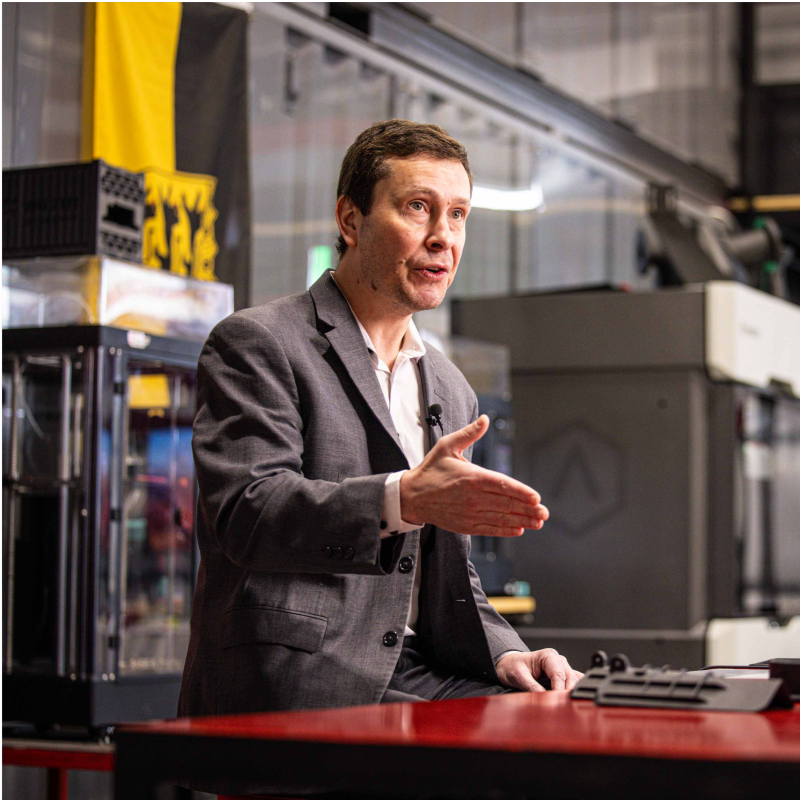
Mikhail Gladkikh. Image courtesy of Mikhail Gladkikh via LinkedIn.
With a PhD in Applied Mathematics from the University of Texas at Austin, Gladkikh’s background spans oil and gas, turbomachinery, hydrodynamics, and advanced manufacturing systems operating in highly regulated industries. More recently, he has focused on digital inventory and distributed manufacturing, helping lead the launch of Würth Additive Group’s Digital Inventory Services (DIS) platform, designed to enable secure, traceable digital supply chains through AM. Outside of his professional work, Gladkikh is also a lifelong learner and science fiction author whose books include Out of Time, reflecting his longtime interest in future technologies and big ideas.
3DPrint.com spoke with Gladkikh about digital inventory, distributed manufacturing, supply chain sovereignty, and why AM could play a major role in the future of global supply chains.
What is Würth and what is the value proposition?
Gladkikh: The Würth Group is a worldwide wholesaler of fasteners, screws, and accessories. Würth expanded its range and today offers a full range of business equipment for craft businesses. Würth offers dowels, chemicals, electronics, furniture, construction fasteners, hardware, automotive parts, tools, machines, installation materials, and inventory management, among other products and solutions.
The Group, made up of more than 400 companies across over 80 countries, has been servicing the automotive, woodworking, metalworking, industrial, and construction industries.
Würth connects millions of suppliers and customers and manages inventory across a wide variety of channels. The Group has a large operational footprint, with warehouses and last-mile delivery mechanisms in many countries, which makes it a unique supply chain partner for many companies and individuals. The company says it is a leader in managing both physical and digital supply chains.
What is the Digital Supply Chain?
Gladkikh: Let’s think about what a supply chain is and what it does. First and foremost, it is a mechanism to ensure uninterrupted business operations that require physical parts and materials.
Like any business process, supply chains come with inherent risks. Those can include disruptions such as strikes, blocked shipping routes, supplier shortages, or sudden changes in market demand.
Traditionally, companies have managed those risks through physical inventory. Manufacturers buffer against uncertainty by keeping parts on shelves, which often means tooling investments for every geometry, minimum order quantities that lead to overproduction, thousands of SKUs spread across warehouses, and complex logistics networks moving goods from factories to distribution centers and eventually to customers.
Digital supply chains approach the problem differently. The safety net is information, specifically certified manufacturing recipes with material specifications and quality control. Instead of storing large quantities of finished parts, companies can store digital manufacturing files and raw materials such as powders, filaments, or resins that can be used to produce many different geometries on demand.
In this model, production moves closer to the point of need, reducing inventory requirements, international shipping costs, tooling costs, and some tariff exposure associated with moving physical goods across borders.
In the end, you still need parts, not just information. How does the Digital Supply Chain address that?
Gladkikh: Yes, digital inventory still requires physical production. The file must become a part. The idea is to move that production as close to the point of use as possible to avoid all sorts of waste, including the waste of making and holding inventory that may never be used.
This is where material science, machine qualification, process parameters, and post-processing all matter. The digital-to-physical gap is where AM professionals add the most value.
The future supply chain will likely be a hybrid system combining digital and physical infrastructure. That includes the digital distribution of encrypted manufacturing recipes with intellectual property protection, quality assurance, and OEM certification, alongside a physical network of machines and materials located close to the point of use to produce parts when needed. It also requires supply chain infrastructure capable of managing both the digital and physical sides of manufacturing, as well as traditional last-mile delivery and transportation systems to move finished parts where they are needed.
A digital supply chain is a complex system of interdependent digital and physical tools and processes. Companies without a deep understanding of both components will not be successful.
Why Additive and how does it fit into the Digital Supply Chain?
Gladkikh: AM is a perfect fit for the digital supply chain since it is already digital by design. The manufacturing machine instructions exist as a digital file prepared by the engineer and executed by the printer.
What happens to the traditional roles in the value chain? From OEM to End User?
Gladkikh: In general, the system becomes more flexible, and some roles can be combined. In a traditional approach, there is always an IP Owner, usually a product company, that creates and owns the part design. The IP Owner might subcontract an engineering firm to redesign the part for AM.
Then there is the manufacturer, usually the same entity as the IP Owner, which follows digital instructions and makes physical objects. Then there is a distributor delivering the physical parts to the end user where actual demand exists.
When you replace this physical flow with information, some roles can be combined or even interchanged. The end user could become the manufacturer, while the IP Owner receives royalties on its intellectual property rights without having to physically produce anything. Think about digital platforms for music or book distribution.
What are the critical concepts? What must be in place to enable a Digital Supply Chain with distributed manufacturing?
Gladkikh: I’d like to mention three pillars of distributed manufacturing.
First, there is supply chain sovereignty. Companies want to be in control. This fits into the “right to repair” paradigm. To ensure operational continuity, companies want to assert ownership downstream.
Second, it is not about simply printing a part. It is about qualifying the whole process and ensuring every step is in conformance with the manufacturing router. This includes proper raw material controls, manufacturing steps, post-processing, assembly, and proper quality control mechanisms dictated by the IP Owner. This also includes proper safety measures and machine maintenance. All of this must be recorded and accessible at any time as a paper trail for provenance and audit purposes.
Third, because we are separating design, manufacturing, and end use, proper liability-sharing mechanisms must be in place, and IP protection must remain a top priority.
Würth Additive Group has launched a Digital Inventory Service. What is it and how is it positioned?
Gladkikh: DIS is a sovereign manufacturing execution layer designed as a cloud-to-edge encrypted delivery platform.
Think about it as Netflix for manufacturing.
The Würth Group already connects millions of customers with millions of suppliers in a traditional distribution and supply chain model. We added a digital supply chain channel that works as described above and is available through the same programs and channels our customers already use.
It gives customers greater control and sovereignty over their supply chains, allowing them to operate more efficiently without tying up capital in inventory sitting on shelves that may never be used.
At the same time, it frees suppliers from the need to manufacture, package, and ship physical goods, since they are instead compensated for making their manufacturing recipes available digitally. Everybody wins.
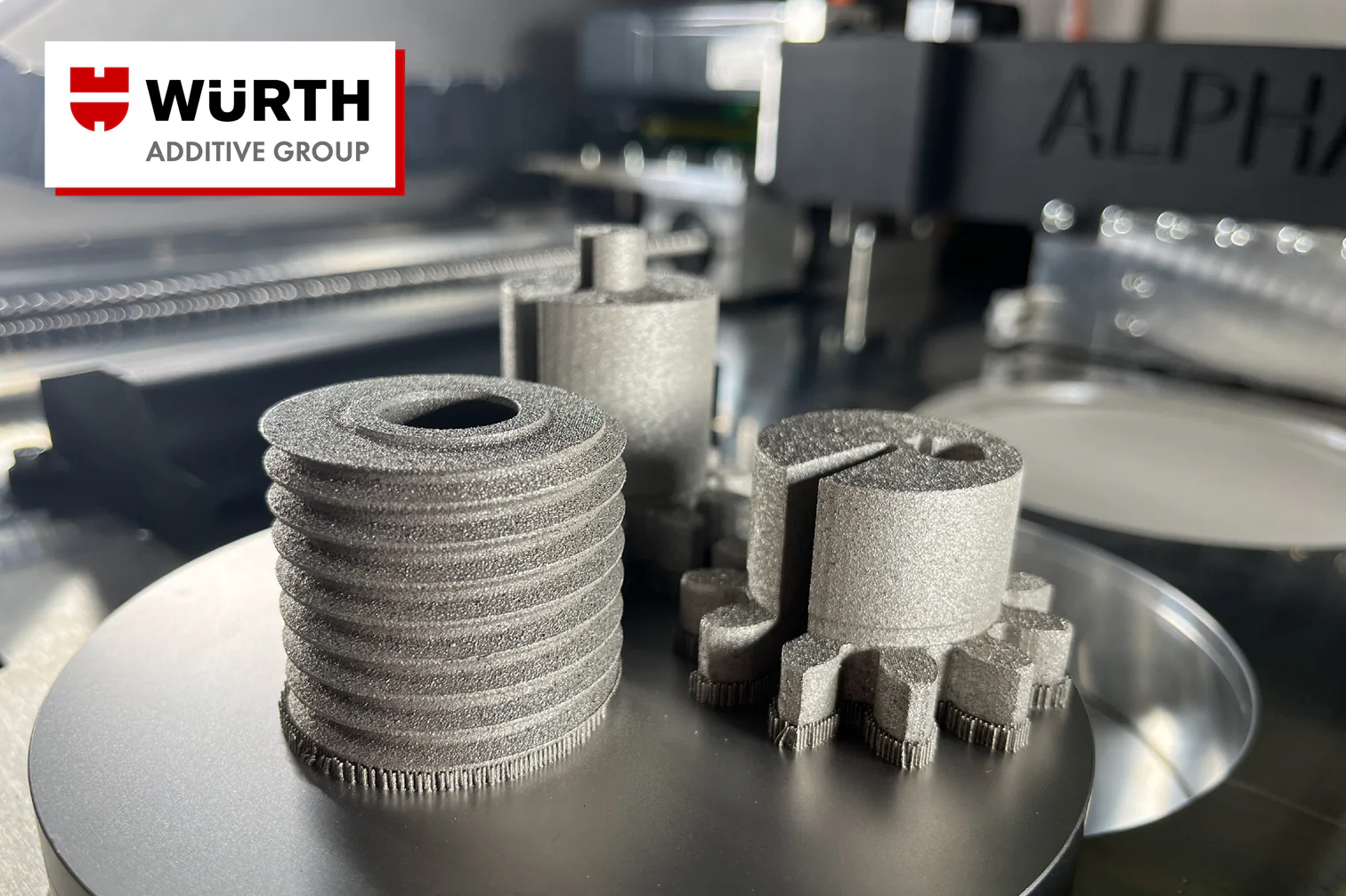
Metal AM component produced on the Alpha 140. Image courtesy of the Würth Additive Group.
For Gladkikh, the conversation around digital supply chains is becoming increasingly urgent as manufacturers face geopolitical instability, supply disruptions, and growing pressure to localize production. He believes companies need to approach the transition strategically, starting with a clear understanding of their business needs, operational pain points, and applications where AM can provide real value.
At the same time, he cautions against using 3D printing simply because the technology is available.
“Should this be printed?” Gladkikh said. That is ultimately a more important question than whether it simply could be.
Subscribe to Our Email Newsletter
Stay up-to-date on all the latest news from the 3D printing industry and receive information and offers from third party vendors.
Print Services
Upload your 3D Models and get them printed quickly and efficiently.













You May Also Like
How Should Businesses Build New Business? Dirk Simon Weighs In — Part 1
Dirk Simon had deep experience in materials and chemistry before joining the 3D printing industry. Instrumental in BASF and Farsoon’s market introduction, Dirk has spent a lot of time thinking...
The Frankenservice Part 2: Have Your Cake and Eat it Too
This series of articles delves into a thought experiment. What if we let go of using a few machines very optimally, but instead use lots of different machines to meet...
The Additive Chicken Coop, Part IV: Lemmings
If we look at our past, we can see how making custom machines, incessantly watching ourselves, and our inability to rescope shaped our industry. We have also looked at the...
The Additive Chicken Coop, Part III: Bananas
A friend of mine, Ed Davis, once pointed out the level of strategic replication in additive. I wasn’t aware of it before and haven’t been able to unsee it since....