CollPlant & United Therapeutics Expand Collaboration to 3D Print Kidneys


Currently, over 100,000 individuals in the US are on the waiting list for organ transplants. Kidney patients make up the majority of the requests, with over 90,000 people hoping for donor organs. Data shows that seventeen people die every day while they are waiting for new organs; meanwhile, one new patient is added to the list every ten minutes.
Modern options, such as bioprinting may one day eliminate the need for treatments like dialysis, and companies like Organovo have previously served as pioneers in the field of 3D printed kidneys. Now, Israel’s CollPlant Biotechnologies and United Therapeutics are amping up their collaboration further to bioprint kidneys, with the ultimate goal of transplantation.
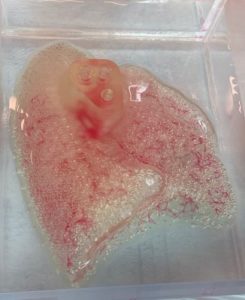
3D printed lung scaffold © 2020 United Therapeutics Corp.
“Organ shortages are an unmet global health need and by partnering with United Therapeutics for the past couple of years, we have made significant progress with this pivotal organ manufacturing initiative,” explained Yehiel Tal, CollPlant CEO.
CollPlant is entirely dedicated to “regenerative and aesthetic medicine” in relation to tissue regeneration and the creation of human organs. For bioprinting, the CollPlant team relies on their rhCollagen-based bioinks. United Therapeutics, in complement to the technology of CollPlant, is focused on developing products to improve treatment for patients suffering from chronic and life-threatening health issues.
The two companies have been working together since 2018, with great enthusiasm shared for the CollPlant technology, using tobacco plants to make collagen-expressing plants that could lead to the production of a variety of human organs.
“Our collagen-expressing plants are already flourishing in Texas where we enjoy three growing seasons,” says Martine Rothblatt, PhD, chairman and CEO of United Therapeutics.
The two companies originally began working together to use 3D printing in lung transplants. Continuing on, the extension of their collaboration includes a $3 million payment to CollPlant for licensing of their collagen and bioink products. The original agreement included $5 million, with “milestone payments of up to $15 million,” depending on development details.
[Source / Images: Genetic Engineering & BioTechnology News]“United Therapeutics is pioneering the emerging organ manufacturing field, and we are honored to be part of this effort via this partnership. This option exercise demonstrates another important validation of our rhCollagen platform technology, performing as an optimal building block for regenerative medicine. We remain committed to exploring new innovative applications in the fields of medical aesthetics and 3D bioprinting of tissues and organs,” said Tal.
Subscribe to Our Email Newsletter
Stay up-to-date on all the latest news from the 3D printing industry and receive information and offers from third party vendors.
Print Services
Upload your 3D Models and get them printed quickly and efficiently.













You May Also Like
3D Printing News Briefs, September 12, 2026: Rebranding, Cybersecurity, Project Call, & More
We’ve got a lot of business news from ATLIX to start off this weekend’s 3D Printing News Briefs, with a new identify for its additive manufacturing (AM) portfolio and some...
Apple’s 3D Printed Hinge Cover & the Inauguration of the Ternus Era
Marc Andreessen notwithstanding, it turns out that hardware is, in fact, eating the world. Perhaps after being starved for so long, the hardware side of tech innovation is now overcompensating,...
3D Printing News Briefs, September 10, 2026: Tax Credits, Polymer Research, Microneedles, & More
We’re starting off this week’s 3D Printing News Briefs with a little business from Axtra3D and Beehive Industries, before moving on to a scientific collaboration agreement between Roboze and a...
IperionX Gets $11.5M Army Boost to Make Titanium Fasteners in the U.S.
IperionX is going to get another $11.5 million, potentially up to $25.4 million, of an existing SBIR Phase III with the Army (Task Order W911QX26FA097). The award covers low-cost titanium...