How Does Thermal Aging Impact 3D Printed Carbon Fiber Parts?


Advances in developing composites for additive manufacturing have accelerated in the last few years, with increasing research and innovation in both, desktop and industrial AM using composites, using chopped or continuous fiber technology, with carbon fibers or nanotubes, or glass fibers most typically used for reinforcement.
3D printed composite materials and sandwich structures (lightweight core sandwiched by thin face sheets) have been the subject of increasing research at universities and national laboratories. But the focus has been more on studying compressive failure, load-carrying capacity, ductility, morphology, tensile or friction properties. This study, published in the Polymer Testing Journal, is a collaboration between researchers at Deakin University (Australia) and University of Siegen (Germany), and the focus was to investigate the impact to performance or properties in 3D printed composite (specifically cores) structures caused by accelerated thermal aging.
The authors chose to focus here due to a lack of investigative research in this area, and more pertinently, because such 3D printed materials/structures will be applied in various temperature conditions, and understanding how temperature impacts their mechanical properties and molecular structures would inform future applications and materials development. Indeed, composite material development and applications using AM are rapidly growing with the market for composites expected to reach $10 billion by 2028, as per SmarTech’s 2018 report, including part production, hardware and materials. Aerospace and medical industry applications are key drivers for composites at present, but that is expected to expand soon into other industries of automotive, construction, energy and consumer products.
FDM (using a FlashForge Creator Pro) was chosen to fabricate two types of composite structure, using ABS and ASA (acrylonitrile styrene acrylate) with carbon fiber face sheets. Two topological structures for the core were fabricated, one truss or triangle-like, and the other, honeycomb or hexagonal. To understand the effects of loading and thermal aging on the structures, compression, tensile and three point bending tests were used to study the mechanical behavior and failure of these components.
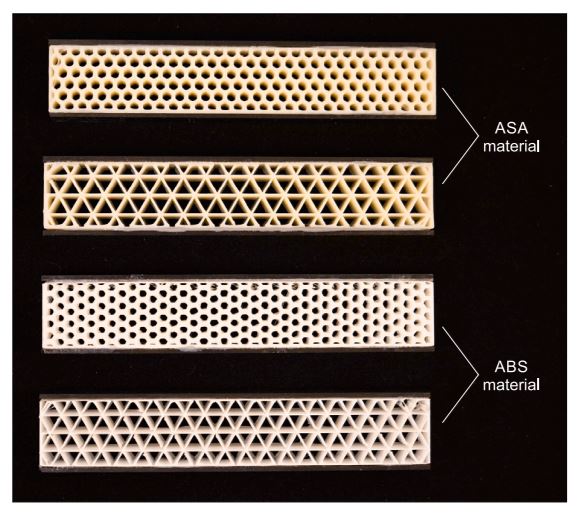
Image Courtesy of Polymer Testing 91 (2020) Journal / Deakin University
The study also hinted toward how continuous fiber reinforcement may provide improved failure load properties over chopped fiber, since initial failure tended to occur at filament intersections within cell walls: “the honeycomb cells had better properties, as there is more continuous filaments between cell walls. The thermal aging also had a greater affect on these joins, as the relaxation and restructuring of the molecules increased the toughness of the join.”
To simulate thermal aging, specimens were ‘aged’ by subjecting them to changing temperatures in a climate test chamber. The max/min temperatures were 60 degrees and 22 degrees Celsius (below the glass temperature of polymers), with an automated, high precision and accuracy device, controlling the rate of temperature change at 1 degree Celsius/minute.
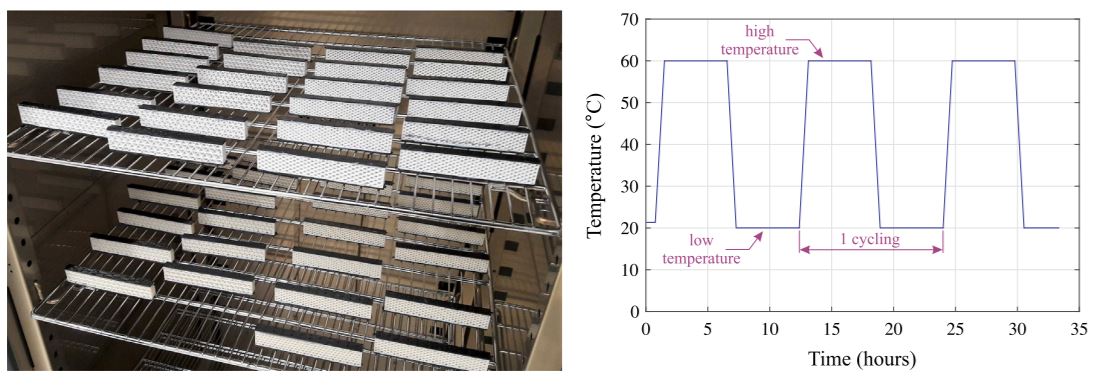
Image Courtesy of Polymer Testing 91 (2020) Journal / Deakin University
It was found that the honeycomb structure with ASA had the higher flexural strength, higher strain-to-load properties, and overall higher load carrying capacity (with ABS or ASA), and that thermal aging increased the maximum strength due to annealing (and molecular structure changes) in specimens with both patterns and materials. The annealing seemed to strengthen the bonds between layers and the print beads. The impacts due to thermal aging could also largely be attributed to aging time, with aging temperature having no significant effect. Thermally aged specimens also had better stiffness and failure load properties, with flexural stress being 15% higher than unaged specimens. In addition, the ASA core failed at a higher strain than the ABS core.
Interestingly, Deakin University is considered to be among the leading research and educational institutions in AM in the country, and worldwide. In 2017, Ian Gibson, Professor of Additive Manufacturing at the university, received the International Freeform and Additive Manufacturing Excellence (FAME) recognizing his lifetime achievements and contributions to 3D printing – which include coauthoring the influential ‘Additive Manufacturing Technologies’ that sold over 300,000 copies, establishing the Rapid Prototyping Journal and the Global Alliance of Rapid Prototyping Associations. Last month, the university launched a research and education program focused on MELD technology, an innovative open-air metal AM technology that can build parts, large or small, without melting any metal. In collaboration with US-based MELD Manufacturing Corporation, the university has placed a MELD machine at its Advanced Metal Manufacture Facility and plans to fund further research into materials, efficiency, and applications for MELD technology.
Subscribe to Our Email Newsletter
Stay up-to-date on all the latest news from the 3D printing industry and receive information and offers from third party vendors.
Print Services
Upload your 3D Models and get them printed quickly and efficiently.













You May Also Like
3D Printing News Briefs, September 12, 2026: Rebranding, Cybersecurity, Project Call, & More
We’ve got a lot of business news from ATLIX to start off this weekend’s 3D Printing News Briefs, with a new identify for its additive manufacturing (AM) portfolio and some...
Apple’s 3D Printed Hinge Cover & the Inauguration of the Ternus Era
Marc Andreessen notwithstanding, it turns out that hardware is, in fact, eating the world. Perhaps after being starved for so long, the hardware side of tech innovation is now overcompensating,...
3D Printing News Briefs, September 10, 2026: Tax Credits, Polymer Research, Microneedles, & More
We’re starting off this week’s 3D Printing News Briefs with a little business from Axtra3D and Beehive Industries, before moving on to a scientific collaboration agreement between Roboze and a...
IperionX Gets $11.5M Army Boost to Make Titanium Fasteners in the U.S.
IperionX is going to get another $11.5 million, potentially up to $25.4 million, of an existing SBIR Phase III with the Army (Task Order W911QX26FA097). The award covers low-cost titanium...