MELD Manufacturing Reaches Major Milestone with Metal 3D Printed Components


Virginia-based company MELD Manufacturing Corporation was launched in the spring of 2018 as a subsidiary of Aeroprobe Corporation, which produces instruments that provide and measure real-time air and flow data. Aeroprobe had been working with the Edison Welding Institute to develop Friction Stir Additive Manufacturing for printing functionally gradient metal components, and founded MELD to continue working on this novel technology.
 That’s exactly what the company did. Even though its technology had already been in development for more than a decade, MELD continued making strides to its patented process of creating, and repairing, metal components out of off-the-shelf materials. Not long after its launch, MELD was in the news for winning the RAPID Innovation Award at RAPID + TCT 2018.
“The MELD technology is a revolution. To be recognized at RAPID by these industry leaders demonstrates just how much potential MELD has to change the way we think about manufacturing,” MELD Manufacturing Corporation’s CEO Nanci Hardwick said at the time. ” We want to see MELD adopted across industries, so it’s exciting to see genuine interest from such a diverse crowd.”
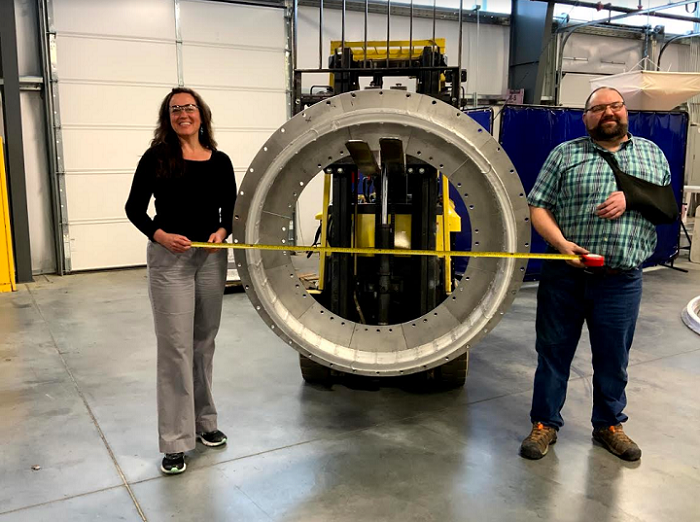
MELD Manufacturing Corporation CEO Nanci Hardwick and Production Manager David Smith with measuring tape extended to 1.85 meters (6 feet).
A few months later, the company was selected as a finalist for the global R&D 100 Awards, and is now celebrating a major milestone regarding the size of its metal 3D printed parts. Using off-the-shelf Aluminum 6061, MELD has 3D printed components that are larger than 1.4 meters (55 inches) in diameter; some of these components even have solid walls that are over 102 mm (4 inches) thick!
So, what makes this technology so unique? It can actually print fully dense parts without having to melt any metal. The innovative, solid-state process can be used to 3D print, coat, repair, and join metals and metal matrix composites. By avoiding melting, MELD also avoids issues like hot-cracking and porosity, and uses less energy to produce high-quality parts with full density and low residual stresses.
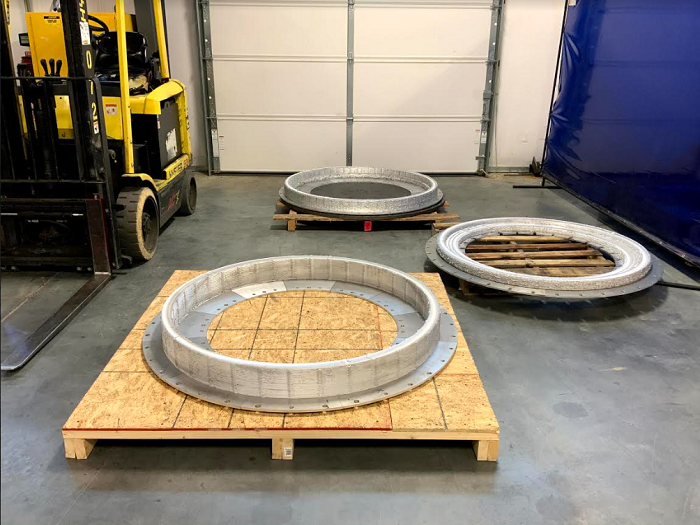
Large scale components made from off-the-shelf Aluminum 6061 material using the MELD process.
“MELD is uniquely open atmosphere, meaning no special chambers or vacuums are needed. This flexibility not only means less equipment and cost, but also that MELD is scalable and can make parts bigger, better, and faster than other processes,” the MELD website states.
“The combination of material freedom and scalability make MELD a revolution for a wide range of industries, including aerospace, defense, turbomachinery, and many others.”
Due to a decrease in domestic forges and mills, there’s an increased demand for large-scale metal parts, like the ones MELD is now creating, than foreign companies can readily supply. The current COVID-19 pandemic has not made these delays any better, either.
“Prior to the pandemic our customer told us that these parts, printed in a few days at MELD, would have taken them up to two years to get from their supply chain,” Dr. Chase Cox, MELD’s Director of Technology, said in a press release. “This global economic shutdown likely added 6 months or more to that 2-year lead time estimate. MELD represents an opportunity to re-establish domestic manufacturing capability at a critical time.”
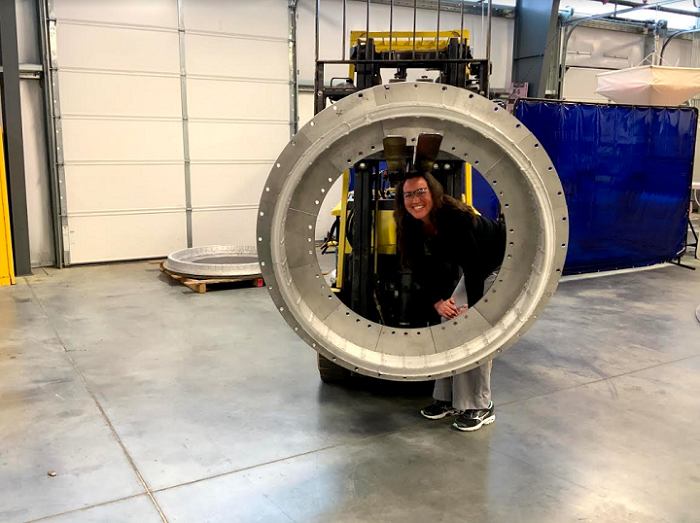
MELD Manufacturing Corporation CEO Nanci Hardwick with a large-scale aluminum component built with the MELD process.
MELD’s material is widely used in industry applications, though it’s not compatible with other forms of metal additive manufacturing, and the large size of its 3D printed components is a good example of the advantages in scalability that this type of open-air 3D printer can provide. Large metal structures that are commonly fabricated with forging can now be 3D printed, on-demand, with MELD’s technology.
What do you think about this? Discuss this story, and other 3D printing topics, at 3DPrintBoard.com or share your thoughts in the Facebook comments below.
(Images provided by MELD Corporation)
Subscribe to Our Email Newsletter
Stay up-to-date on all the latest news from the 3D printing industry and receive information and offers from third party vendors.
Print Services
Upload your 3D Models and get them printed quickly and efficiently.













You May Also Like
Russia’s 3D Printed Missiles & Can NATO Get Its Act Together?
For most of US history, however much the two major parties differed on domestic policy (in some cases a lot, overall less than you’d think), there was always essentially a...
3D Printing News Briefs, October 21, 2026: Digital Twins, AI CAD Service, AR Smart Glasses, & More
In today’s 3D Printing News Briefs, America Makes announced the winners of its MIAMI Project Call, and AM Europe released a new report. Artec 3D launched its new Artec Twins...
3D Printing News Briefs, October 10, 2026: Drones, WAAM, Ceramics, & More
We have a packed 3D Printing News Briefs for you this weekend! First, America Makes celebrated the recent National Manufacturing Day with 3D printed drones, and then it’s on to...
The Manufacturing Race Behind the Drone Revolution
We are in the middle of a major manufacturing shift focused on the production speed and payload capacity of uncrewed aerial systems (UAS), or drones. A recent Manufacturing Dive article...