Guinness Certifies World’s Longest 3D Printed Concrete Bridge in China

Last year in February, a team at the Tsinghua University School of Architecture built a 26.3 meter long concrete bridge, claimed to be the world’s longest 3D printed bridge. Just this Tuesday, the bridge was certified by the Guinness World Records as the world’s longest 3D printed concrete bridge.
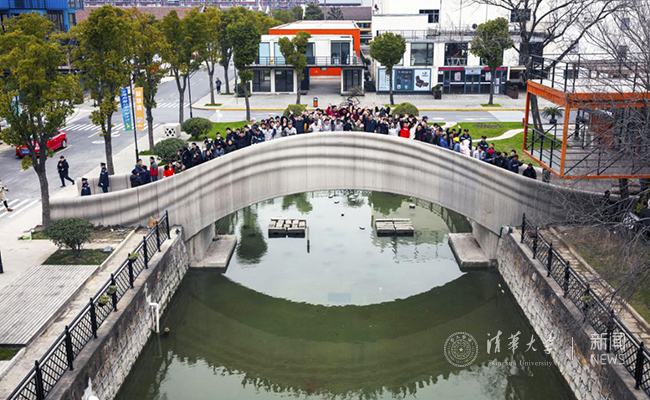
Image courtesy of Tsinghua University, Beijing, China
Designed by Professor Xu Weiguo’s team at the university, and built by Shanghai Wisdom Bay Investment Management Company, the 3.6 meter wide pedestrian bridge was installed last year across a canal in Shanghai’s Baoshan district. The design of the bridge was based on that of China’s oldest standing bridge, the 1,400-year-old Anji (commonly known as Zhaozhou) Bridge in Zhaoxian (280 km south of Beijing). While the ancient Anji bridge took over ten years to build, this 3D printed bridge was completed in just under 19 days.
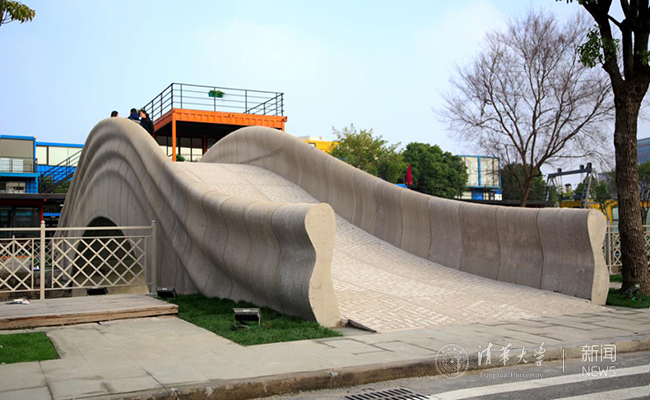
Image courtesy of Tsinghua University, Beijing, China
The new 3D printed bridge involved the printing of 176 concrete units by two robotic-arm 3D printing systems in under 450 hours. The material used for printing is a composite of polyethylene fibre concrete and admixtures. The bridge costs two-thirds that of a traditionally built bridge since the 3D printed bridge doesn’t require templates or reinforcing bars, a significant portion of costs. The structure of the bridge is composed of 44 hollowed concrete 3D printed units, with a brain coral-inspired deck design, while the sides are composed of 68 units.
What is unique to the bridge is the inclusion of sensors for real-time monitoring, and the approach taken with the two robotic arms that built it. The high precision sensors will convey measurements of vibrating wire stress and strain in real-time. The two arms have separate functions, with one stirring and pushing the concrete, and the other controlling the print-path and operating system. Not only is this construction solution faster, cleaner and more efficient than conventional alternatives, it also produces a more durable, ‘intelligent’ bridge at a lower cost.

Image courtesy of Tsinghua University, Beijing, China
For China, such automated construction technologies offer a much needed, low labor-intensive construction solution for the future, where labor supply will be significantly reduced due to China’s declining demographic dividend. While such technologies are yet to be proven for practical engineering applications, Chinese research and development, especially in such robotic arm 3D printed concrete technology, is already proving to be world-leading for 3D printing in the construction industry.

Image courtesy of Tsinghua University, Beijing, China
This bridge is longer than Madrids’ Alcobendas Bridge which was previously the world’s longest 3D printed bridge, 12 meters long and 1.75 meters wide. The world’s first 3D printed concrete bridge, eight meters long, integrated steel wires into pre-stressed concrete layers, and was built in the Netherlands by the Eindhoven University of Technology. In Amsterdam, MX3D built the world’s first 3D printed steel bridge, 12.5 m long, which used multiple robots for construction. Earlier this month, the city of Rotterdam in partnership with DSM announced its intent to construct a polymer footbridge using circular composites to be ready by the end of 2020. Interestingly, in addition to Professor Weiguo’s 3D printed concrete bridge, Shanghai is also home to a 15 meter long 3D printed polymer pedestrian bridge that took 35 days to build.
Subscribe to Our Email Newsletter
Stay up-to-date on all the latest news from the 3D printing industry and receive information and offers from third party vendors.
Print Services
Upload your 3D Models and get them printed quickly and efficiently.













You May Also Like
Creality K3 Opens for Pre-Order at $849, Advancing Multi-Color 3D Printing
Creality has officially opened pre-orders for the Creality K3, its latest flagship K Series 3D printer, starting at $849 in the United States. Recognized as an IFA Innovation Awards 2026...
Beyond the Printer: HP and DyeMansion Tackle the Future of Prosthetics
Making a custom orthotic or prosthetic device involves much more than producing the final part. Patients need to be measured, devices must be designed to fit their bodies, and finished...
3D Printing News Briefs, October 14, 2026: Bolus, Aerospace Tooling, Water Filter, & More
In today’s 3D Printing News Briefs, we’re starting with medical news, as Myrava has received FDA 510(k) clearance for its 3D printed bolus. Moving on to aerospace and metals, AML3D...
Can India’s AM Push Help Make it a Viable Supplement to China?
Diversifying manufacturing supply chains to locales outside of China has nothing to do with actually cultivating “substitutes” to the Chinese economy. The real stakes are these: China is an irreplaceable...