3D Printing Aids and Replaces Soft Tooling

In pervious articles, we’ve discussed the benefits that 3D printing brings to tools for injection molding, die casting and forging. The technology also has its place in complementing or supplanting soft tooling, also referred to as rubber molding, silicone molding, room-temperature vulcanized (RTV) molding, or urethane casting.
Unlike hard tooling, made up of an aluminum or steel mold, soft tooling is comprised of silicone, urethane or other flexible materials and is used to produce parts with material properties that are more akin to a final injection molded material. This process is sometimes called RTV molding due to the fact that it can be performed at room temperature, unlike injection molding, which requires melting plastic pellets. Soft molds are usually manually injected with a given material through a gravity-fed tube.
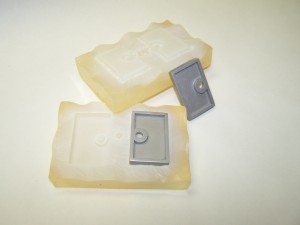
Traditionally made soft tooling. Image courtesy of the Technology House.
Rubber molding is often used as a bridge between the prototyping phase and injection molded parts, providing material properties that are more akin to the final injection molded material but at a lower cost than hard tooling that will be used for end production. Moreover, it can be used to produce limited runs of final parts while hard tooling is being made. While soft tooling is typically more economical for smaller batch sizes, it can’t survive as many shots as a metal mold. Soft tooling may be utilized in any of the following circumstances:
- Properties of the final production material must be evaluated
- Quantity exceeds economical prototyping capacity
- A trial batch is necessary before production
- The design is not ready for production tooling
- Only small production batches (tens to hundreds) of items are required
3D printing is already used today in the fabrication of soft tools. A prototype may be made with stereolithography, digital light processing or some other high-resolution 3D printing technology, like material jetting (e.g., PolyJet from Stratasys, MultiJet Printing from 3D Systems, etc.), before a flexible silicone mold is made around the prototype. The right urethane is then selected to be injected into the mold to create a part.
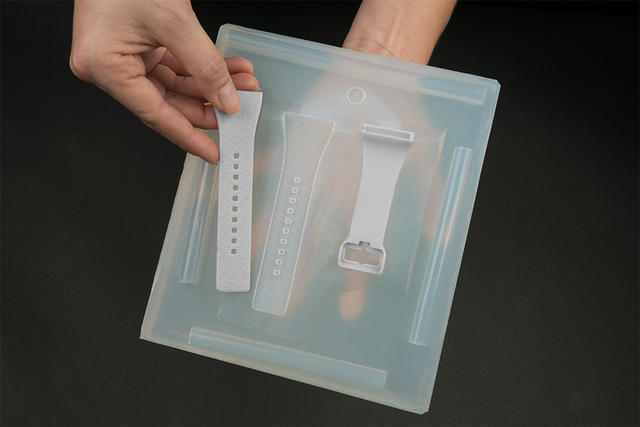
A 3D-printed mold used for urethane casting. Image courtesy of 3D Systems.
Kevin Klotz, Sr. Project Engineer MGS Mfg. Group, for instance, told 3D Hubs that MGS uses 3D printing to produce molds directly, saying, “Sometimes it’s not so much the cost of a 3D printed tool insert verses a soft tool version, it is that we can’t produce the detail in the soft tool without, for instance, applying Electrical Discharge Machining (EDM) techniques. Somos PerFORM allows for the creation of detail that otherwise could not be made and to make it in less time.”
Recently, Israeli startup Nanofabrica has deployed its micro additive manufacturing technology to 3D print micro molds, dubbing the process “Direct Rapid Soft Tooling”. Nanofabrica’s Terra 250 AM system is an “ultra-high” resolution DLP machine that relies on semiconductor lithography to print layers as fine as 1 micron. The company, which recently raised $4 million in a financing round led by Microsoft’s M12 venture fund, was able to inject polypropylene, polyethylene and ABS into micro molds 3D printed with the Terra 250 AM system.
Molds lasted 20 shots at pressures of 400 bar at 230°C. Within the coming months, Nanofabrica is aiming to optimize the technology to create molds that can last 1,000 shots at temperatures of 350°C and pressures of 800 bar. So far, soft tooling that small was limited to research efforts, with a team from the Technical University of Denmark, printing micro mold inserts, as shown in the video below.
A Soft Tooling Process Chain for Injection Molding of a 3D Component with Micro Pillars
At the macroscale, now that polymer 3D printers are beginning to achieve the throughput and material properties possible with silicone molding, they are able to compete directly. In particular, companies like Carbon are working to develop materials that most closely resemble material properties used in injection molding, while AddiFab and Collider have learned how to combine injection molding with 3D printing in unique ways that allow for the use of existing injection molding plastics.
Subscribe to Our Email Newsletter
Stay up-to-date on all the latest news from the 3D printing industry and receive information and offers from third party vendors.
Print Services
Upload your 3D Models and get them printed quickly and efficiently.











You May Also Like
3D Printing News Briefs: February 19, 2026: Market Data, Africa, Metal Parts for Defense, & More
We’re starting with some business news for you in today’s 3D Printing News Briefs! The Wohlers Report 2026 is now available, Carbon announced its new Chief Technology Officer, and Farsoon...
“A More Complete End-to-End Solution”: Stratasys Launches Post-Processing Partnership Program
I think it’s safe to say that post-processing is no longer considered the “dirty little secret” of 3D printing that it once was, with users realizing that finishing is just...
Why SiC-Dedicated Additive Manufacturing Is Gaining Industrial Relevance
Silicon carbide is not a material problem—it’s a manufacturing one. Silicon carbide (SiC) has become a critical material across semiconductors, aerospace, energy, and defense. Its exceptional thermal stability, chemical resistance,...
3D Printing News Briefs, February 5, 2026: Advisory Board, Virtual Twins, & More
We’re starting with business in today’s 3D Printing News Briefs, including a new website launched by Metamorphic AM. Massivit appointed two senior leaders to its advisory board, and Dassault Systèmes...