The Great AM Reset: Why Applications Will Decide Who Survives


For decades, the AM industry has been powered by an exciting narrative of endless growth and disruptive potential. We celebrated every new technology, every injection of capital, and every bold promise about a transformed future. But as we head into 2026, the “growth at all costs” mantra is being replaced by a more sober and critical question: where is profitability? The truth is: our industry is overcrowded, unfocused, and, for many, deeply unprofitable. This is the Great AM Reset, a necessary shift from a technology push to an application pull mindset.
The Unprofitable Playground
The problem is not a lack of effort, but the very nature of the tools we have created. For years, the industry has collectively built the equivalent of a giant Swiss Army Knife, a universal super-tool designed with the potential to solve every imaginable problem. This was essential to get the technology off the ground and prove its broad applicability. However, once you have a specific application that never requires the corkscrew, that feature becomes a liability. Its complexity and cost weigh down the business case, making it harder to compete with established, specialized manufacturing methods.
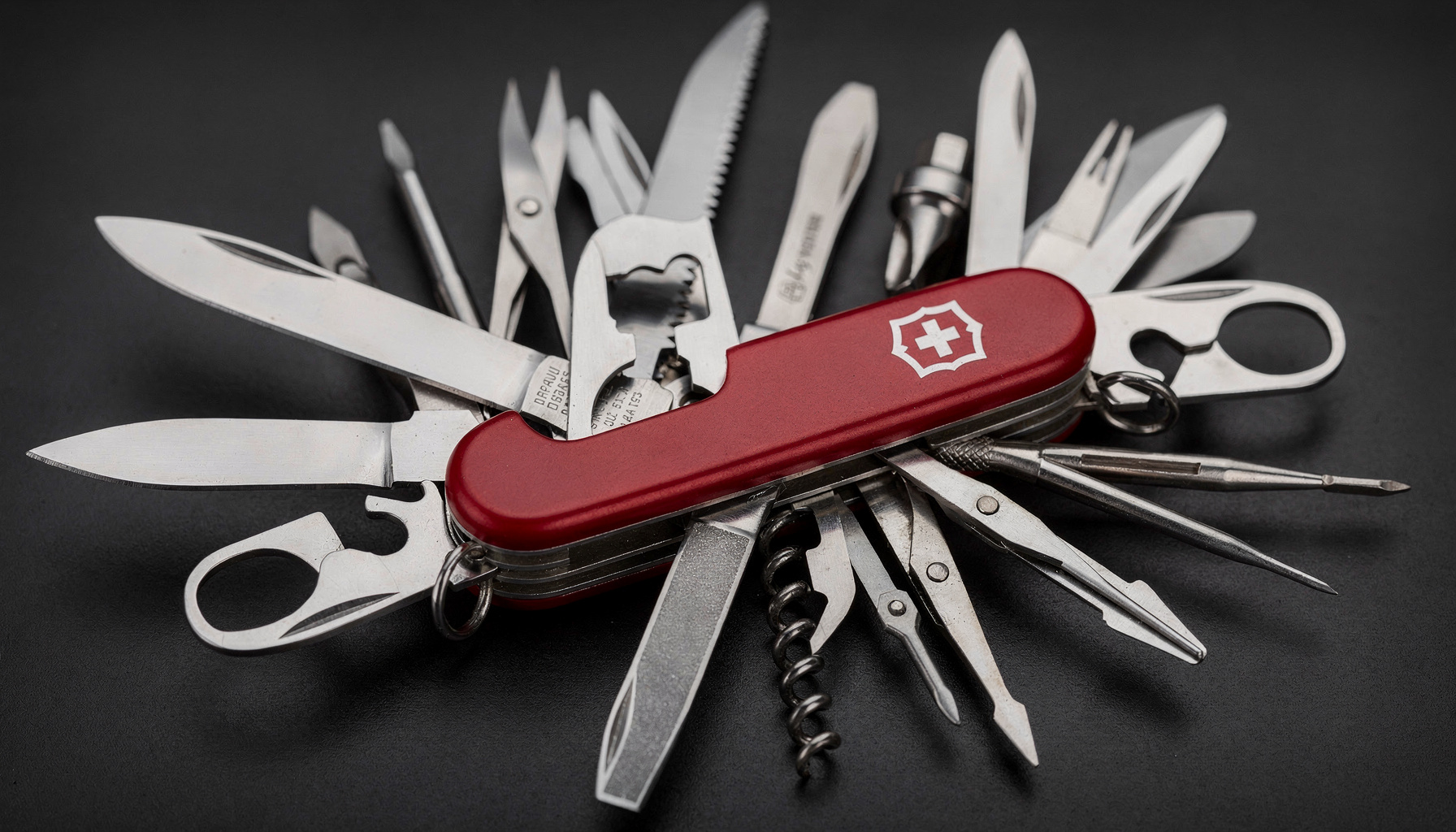
Source: A Swiss Army Knife with a lot of tools, AI-generated with FLUX.2 [pro]
This is the industry’s 80/20 problem. Getting a machine to perform a novel trick once represents the first 80% of the desired effect, but it only takes about 20% of the total engineering effort. We are now facing the truly hard part: the final 20% of the effect, making that machine operate reliably at scale, requires the remaining 80% of the work. The era of the generalist “do-everything” machine is ending. Just as the best injection molding suppliers dominate medical technology and specific milling companies own the defense sector, AM will specialize.
Companies like AMCM are already leading this transition. By deeply customizing their systems for specific customer applications, e.g. for space components or in defense applications, they are effectively moving away from the from the Swiss-Army-Knife-principle and develop superior single-application-tools instead. They have proven that specialization is how this technology truly begins to function and deliver value.
This history of building universal tools is precisely why the classic startup disruption playbook has failed so spectacularly in AM. The model is simple: a startup with a lean minimum viable product (MVP) attacks an established player’s profitable product from below and steals their customers. But in AM, this model collapses. The market is a fragmented landscape of companies with minor technological tweaks, all battling for a piece of a market that is not yet mature enough to support them. There are no profitable, billion-dollar incumbents to disrupt. This raises a critical question: why are we trying to disrupt an industry where you cannot make money? This flawed premise has led to a painful cycle where an estimated USD 2bn of VC money has evaporated without a clear path to sustainable profitability, turning the industry into a playground of possibilities, not a marketplace of proven solutions.
Two Paths to Survival: Become a Giant or Pivot
In this this reset, only two viable paths remain.
The first path is a tough race for the base technology suppliers, who must now solve the fundamental challenge of achieving profitability through scale. The future for these players will be a consolidation mirroring the one we witnessed in other manufacturing technologies. Like in the conventional machining industry, the early market was also a fragmented “Wild West” of proprietary systems. It only broke into the mainstream when champions like Fanuc and Siemens created a standardized ecosystem, turning a collection of disparate tools into a predictable, scalable industrial platform. The winners in AM will not be those with just a novel technology, but those who can deliver on the unsexy but critical triad of reliability, scalability, and a low cost per part.
For every other company not competing in that race, the only strategy is the second path: a deliberate pivot away from technology and towards the application. For years, the fatal mistake has been to approach customers, present a novel printer, and essentially say, “You are the experts; figure out how to use this.”
This is the classic “technology push” fantasy. The company naively assumes their presentation will set off a creative chain reaction, that engineers will instantly dream up a hundred new applications, that management will immediately divert resources, and that the entire organization will eagerly re-engineer its processes around this new possibility. This is definitively not what happens. The customer’s reality is a world of high pressure and strict rules where risk is not an option. They don’t want a science project; they want a solved problem.

Source: One hand holding a finished castle and other hand holding a box of bricks, AI-generated with FLUX1.1 [pro] Ultra
Do not sell Lego bricks and hope the customer builds a castle. Walk in with the finished castle and prove it is better than the one they live in now. You are not asking them to take a bet on your technology; you are delivering them a superior solution. Your job is to drive the disruption yourself.
The Application First Mandate
Embracing this pivot requires a radical change in identity. Companies must stop calling themselves “AM companies” and start acting as “solution owners.” This is not theoretical. Look at the companies quietly winning today: Additive Drives is building superior electric motors for the e-mobility sector; Conflux is engineering the most cutting-edge heat exchangers; Domin is conquering the world of hydraulic motion control. Evove is creating next-generation filtration membranes; Vectoflow is redefining flow measurement with its robust probes; and Lightforce is transforming orthodontics.
They all share a common pattern: they possess deep application knowledge. They are not AM experts dabbling in a market; they are market experts who leverage AM as a tool to solve a high-value problem.
They are building the castle. They are delivering the lighter component, the more efficient part, the qualified product that solves a real, expensive problem for their customers. Successful startups scale by entering an existing, profitable industry and doing something fundamentally better. The goal is to create an “application monopoly”, a niche where your solution is not just an improvement, but indispensable. In this model, technology is merely the enabler; the true value lies in the final product and in owning the customer’s problem.

Alexander Schmoeckel, Associate, joined the investment team at AM Ventures in 2018 and plays a central role in overseeing portfolio companies such as Elementum 3D, Fortius Metals, Headmade Materials, Incus, Lithoz, MetShape and Vectoflow. In addition to managing these investments, he leads scouting activities across the United States and builds the firm’s network in the region.
Alexander holds a Bachelor and a Master degree in Management and Technology from the Technical University of Munich with a focus on finance, accounting, and mechanical engineering. He spent a semester in Paris and was part of the TUMfast scholarship program. He recently earned the Certified Private Equity Analyst qualification from TUM and BVK.
With a background that combines technical insight and financial experience, he is committed to supporting founders and advancing innovation in advanced manufacturing.
AM Ventures is the Networking Sponsor for Additive Manufacturing Strategies (AMS) 2026, a three-day industry event taking place February 24–26 in New York City. On February 25 at 4:55 pm, Alexander will participate in a panel on “Leveraging VC for an Industrial AM Future.” AMS brings together industry leaders, policymakers, and innovators from across the global additive manufacturing ecosystem.
Subscribe to Our Email Newsletter
Stay up-to-date on all the latest news from the 3D printing industry and receive information and offers from third party vendors.
Print Services
Upload your 3D Models and get them printed quickly and efficiently.













You May Also Like
50,000 Orders and Counting: EPlus3D & Chinese AM Services Provider Are Scaling Liquid Cooling Solutions for AI Servers
An under-appreciated story driving the additive manufacturing (AM) industry this year has been the divergence between what’s driving the market in China and what’s driving it everywhere else. Let’s start...
Additive Manufacturing Has a Major Growth Opportunity; Trust Will Decide Who Captures It
After years of overpromising, the next phase of AM growth will be won by companies that consistently deliver what they say. When I entered additive manufacturing in 2014, after 15...
Seven Trends Reveal What’s Next for 3D Printing at TCT Shenzhen 2026
TCT Shenzhen 2026 opened on October 14 in Hall 15 of the Shenzhen World Exhibition & Convention Center in Bao’an, and ran through October 16. The event brought together equipment...
AM Investment Strategies 2026 Sets the Stage for AMS 2027
AM Investment Strategies 2026 Nov. 5 · 12 p.m. ET · Free online event RESERVE YOUR SPOT ↗ A one-hour online discussion featuring some of the biggest names in 3D...