3D Printing Porous Ceramics with Bioinspired Materials for More Accurate Molds, Templates

International researchers continue in the quest to use new materials for modern applications, outlining how porosity affects macroporous diatomite-based foams in the recently published ‘Process strategy to fabricate a hierarchical porosity gradient in diatomite-based foams by 3D printing.’
In this study, the researchers wanted to design porous ceramics that could ultimately serve as a ‘bioinspired’ product using the natural material, diatomite. In the hopes that 3D printing could improve graded foams, the researchers are looking toward greater ease and accuracy in the production of templates and molds. In using stereolithography (SLA), the team was able to produce samples of polymeric templates as they combined macropores with diatomite-based foams.
In creating a solid ceramic matrix with diatomite, the researchers selected alkali-bonded ceramics or chemically bonded ceramics (CBCs) due to their potential for use in a variety of applications.
“CBCs are produced through a chemical reaction, consisting of a polycondensation of silica phases dissolved in a strong alkaline environment at low temperature, in contrast to traditional ceramic materials that are usually produced using fusion or sintering processes at elevated temperature,” explained the researchers.
During the process created for this study, the researchers ‘guarantee the presence of both microscopic- and macroscopic-scale porosity.’ Three different samples were printed as the team tested the template geometry of the microstructure. Each template was ‘impregnated’ with the slurry, with the systems cured and set at ‘room humidity’ for 24 hours.
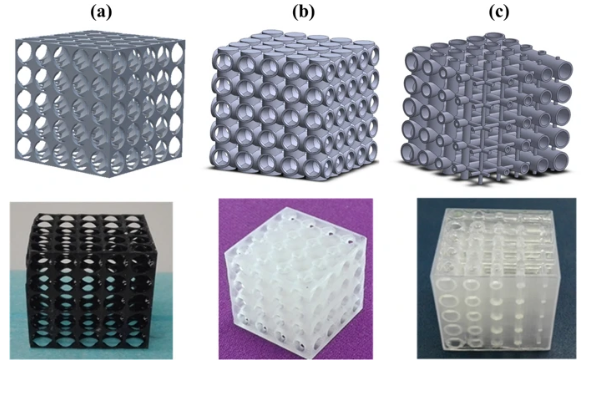
3D rendering and printed (lower part) of the three different sacrificial templates.
No shrinkage or swelling were evident upon curing, and samples were still solid even after thermal treatment, leaving the researchers to note that the template removal process worked, and the chosen parameters were correct.

Sacrificial template impregnated with diatomite-based foam after curing (a) and after template removal process (b).
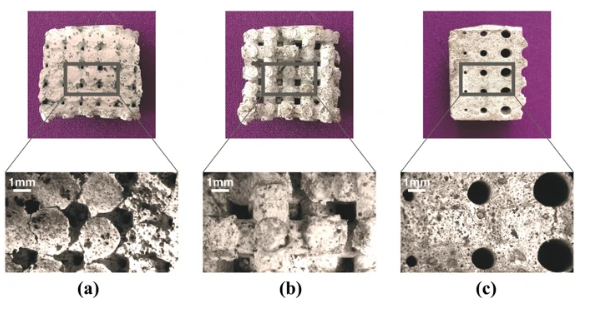
Diatomite-based foam inverse replica obtained after the complete template removal and corresponding stereomicroscopic images.
Micropores were identified easily, and the researchers noted that all the foam samples exhibited the desired ‘regularity’ of structure. No cracks or cavities occurred, and macropores were still intact even after the ‘burning out of the sacrificial template.’
“The indirect inverse replica approach allowed to overcome some of the limitations of other AM techniques, especially of the direct printing,” concluded the researchers. “In fact, in this process, templates and molds can be produced with high accuracy with common polymers, taking advantage of freedom and shape possibilities provided by this technique and avoiding limitations, in terms of homogeneity and microstructure control of the final ceramic part, filling the templates with suitable slurries.
“Moreover, it has been found out that the presence of this porosity of graded dimensions affects the mechanical properties of the macroporous diatomite-based foams causing a toughening effect. Finally, ranging from three orders of magnitudes macro, micro and nano, it is possible to properly tailor the foam porosity according to the final properties desired.”
While the researchers have performed unique experimentation here, 3D printing with foam has been the topic of studies from printing with polyurethane to creating foamed concrete panels to graphene, and more. What do you think of this news? Let us know your thoughts; join the discussion of this and other 3D printing topics at 3DPrintBoard.com.
[Source / Images: ‘Process strategy to fabricate a hierarchical porosity gradient in diatomite-based foams by 3D printing’]Subscribe to Our Email Newsletter
Stay up-to-date on all the latest news from the 3D printing industry and receive information and offers from third party vendors.
Print Services
Upload your 3D Models and get them printed quickly and efficiently.











You May Also Like
3D Printing News Briefs, October 30, 2025: EASA Certification, Ultrasonic Metal Atomization, Kickstarter, & More
In today’s 3D Printing News Briefs, a Fortune 500 company has grown its deployment of 3DPrinterOS. The Aviation AM Centre achieved an important certification for metal additive manufacturing on EOS...
3D Printing Webinar and Event Roundup: August 25, 2024
3D printing webinars and events are picking up this week! In today’s roundup, Stratasys continues its advanced training and U.S. tour, and HP will hold the next session of its...
Blue Laser-powered M600 3D Printer Launched by Meltio
Founded in 2019 as a joint venture between Additec and Sicnova, metal 3D printer OEM Meltio develops and manufactures high-performance and easy-to-use metal 3D printing solutions that use its patented wire-laser metal...
3DPOD Episode 188: Clare Difazio of E3D – Growing the Industry, and Growing With the Industry
Clare DiFazio’s journey into the 3D printing industry was serendipitous, yet her involvement at critical moments has significantly influenced the sector. Her position as Head of Marketing & Product Strategy...