HP Teams with New Balance and Superfeet for 3D-Printed Custom Insoles


HP has announced a further expansion of its customized, 3D printed insoles business via a partnership with New Balance and Superfeet. Select New Balance stores will now be offering personalized, 3D printed insoles using the solutions provided by HP and its other partners.
Starting in 2017, HP began offering insoles that could be tailored to the individual through a foot scanning device, dubbed the Fitstation, created with a company called Volumental. The Fitstation is capable of not only capturing the contours of one’s feet, but purportedly also analyzes one’s gait to create a personalized insole design.
The resulting design is then 3D printed using HP’s Multi Jet Fusion technology by a service provider. In the case of this product line, that provider is Flowbuilt Manufacturing in Washington. The insoles are made from BASF’s thermoplastic polyurethane, ULTRASINT, meant to be sufficiently flexible and elastic for footwear applications.
While you will likely have heard of the athletic wear giant New Balance, Superfeet may be less familiar to those without aching arches. The company is an insole and footwear (sandals) manufacturer with products in such stores as REI, Dick’s and Nordstrom’s. In addition to this partnership with New Balance, Superfeet offers 3D printed products made with the FitStation and MJF, including the Superfeet ME3D insole and ME3D Aftersport Custom Recovery Slides.
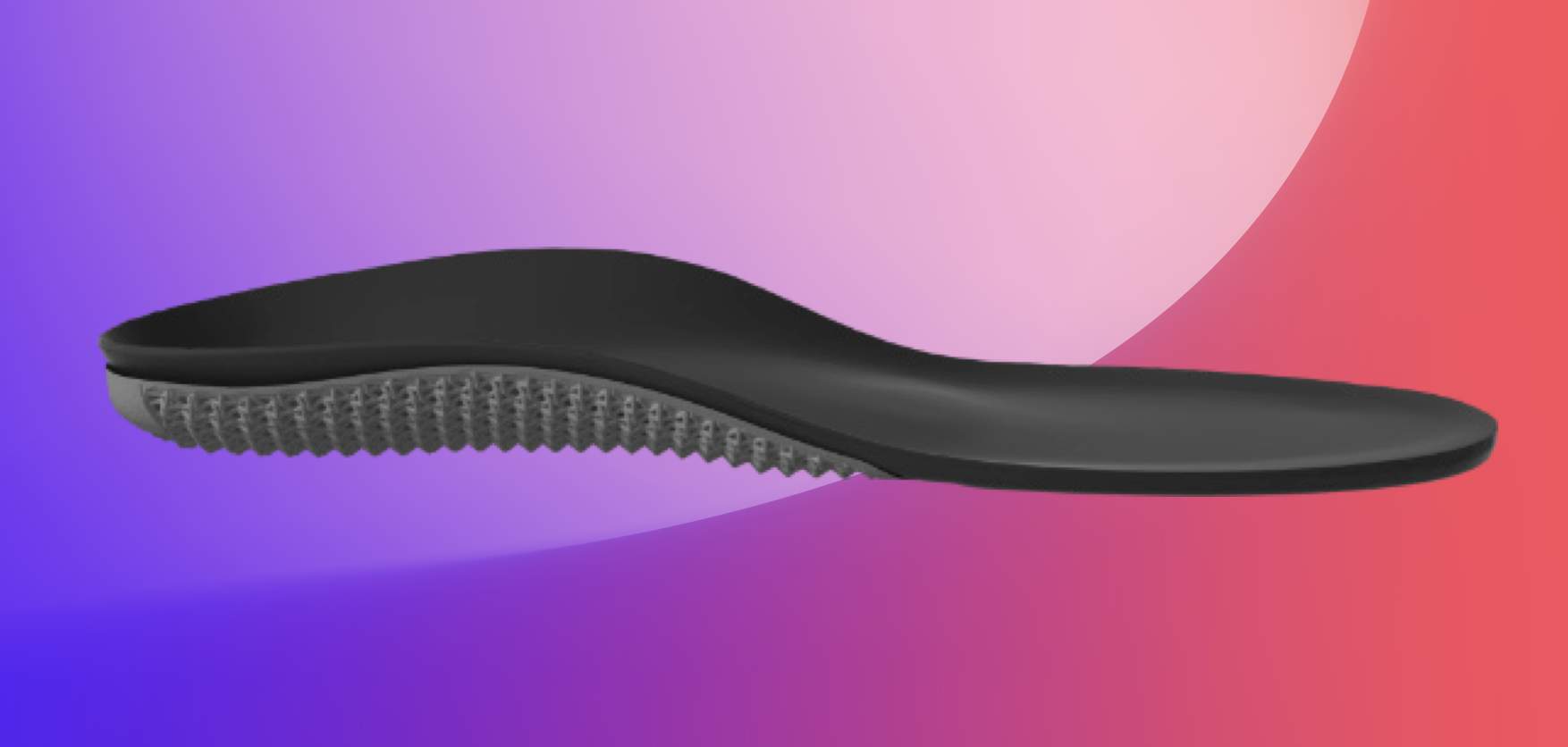
A 3D printed insole made using MJF and the FitStation. Image courtesy of HP.
Superfeet has secured a licensing agreement with New Balance to brand this new line of insoles being manufactured using HP technology, as well as some new off-the-shelf products. Now, customers will be able to purchase New Balance Stride 3D insoles—available in Casual, Running, and Sport styles—at select stores in Canada and the U.S. This expands New Balance’s own footprint in the 3D printed footwear market, which includes a number of shoes with 3D printed midsoles.
3D printed insoles continue to be an important entry point for 3D printing into the consumer market, while also acting as an opportunity to develop mass customization. The possible need for a consumer-specific product is obvious in the case of insoles, given the improved comfort and relief they would ideally provide a wearer. However, the stakes are not as high for companies like HP and New Balance, as insoles are not as complex or expensive to manufacture as an entire shoe. At the same time, it introduces consumers to the concept of personally tailored, 3D printed goods, while also allowing those brands invested in the technology to further develop the ability to mass customize products.
Though somewhat later to the race than companies like Wiivv and Sols (R.I.P.), HP has the corporate strength to potentially come out ahead. Its latest partnerships with New Balance and Superfeet demonstrate that it could be quickly moving into first position. However, with Wiivv partnering with Dr. Scholl’s, they may have some steep competition.
HP will be showcasing a range of its 3D-printed footwear products at the ISPO Munich sports business trade show at Booth 205, Hall A5 next week, January 26-29, 2020.
Join the discussion of this and other 3D printing topics at 3DPrintBoard.com.
Subscribe to Our Email Newsletter
Stay up-to-date on all the latest news from the 3D printing industry and receive information and offers from third party vendors.
Print Services
Upload your 3D Models and get them printed quickly and efficiently.













You May Also Like
50,000 Orders and Counting: EPlus3D & Chinese AM Services Provider Are Scaling Liquid Cooling Solutions for AI Servers
An under-appreciated story driving the additive manufacturing (AM) industry this year has been the divergence between what’s driving the market in China and what’s driving it everywhere else. Let’s start...
Seven Trends Reveal What’s Next for 3D Printing at TCT Shenzhen 2026
TCT Shenzhen 2026 opened on October 14 in Hall 15 of the Shenzhen World Exhibition & Convention Center in Bao’an, and ran through October 16. The event brought together equipment...
With Increased Aerospace & Defense Focus, CORE Industrial Partners Buys More Manufacturing Firms
Private equity’s march into manufacturing continues with CORE Industrial Partners’ latest acquisitions. CORE purchased Fathom a few years ago, and later bought 3DXTECH LLC, Triton 3D LLC, and Gearbox3D. It...
Can India’s AM Push Help Make it a Viable Supplement to China?
Diversifying manufacturing supply chains to locales outside of China has nothing to do with actually cultivating “substitutes” to the Chinese economy. The real stakes are these: China is an irreplaceable...