Researchers Tackle Fluid Flow Issues 3D Printing Microfluidics Platform

In ‘Microfluidics as a Platform for the Analysis of 3D Printing Problems,’ authors Rui Mendes, Paola Fanzio, Laura Campo-Deaño, and Francisco J. Galindo-Rosales explore new ways to tackle ongoing issues with fluid flow in FFF 3D printing.
For this study, the authors decided to create several different types of printing conditions in microfluidics, defined as:
- The Deborah number
- The Reynolds number
- The Elasticity number
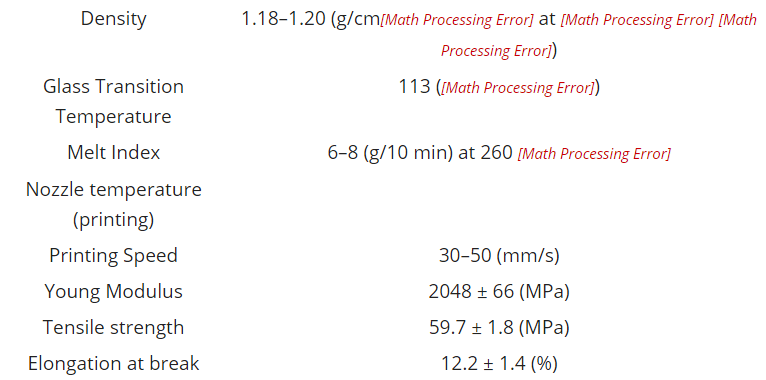
Technical information of the polycarbonate used in the 3D printing
The microfluidic nozzle was created in 2D with CAD software, and up to four different scale ratios were shown:
- 1:1
- 1:2
- 1:4
- 1:8

Viscosity curves for PAA solutions.
Each microchannel possessed its own inlet and outlets, with a contraction in between acting as the cross-section of the nozzle. The authors used photolithography to create the master for cast moling, and UV light to transfer ‘the geometry of the channels’ from a photomask to photosensitive substrate. They noted that shear thinning was more noticeable when the concentration of polymers was larger. For the study, three samples were created.
Upon analyzing the four microfluidic nozzles, they noted three different flow patterns:
“… at lower [Math Processing Error] and [Math Processing Error], it was possible to observe a laminar profile, very similar to a Newtonian fluid-flow at low [Math Processing Error], where the fluid stayed attached to the walls of the microchannel without any disturbance; as the elastic effects increased, a second zone was visible, where the flow detached from the walls upstream of the contraction and the typical printing conditions were located; and, finally, if the [Math Processing Error] and [Math Processing Error] were further increased, large vortices promoted a preferential central flow path,” stated the researchers.
It was possible to see the formations of the vortices ‘upstream’ of the contraction, with the research team noting that the elastic efforts of the analog fluids led to lower velocity than the extruded one.
“Eventually, they could even lead to a formation of solid pieces, promoting clogging. Furthermore, the vortex creates a zone of under-extruded material, which can accumulate near the walls up to the point it escapes between the filament and liquefier, resulting in a back-flow effect that leads to a catastrophic failure in a 3D printing process,” concluded the researchers.
“This work constitutes a first microfluidics approach to elucidate the physics behind the main problems in a printing process when using viscoelastic polymers. In future works, a wider range of analog fluids should be studied, not only to further complete the flow pattern map, but also to replicate the exact conditions of the printer and to discover the critical [Math Processing Error] and [Math Processing Error] values that potentiate a laminar flow.”
Microfluidics and 3D printing accompany each other in many a research lab today as scientists create new designs, assess miniaturization also, and examine such structures in connection with bioprinting. What do you think of this news? Let us know your thoughts! Join the discussion of this and other 3D printing topics at 3DPrintBoard.com.

k coefficients for each microfluidic channel.
Subscribe to Our Email Newsletter
Stay up-to-date on all the latest news from the 3D printing industry and receive information and offers from third party vendors.
Print Services
Upload your 3D Models and get them printed quickly and efficiently.











You May Also Like
3D Printing News Briefs, January 17, 2026: Titanium Scrap, Autopsy Analysis, & More
In this weekend’s 3D Printing News Briefs, we’ll start with government funding news from IperionX. Then, a German contract manufacturer has acquired its 6th and 7th Lithoz ceramic 3D printers....
3D Printing News Briefs, January 15, 2026: Project Call, Sports Medicine, Aluminum Alloy, & More
In today’s 3D Printing News Briefs, America Makes announced the winners of a $1.1 million Project Call, Austal USA named a new Vice President for Business Development and External Affairs,...
U.S. Navy Funds Senvol’s Machine Learning Software to Boost In-Situ Monitoring for 3D Printing
The additive manufacturing (AM) industry is well-positioned to benefit from increased incorporation of AI and machine learning (ML) into its core processes, and 2026 should provide plenty of opportunities for...
US Army Awards Contract to Phillips Federal for Containerized WAAM Factories
Everything that the U.S. Army has been doing with additive manufacturing (AM) over the last year or so suggests that the branch is getting serious about deployable production systems. One...