LASEA & Aerosint to Develop L-PBF Technology With In Situ Laser Ablation

High-powered collaborations are in the works everywhere lately, including Belgium, as LASEA and Aerosint launch a funded development project for a hybrid L-PBF technology with in situ laser ablation and selective powder deposition. With this project, Aerosint foresees the potential for LASEA to become a ‘new entrant’ in the OEM space of additive manufacturing.
 The regional government of Wallonia is behind the research grant, recently awarded to LASEA as they have continued to specialize in precision laser micromachining systems, and to Aerosint for furthered research and development of AM powders.
The project has now received funds of nearly €1 million, and the project for building the hybrid system is expected to span two years, with each company bringing their specific skill sets to the process as LASEA manages powder melting and ablation, and Aerosint investigates powder handling and deposition control of metal powders in relation to the joint project.
 Applications to benefit from this project follow the typical LASEA target markets such as:
- Watches
- Jewelry
- Electronics
- Medical devices
Previously, there have been great challenges with both surface quality of parts, and dimensional tolerances too.
“We always seek synergies with other companies in our market niches and we are convinced that the collaboration with Aerosint will be pleasant and fruitful. At LASEA, we have been developing subtractive laser systems for many years for applications such as cutting, drilling, engraving, marking… based on ablation with ultrashort pulse lasers, a technology in great expansion and for which the advantages have been demonstrated over the past decades,” said Axel Kupisiewicz, Founder and CEO of LASEA.
“At the same time, we are seeing attraction around laser additive manufacturing. As a laser integrator, we are seeing this as an opportunity to enter this domain in an innovative way. Thanks to the collaboration with Aerosint and its innovative powder management system, we are convinced that their approach combined with LASEA knowhow on ultrafast laser micromachining will lead us to promising results,” continued Kupisiewicz.
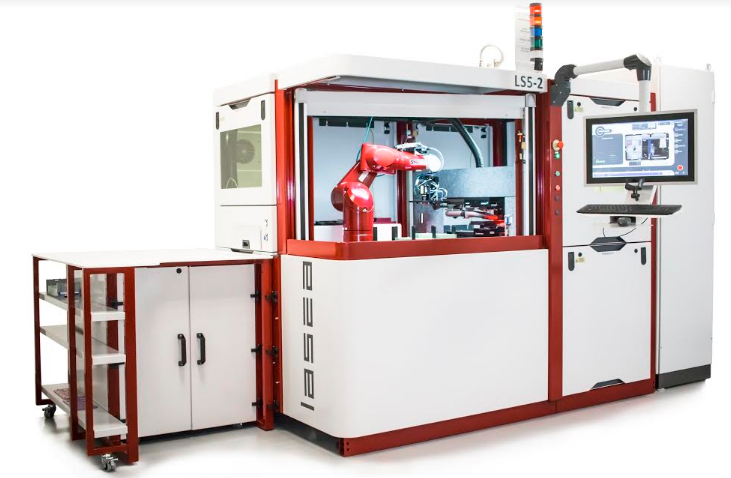
Additive manufacturing offers many benefits over traditional practices, and for this project, unique powder handling due to Aerosint’s powder recoater allows for greater flexibility in materials, localized deposition, and the option to print parts made from multiple metals.
It is expected that the new systems developed during this project will be made available commercially later.
“LASEA is a company we look up to in the Liège area. They have been extremely successful in the last couple of years showing double-digit growth year after year. Working on such an innovative process with LASEA is in line with our strategy to demonstrate how selective powder deposition can unlock a range of unique use cases in AM and beyond,” said Matthias Hick, co-founder and CTO. “We look forward to supporting LASEA in this project which we are convinced will yield very interesting results.”
Metal 3D printing continues to expand within the 3D printing world—and mainly among industrial users, from developments in engine technology to 3D printing with metal in space, and even super alloys for extreme environments.
What do you think of this news? Let us know your thoughts! Join the discussion of this and other 3D printing topics at 3DPrintBoard.com.
[Source / Images: Aerosint]Subscribe to Our Email Newsletter
Stay up-to-date on all the latest news from the 3D printing industry and receive information and offers from third party vendors.
Print Services
Upload your 3D Models and get them printed quickly and efficiently.











You May Also Like
Goldilocks’ Flywheel: Refractory Complex Concentrated Alloys (RCCAs) & The Race for the Future
Recently, Metalysis, Skyrora, and Thermo-Calc Solutions started to try to commercialize Tanbium. This alloy has been created for use in combustion chambers and rocket nozzles. Tanbium is a Refractory Complex...
QuesTek’s Space Bet: New Alloys Built for 3D Printing, Not for the Old Rules
If you ask most people what’s holding back 3D printing in aerospace, they usually think the answer is better hardware; mainly faster machines, bigger build chambers, and tighter process control....
Japanese Aerospace Leader Invests in 3DEO and Its Metal 3D Printing Tech
Los Angeles-based metal 3D printing startup 3DEO has announced a key investment from IHI Aerospace Co., Ltd. (IA), a subsidiary of Japanese manufacturing leader IHI. This collaboration marks a significant...
3D Printed Electrodes Could Make Lithium Batteries Cheaper
Now that additive manufacturing (AM) is being applied to an increasing number of energy applications, the technology has truly begun demonstrating the potential for revolutionizing the efficiency of power generation....