WASP to Create 3D Printed Habitat in Bologna

The WASP 3D printer is becoming synonymous with community living, as the TECLA concept arrives on the heels of years of work on the Shamballa village in Italy. Known as pioneering specialists in 3D printing for Italy, WASP and Mario Cucinella Architects (MC A), collaborated on the 3D printed habitat being installed in Bologna.
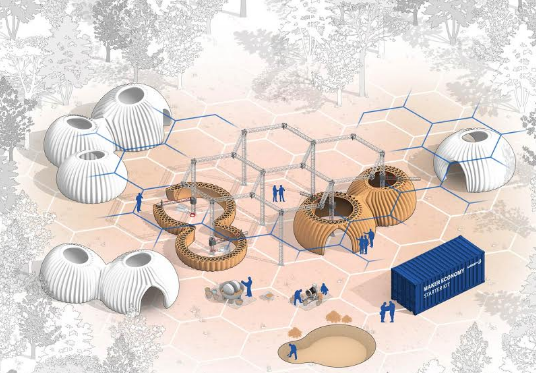
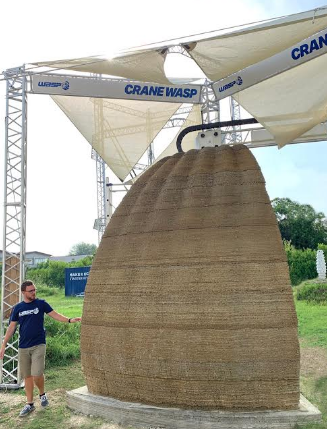
Inspired by issues with overpopulation, the circular housing model to be 3D printed with the Crane WASP is meant to offer affordable housing to everyone. Created with completely recyclable materials used from local terrain, TECLA (modeled after offers another foot forward in eco-housing around the globe.
“WASP takes inspiration from the potter wasp. We build 3D printed houses using earth found on the spot, under a sustainable perspective. The oldest material and a state of the art technology merge to give new hope to the world, our first 3D printed house made with raw earth, was born a year ago. Today with our partners we are printing TECLA an entire eco-sustainable habitat. The planet is asking for a joint project that we share with Mario Cucinella,” says Massimo Moretti – Gaia.
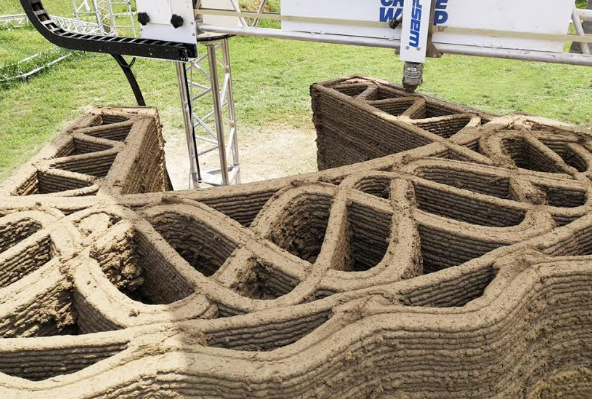
TECLA should make history as the first area of homes developed with numerous 3D printers working together, using locally sourced clay that is both biodegradable and recyclable ‘km 0 natural,’ meant to ultimately create a zero-waste building. Meant to adapt to more than just one environment, TECLA will be customized via choices for environment and self-production.
“TECLA was developed using in-depth research undertaken by the School of Sustainability – a professional school founded by Mario Cucinella that combines education, research and practice. The research, conducted with the support of MA students from the Sustainable Environmental Design program at the Architectural Association School of Architecture in London, explored the cause and effects of homelessness. It interrogated the use of technological advances to enable a solution, based on case studies in locations with different climates. The result is a highly flexible envelope, designed to be resilient to any climate and energy-efficient in a way that traditional housing models are not,” said the WASP team.
Their collaboration with MC A has been supported, which is good, meaning they can study materials and main components, much of which is so optimized it must come from the raw earth. RiceHouse created structural tests, and the research teams often needed help to customer parts. TECLA, or an imaginary city represents the city’s agreement regarding the need for environmental respect.
“TECLA received planning approval in May 2019, commenced printing in September 2019, and is due to complete by the beginning of 2020. Starting with the first prototype at WASP headquarters in Massa Lombarda, the project’s aim is to work towards communities of smart houses around the world,” said the research group.
Collaborations were expected, especially in regards to hot 3D printing.
“The collaboration between WASP and MC A has been supported by Mapei, a worldwide producer of construction materials, which has studied the clay materials and identified the key components within the raw earth mixture to create the final highly optimized printable product,” stated the researchers. “Structural tests were carried out by Milan Ingegneria, a Milan-based engineering consultancy, which worked on the optimisation of the shape in order to create a self-supporting structure. Frames created by Capoferri and Frassinago.”
3D printing in construction is huge, and it is easy to see why new homeowners are so interested as they can create autonomous robots, construct biomaterials, and more.
What do you think of this news? Let us know your thoughts! Join the discussion of this and other 3D printing topics at 3DPrintBoard.com.
[Source / Images: WASP 3D)
Subscribe to Our Email Newsletter
Stay up-to-date on all the latest news from the 3D printing industry and receive information and offers from third party vendors.
Print Services
Upload your 3D Models and get them printed quickly and efficiently.













You May Also Like
The Manufacturing Race Behind the Drone Revolution
We are in the middle of a major manufacturing shift focused on the production speed and payload capacity of uncrewed aerial systems (UAS), or drones. A recent Manufacturing Dive article...
ADDMAN to Buy Up to $10.8M in Nickel 718 Powder from 6K Additive Over 30 Months
After years of buildup, we’re finally starting to see what the US metal additive manufacturing (AM) market could look like at scale. To be sure, it’s still not quite there,...
Metal AM in a Multipolar World, Part 2: How PBF and DED Could Change by 2035
The first decades of PBF development were heavily shaped by machine capability: more power, more lasers, larger build volumes, better recoating, and improved process monitoring. These developments will continue, but...
Advanced Manufacturing at IMTS 2026: 3D Printing and AI and Drones, Oh My!
Last week’s International Manufacturing Technology Snow (IMTS) in Chicago welcomed over 90,000 attendees to the jungle that is McCormick Place. With over 1.17 million square feet of exhibit space, and...