nAngioDerm: European Grant for 3D Printed Skin and Wound Care


nAngioDerm will develop nanostructured ion-release platforms
“Microlight3D is very proud to be a partner in nAngioDerm, its first European research consortium,” said Denis Barbier, CEO of Microlight3D. “Collaborating with such high-level academic organizations on such a key health issue is further recognition of the value of our 3D microprinting technology for regenerative medicine applications. This project is a great opportunity to help further develop our micro-scale 3D printing systems for use in future health applications.”
 Microlight3D was founded in 2016 on the basis of 15-year 3D printing research by Patrice Baldeck and Michel Bouriau at the Université Grenoble Alpes. The process would be the first-ever non-additive two-photon polymerization direct laser writing technology, allowing a laser to move freely in three dimensions, performing uninterrupted printing inside a polymer resist. The company later went on to introduce a new 3D printing system for high-resolution, microscale parts, the Altraspin.
The Institute for Bioenginnering of Catalonia (IBEC) will be responsible for bringing its research capacity in bio-active ions and bioengineering to the nAngioDerm project and coordinating the contributions of the other partners starting this month, and working on the project which will run for the next three years.
Elisabeth Engel, associate professor and principal investigator of the group of Biomaterials for Regenerative Therapies at IBEC, will lead the nAngioDerm project, along with partners Barbier, Joan Perre Barret, head of the Department of Plastic and Burned Surgery at HUVH in Barcelona, and Olivier Stéphane from the Universitè Grenoble Alpes.
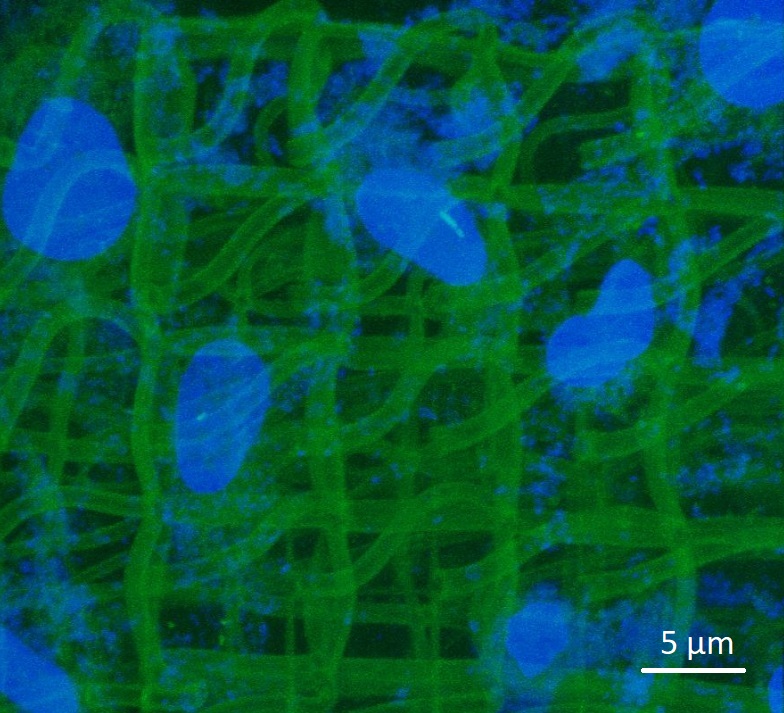
3d printed collagen structure for cell culture Confocal Fluorescence Microscopy
The nAngioDerm initiative falls within the scope of EuroNanoMed3 (2016-2021), which supports multidisciplinary and translational research and innovation projects covering regenerative medicine, diagnostics, and targeted delivery systems, under the European Horizon 2020 program, which is the biggest EU Research and Innovation programme to date with nearly €80 billion of funding available over a seven-year period ending in 2020. Working to promote European innovative research and technological development projects in nanomedicine, EuroNanoMed3 is funding 12 successful consortia with a total €9 million for three years, and a total of 57 research groups from 13 participating countries.
The comprehensive nAngioDerm project will equip researchers with a transferable and multidisciplinary skill set to enable them to adapt quickly to the challenging needs of the Medtech sector and to afford them rapid ascent to key leadership positions in the field. In the long-term, the technologies developed will be implemented in other clinical areas, resulting in increased European-based knowledge, innovation, competitiveness and leadership in the field.
Subscribe to Our Email Newsletter
Stay up-to-date on all the latest news from the 3D printing industry and receive information and offers from third party vendors.
Print Services
Upload your 3D Models and get them printed quickly and efficiently.













You May Also Like
Bambu Lab Moves Beyond 3D Printing with R1 Laser Cutter
Bambu Lab has gone from one X1 printer, which did very well, to entry-level A1 systems, mid-market P2S systems, and larger H3Ds and more. They’ve also made systems that couple...
Stratasys Wins $27.6M in Patent Case Against Bambu Lab; Bambu Challenges Verdict
Update, September 21, 2026: This article has been updated with a statement from Bambu Lab responding to the verdict, along with additional information about the company’s ongoing patent challenges against...
Ski Lift Foundations Made With 3D Printing in Hemavan, Sweden
While most of the 3D printed construction hype has been around houses, we’re more bullish on infrastructure. By 3D printing in hard-to-reach areas, remote structures can bring infrastructure to new...
3D Printing News Briefs, September 12, 2026: Rebranding, Cybersecurity, Project Call, & More
We’ve got a lot of business news from ATLIX to start off this weekend’s 3D Printing News Briefs, with a new identify for its additive manufacturing (AM) portfolio and some...