
ORNL Origami Creates Large Foldable Structures

Oak Ridge National Laboratory (ORNL) is using a hybrid 3D printing method to make foldable panels. At the Department of Energy’s (DOE) Manufacturing Demonstration Facility (MDF) at ORNL, researchers turned composite panels into foldable, durable structures.
“This pioneering method redefines advanced manufacturing by fusing material science with transformative design principles. By applying origami-inspired principles to hybrid composites, we are improving the efficiency and scalability of large-structure manufacturing and achieving forms unattainable with traditional additive approaches — advancing robust, cost-effective solutions for a broad range of applications.”
According to ORNL, the process starts with fabric,
“Such as nylon, glass fiber or resin-infused composite fibers, followed by an integration or bonding layer such as thermoplastic polyurethane for compatibility and adhesion. The reinforcing layer is then applied using deposited composite materials, including thermoplastic carbon-fiber acrylonitrile butadiene styrene for lightweight structural performance or thermoset formulations such as styrene-based or epoxy-based resins for enhanced stiffness, geometry control and durability….The materials bond at the molecular level, forming a strong connection between the grid and the outer layer.”
I once tried to print TPU onto a T-shirt, but this did not work. But I did not know that I was so close to greatness. ORNL thinks this can produce large objects and could reduce manufacturing time by 95% and costs by 90% compared to traditional manufacturing methods. Oak Ridge has patented the process and wants to license out this innovation.
Guzorek goes on to say that,
“Our goal is to make this innovation scalable so manufacturers across industries can harness its potential. By broadening access to mold-free hybrid composites, we’re empowering manufacturers to explore new design possibilities and unlock entirely new applications for this transformative technology.”
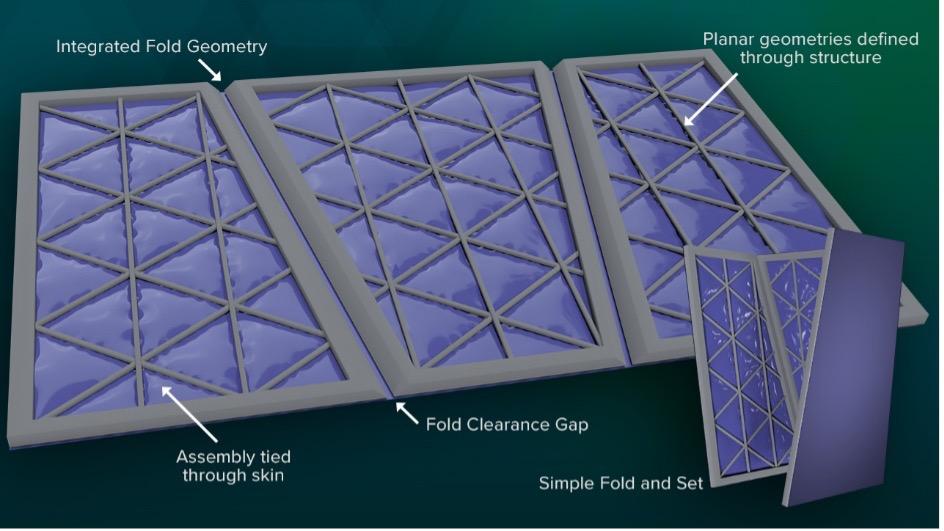
Integrated fold geometries and structural reinforcement patterns enable this origami-inspired composite to transition from a flat panel into a three-dimensional form. Image courtesy of Andrew Sproles/ORNL, U.S. Dept. of Energy
As much as I’d like to think that ORNL is making 3D printable homeless shelters, it’s probably something else that’s going to be the output here. One obvious application is to make flexible insulation structures for rockets and aviation applications. Previous Space Shuttle heat blankets, enhanced with ceramics (Fibrous Insulated blankets), were used in fire protection and aviation. These blankets protected the Shuttle from heat and replaced the tiles that malfunctioned, causing the Columbia disaster. On some hypersonics, a flexible, reusable surface insulation layer made of Nomex is used along with lightweight phenolic ablation materials to protect the craft from intense heat. TPS (thermal protection systems) are to be a key part of future extended space missions. Research into nanodoped ceramic-polymer composites and advanced resins is also expanding rapidly. Current work in Multi-Layer Insulation (MLI) could really benefit from this.
Foldable drones may seem fanciful, but this is another possibility. There’s an SBIR out for Juggerbot, which makes structures using material extrusion and then enhances them by jetting thermosets onto them. This is a super exciting way to make extremely lightweight structures. No more rivets, no more internal structures and skin, just one strong skin. Another possibility is to make IR-blocking structures. Kastinger, for example, makes HT4 a fabric that blocks IR cameras from seeing you or your vehicle. With drones all over the place, having large structures being made quickly to keep you from being seen seems like a great idea.
Now imagine printing a large structure flat. We love flat structures because they’re fast and cheap to make. And then, with little print time, you fold it into a drone body or a wing shape. That would be super nice. That would allow you to make super-cheap structures super quickly. With our drone event upcoming, I’m thinking quite a lot about drones, so maybe you could do other things with this.
Temporary structures are a considerable business and could be another target for this. Such structures could also find applications in offshore energy, wind power, and other large-scale infrastructure projects. I don’t know if we should 3D print room dividers or something like this, but this is one way to do it. Apart from this invention, more people should be thinking along these lines. With similar methods, you could make very large structures at very low cost. Years ago, Nervous System showed that by printing on pre-stretched fabric, you can effectively program a shape to emerge when the fabric’s tension is released. Coupling this with the ORNL approach could let you print a table faster, and then it can self-assemble. Combining this approach with DefeXtiles, you could even add a woven layer using under-extrusion to reinforce your print.
Subscribe to Our Email Newsletter
Stay up-to-date on all the latest news from the 3D printing industry and receive information and offers from third party vendors.
Print Services
Upload your 3D Models and get them printed quickly and efficiently.













You May Also Like
Kickstarter is Testing the Next Wave of Desktop 3D Printing
3D printers are raising serious money again…on Kickstarter, that is. Over the last few months, a new group of 3D printer campaigns has attracted millions of dollars and thousands of...
Stratasys vs. Bambu Lab: What’s Really Behind the $27.6M Patent Verdict?
Editor’s note: This is Part 1 of a two-part series by Xu Fanglei examining the technology and patent issues behind the Stratasys-Bambu Lab dispute. Part 1 looks at the U.S....
Bambu Lab and SUSAN FANG 3D Print for London Fashion Week
At London Fashion Week, some of the more unusual pieces on the runway came from 3D printers. Chinese fashion designer SUSAN FANG presented her Spring/Summer 2027 Air-Illusion collection at the...
Stratasys Wins $27.6M in Patent Case Against Bambu Lab; Bambu Challenges Verdict
Update, September 21, 2026: This article has been updated with a statement from Bambu Lab responding to the verdict, along with additional information about the company’s ongoing patent challenges against...























































