Maskless Microfabrication: Nanoscribe Releases Quantum X

Germany-headquartered Nanoscribe has just announced the formal release of their Quantum X device, presenting the new technology at the LASER World of Photonics in Munich (running from June 24-27). Continuing in their mission to target industrial users engaged in microfabrication endeavors, this launch expands on their additive manufacturing systems for nano- and microscale projects.
 The Nanoscribe development team created Quantum X specifically for highly-precise micro-optics, offering a powerful combination with grayscale lithography and two-photon polymerization technology.
“Quantum X provides a more flexible, straightforward and cost-effective maskless lithography solution for various use cases,” reports Nanoscribe in their latest press release sent to 3DPrint.com. “Within its compact housing, prototypes of refractive and diffractive microoptics, as well as, polymer masters are produced. The system features an industrial form factor with intuitive and ready-to-use interfaces for process control.”
Nanoscribe created this new technology in response to the high demand for manufacturing in applications like:
- Sensors
- Mobile devices
- Data
- Telecommunications
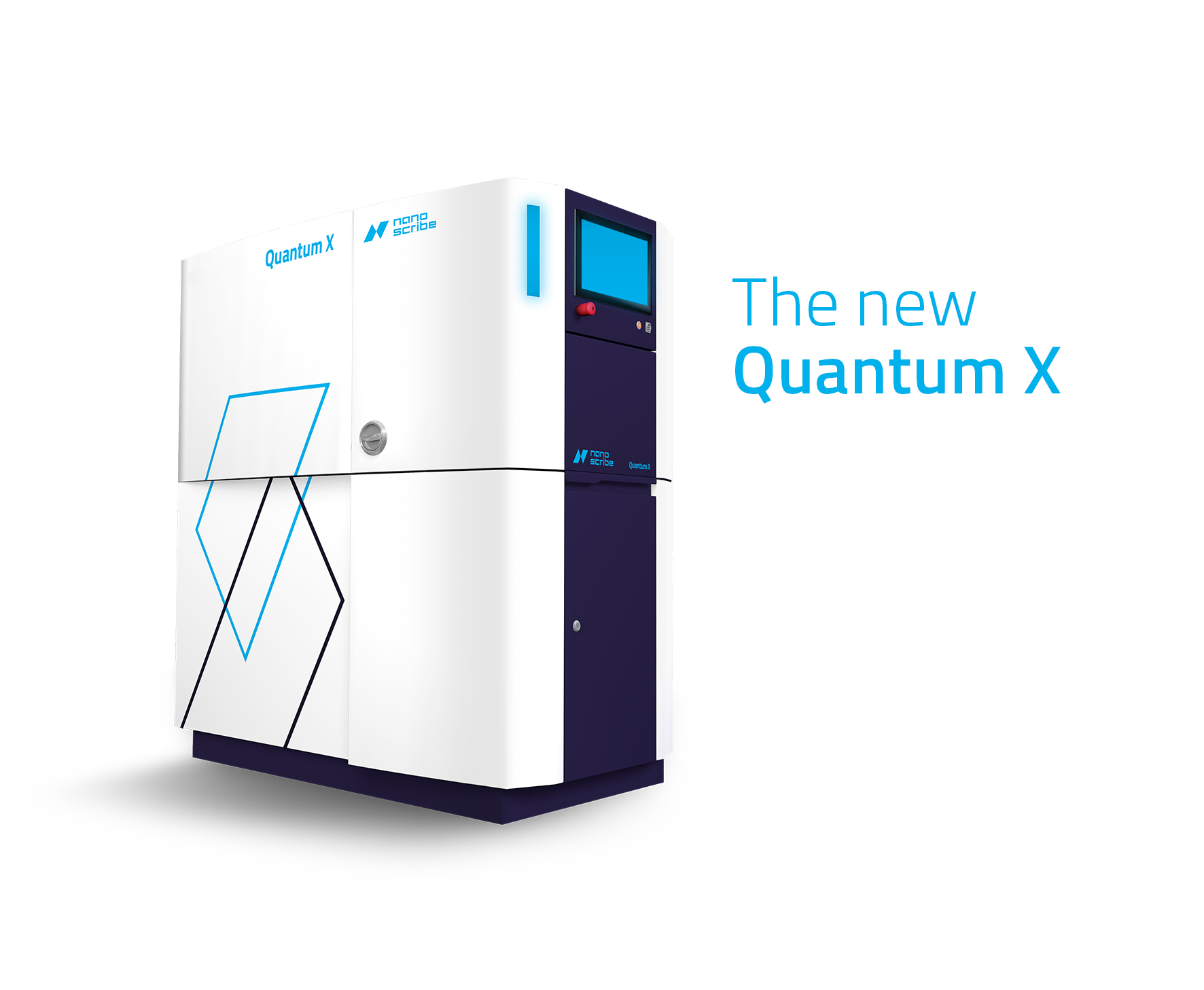
Quantum X is Nanoscribe’s new maskless lithography system for the fabrication of refractive and diffractive micro-optics with the highest precision.
Microfabrication work can be completed quickly and accurately, relying on three cameras for live monitoring and process control. Users can look forward to benefits like faster development, shorter design iteration cycles, greater affordability, rapid production, and a more expedient printing process overall. Nearly any 2.5D shape can be created on the microscale, a feat Nanoscribe states was previously impossible, now ‘paving the way to new or strongly enhanced optical elements from imaging, illumination, to sensing.’
Multilevel diffractive optical elements (DOE) are produced in one scanning plane, as laser power is modulated—resulting in excellent contouring capabilities for more efficient fabrication of:
- Single optical elements
- Spherical and aspherical lenses
- Arrays with high fill factors up to 100 percent
“Quantum X developers have put great effort to excel in advanced user-machine interactions,” states the Nanoscribe team.
A touchscreen is built-in for monitoring jobs, adjusting parameters, and seeing the print in real time—along with a software wizard that guides users through the entire cycle of a print job. The software will accept images of optical designs up to 32-bit resolution like BMP, PNG, or TIFF. A wide range of feature heights are possible in each scan field, and quasi-continuous topographies can be manufactured in one step. The AM approach allows users to expand beyond traditional limitations in height, throughput, and resolution.
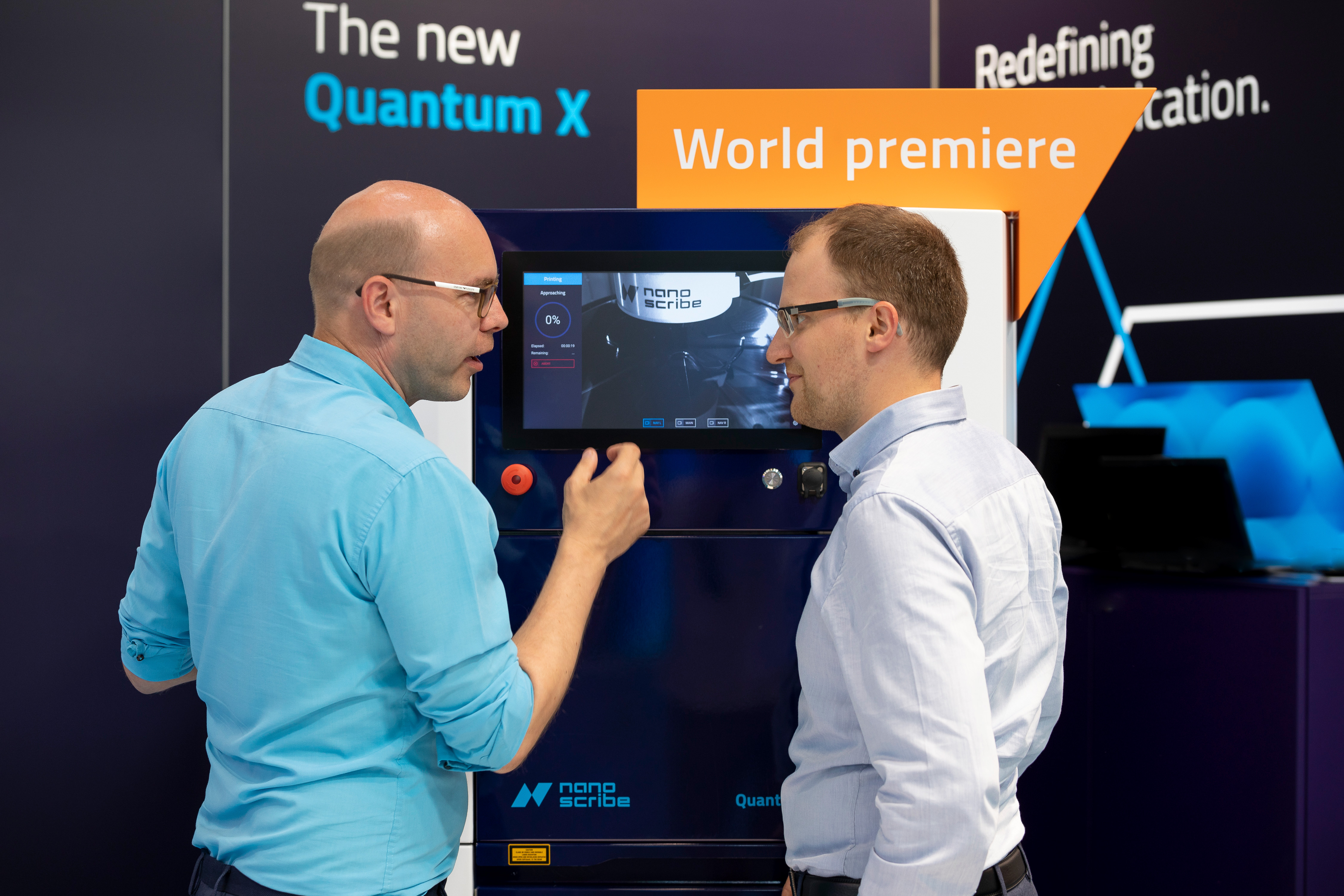
Quantum X intuitive touchscreen panel offers process control, job status and print job queue. (Photo: Chris Frühe)
“The fabrication process with Quantum X allows a wide range of substrates, including transparent and opaque ones, accepting sizes of up to six-inch wafers. Working with this new device avoids costly mask fabrication, spin-coating, and pre- or post-baking when used with Nanoscribe photoresins. These resin materials are easy to handle, allow high aspect ratios and enable high structures, approaching the limits of the physically possible,” states Nanoscribe.
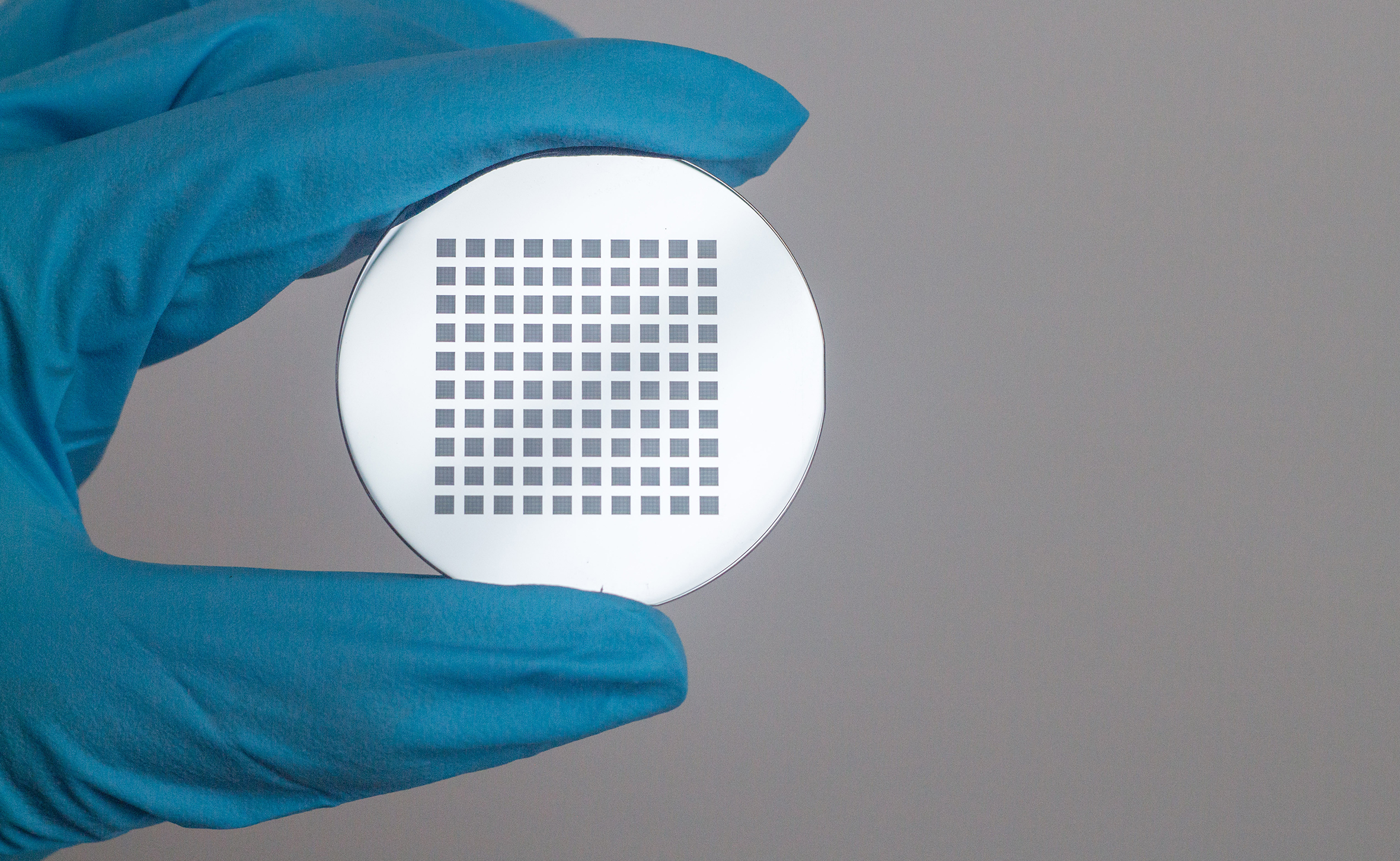
Micro-optics directly printed on a two-inch wafer without the need for additional lithography steps or mask fabrication.

Micro-optics directly printed on a two-inch wafer without the need for additional lithography steps or mask fabrication.
Nanoscribe has been a dynamic presence in the world of printing and microfabrication for years, growing with one innovation after another—from extensive collaborations to a variety of different technologies and processes. What do you think of this news? Let us know your thoughts! Join the discussion of this and other 3D printing topics at 3DPrintBoard.com.
Subscribe to Our Email Newsletter
Stay up-to-date on all the latest news from the 3D printing industry and receive information and offers from third party vendors.
Print Services
Upload your 3D Models and get them printed quickly and efficiently.











You May Also Like
New 3D Printing Approach Enables More Complex Electrical Routing for 3D Integration of Microelectronic Subsystems
Demand for higher resolution and high-precision parts is driving the evolution of additive manufacturing. The latest 3D printer design from Boston Micro Fabrication (BMF) uses a new approach called Projection...
Air Force and HRL Laboratories Study 3D Printed Ceramics for Hypersonic Flight
The Air Force has been researching additive manufacturing for military purposes for quite some time, with resources for both plastic and metal 3D printing. Now the Air Force is looking...
HRL Laboratories Figures Out How to 3D Print Unprintable Metals
Developing a new material for 3D printing isn’t easy – especially metal materials. Creating a new metal powder for 3D printing is a complex and delicate process that requires a...
3D Printing News Briefs: August 22, 2017
We’re talking about everything from business and 3D printing materials to outer space in today’s 3D Printing News Briefs. Using a new digital platform, thyssenkrupp has connected all of the machines...