With ARPA-E Backing, HRL Laboratories Advances 3D Printed Cooling for More Efficient Data Centers

In the report “AM for Data Centers: a 3D Printing Market Opportunity” that I wrote last year for Additive Manufacturing Research (AMR), I referenced Theodore Maiman, the man credited with inventing the first working laser, while he was employed by Hughes Aircraft Company. Maiman famously said that lasers were “a solution in search of a problem,” and I used that as an analogy for how the complex geometries enabled by AM are a solution in search of a problem that is thermal management.
I didn’t realize that some version of Hughes Aircraft Company (as in Howard Hughes) is still around: it is now HRL Laboratories, a Malibu-based R&D venture that is, fascinatingly, jointly owned by Boeing and General Motors. I bring up this anecdote not solely to plug the data center report, but, more importantly, because HRL Laboratories has just announced a 3D printed, direct liquid cooling (DLC) solution that the company developed in part thanks to funding from the US Department of Energy’s (DOE’s) ARPA-E program.
In 2022, ARPA-E launched COOLERCHIPS, a project call with the aim of drastically lowering cooling costs for data centers, which costs currently account for 40 percent — sometimes more — of a data center’s energy expenditure. According to HRL Laboratories, the Low-Chill solution uses a 3D printed manifold “to distribute coolant through hundreds of short flow paths”, without a need for vaporizing and recondensing the coolant: this makes it a ‘single-phase’ cooling system, in contrast to more expensive two-phase cooling systems.
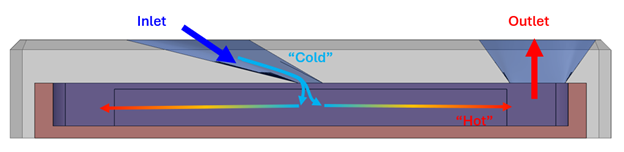
Current cooling technology relies on long intra-channel flow paths along hot fins.
HRL Laboratories claims that the Low-Chill cooling technology increases cooling capacity by 40 percent under equivalent pumping power compared to existing solutions, and notes that the design is scalable to achieve the same performance for multi-chip modules. The company also states that Low-Chill is built to handle the more intense cooling requirements of the next generation of chips from NVIDIA.
In a press release about HRL Laboratories’ launch of the Low-Chill cooling solution for data centers, Christopher Roper, HRL’s principal investigator and the technical lead for the company’s COOLERCHIPS project, said, “We designed this technology with real data center constraints in mind. By rethinking how coolant is delivered at the block level, we can cool far more powerful processors using single-phase liquid cooling that fits within today’s data center architectures and operational risk profiles.”
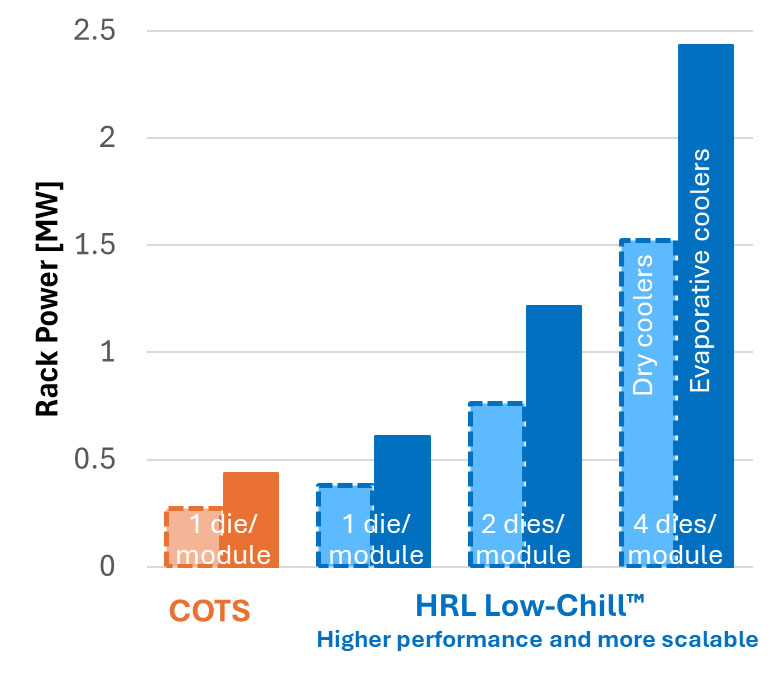
Low-Chill direct liquid cooling.
Nothing like a major military conflict snarling global energy supply chains to remind everyone that all critical infrastructure is, ultimately, national security infrastructure. It looks like I will continue linking to this post from late January 2026 and this one from the end of 2022, over and over again, for the foreseeable future.
In a world where physical security operations follow the lead of cybersecurity operations as opposed to the other way around, data centers are thus arguably the quintessential national security chokepoints of our day. Couple this with the fact that data centers and military tensions are now in a race to see which can drive up energy bills more quickly, and it becomes clear why making data centers more energy efficient is kind of where all the global economy’s most daunting challenges converge.
So, while defense tech startup CEOs may triumphantly boast to everyone that they told them so about how the US will disintegrate without more hypersonics, the US may actually disintegrate without more clean energy solutions. The exchange of missiles won’t last forever, but the effects on fossil fuel prices will endure much longer.
In no way is this meant to suggest that higher prices compare on any level to the loss of human life. Rather, the point is that if global powers can become less dependent on energy sources imported from overseas, then, in the long run, we may see fewer pointless conflicts driven by myopic competition over resources.
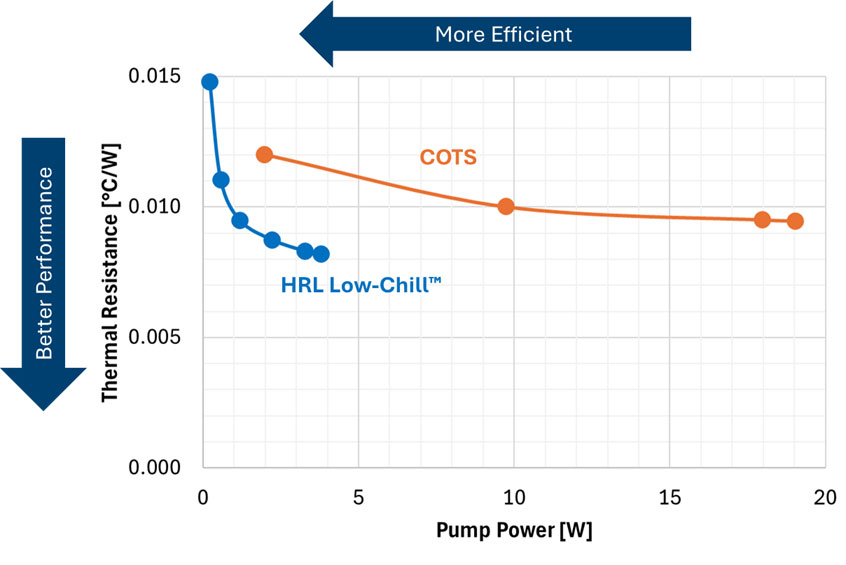
Performance data: Low-Chill pump power.
Images courtesy of HRL Laboratories
Subscribe to Our Email Newsletter
Stay up-to-date on all the latest news from the 3D printing industry and receive information and offers from third party vendors.
Print Services
Upload your 3D Models and get them printed quickly and efficiently.












You May Also Like
Push Button Metal: Market Overview 2026
Pioneered by Xact Metal, low-cost metal printing could break open the LPBF market and make it much bigger than it is now. OneClickMetal showed us how canisters and ease of...
Push Button Metal: SnowX
In addition to MetalBase and ScrapLabs, we now have a new competitor in the low-cost LPBF space. Chinese firm SnowX aims to release its SnowPod through Kickstarter. The 80 ×...
Push Button Metal: FastForm Sells 1,000 LPBF Machines
We’ve been fascinated by the idea of Push Button Metal for a few years. Rather than a $1 million machine that needs lots of stations and preparation, affordable, easy-to-use metal...
The Business Case for Binder Jet in an Uncertain World: Jedi Mind Tricks, Part I
You’ve probably noticed that the binder jet market has been rather rocky as of late. Voxeljet was delisted, was not sold, and is now restructuring. Nano Dimension subsidiary Desktop Metal...