Rapid 2019: FluidForm 3D Prints Silicones, Urethanes, Epoxies & Liquid metals

 As hundreds of exhibitors take over the Cobo Center in Detroit for the RAPID+TCT show from May 20-23, visitors are able to see a wide range of different 3D printing hardware, software, and materials, along with countless examples of impressively fabricated prototypes and products.
FluidForm is in attendance at the Medical Manufacturing Innovation Collaboration Center (Hall B), offering a comprehensive exhibit with live demonstrations and videos also that inform the crowds of their abilities within the 3D printing industry.
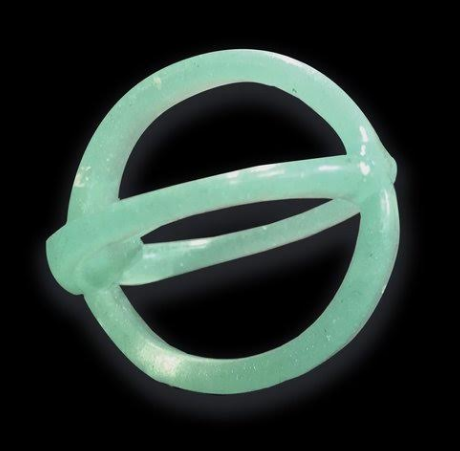
3D printing without supports.
FluidForm will also be displaying a 3D printed brain model, something that is certain to garner plenty of attention at the massive show. This medical model is meant to educate eventgoers on the latest medical applications being impacted by 3D printing technology, with the FRESH human brain created via MRIs, and ‘demonstrates the ability to guide personalized manufacturing of tissue scaffolds for future applications in repair and regeneration.’
FluidForm realizes that most 3D printing has been relegated to materials like metals, ceramics, and plastics, while softer materials like silicone have been ignored due to their inability to solidify or flow suitably. The FluidForm team points out that that soft materials ‘are more challenging and cannot be effectively 3D printed.’
In typical fashion of 3D printing users, however, as soon as one points out major challenges with a facet of the technology, it immediately becomes a challenge; for example, this led FluidForm to use their patented Freeform Reversible Embedding of Suspended Hydrogels (FRESH™), printing within a support gel ‘rather than in the air.’ According to FluidForm, this new system leads to access of many new types of materials for 3D printing, along with design strategies and new applications.
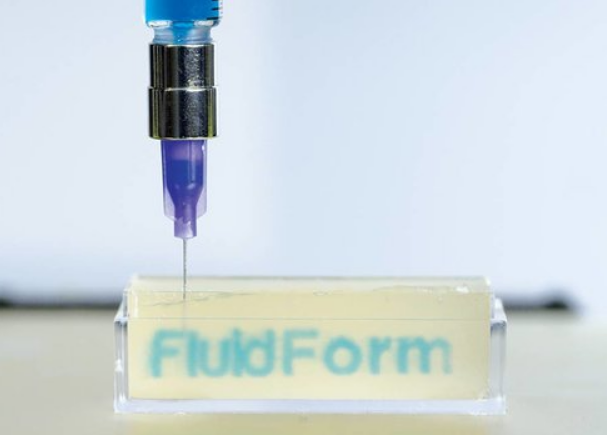
3D printed materials created by FluidForm not only for ‘unlimited geometries’ to be created, they also support numerous materials embedded into one single print.
“FluidForm’s FRESH multi-material technology enables printing of silicones, urethanes, epoxies, liquid metals, biologic materials and much more, serving as the manufacturing platform to revolutionize diverse fields, from aerospace to wearable sensors to regenerative medicine,” states the company in their latest press release.
3D printing in the medical realm around the world is vast today, mainly after heavily infiltrating the mainstream in the past few years and catching the attention of so many researchers and medical professionals, whether in the university, lab, clinical, or hospital setting. Nearly every facet of medicine is being affected today, whether in the development of diagnostic devices for developing countries, offering for much better self-sustainability in health care, or robotic prosthetics for children in need, or a growing world library of 3D printed models and devices. Find out more FluidForm and their hardware and other products here, or email info@fluidform3D.com for more information.
What do you think of this news? Let us know your thoughts! Join the discussion of this and other 3D printing topics at 3DPrintBoard.com.
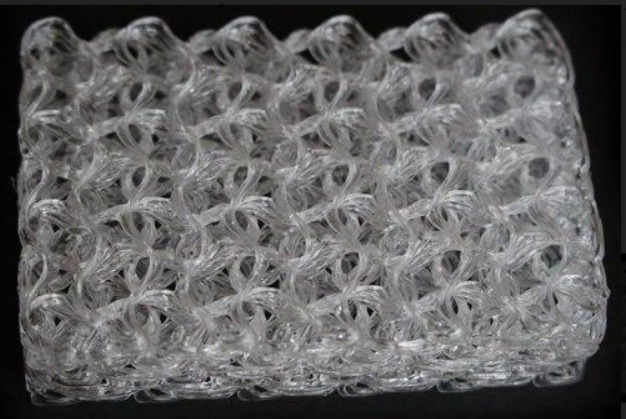
FRESH printing.
Subscribe to Our Email Newsletter
Stay up-to-date on all the latest news from the 3D printing industry and receive information and offers from third party vendors.
Print Services
Upload your 3D Models and get them printed quickly and efficiently.













You May Also Like
3DPOD 316: Beehive’s Gordie Follin on 3D Printed Engines and More
Gordie Folin had deep experience in engineering at Pratt & Whitney, GE, and GE Aviation before becoming the Chief Product Officer at Beehive Industries. Among his achievements, he served as the...
3DPOD 315: Dirk Simon, from BASF to Farsoon to FKM, and now Square New Business
Dirk Simon had already spent years in the chemicals industry before joining and pioneering BASF‘s 3D printing effort. We get to hear how that firm looked at 3D printing and...
Printing Money Episode 42: Q2 2026 Public Markets 3D Printing Earnings Analysis with Troy Jensen, Cantor
Welcome to Printing Money Episode 42. Troy Jensen (Managing Director, Cantor) returns, joining Danny Piper (Managing Partner, NewCap) to review Q2 2026 publicly traded 3DP/AM company earnings reports. Troy’s quarterly...
3DPOD 314: Debinding, Sintering, and Metal Binder Jetting with Stefan Joens, Elnik Systems and DSH Technologies
Stefan Joens of Elnik Systems sells ovens. Their debind and sintering equipment powers a lot of high-volume binder jet and MIM production. We learn about Elnik and its origins. But...