Project Miliquant: Nanoscribe Participates in Collaboration Using 3D Printing in Quantum Technology Research

 Nanoscribe has been impressing us at the micro- and nano-level for years now in 3D printing, from their work with plasmonics to micro-optics and many other projects related to industrial microfabrication. Now, the German manufacturer is developing miniaturized, frequency- and power-stable diode lasers with other industry leaders, to include:
The group has come together for the three-year Miliquant project, funded by Germany’s Federal Ministry of Education and Research (abbreviated as BMBF for the German Bundesministerium für Bildung und Forschung). This is meant to be a technological and innovative forum where the 3D printed components for light sources that the companies involved create will be used in quantum technology innovation, suitable for applications like medical diagnostics, autonomous driving, and imaging procedures like infrared microscopy of cells.

Model of a microlens directly printed onto the facet of a laser chip. (Image: Nanoscribe)
Their goal is to work on multiple experiments in the lab for developing sensors and imaging systems primarily for industrial use. Complex research and development efforts will be required to develop robust components—along with new approaches for assembly and manufacturing—leading to the assembly of such a dynamic group that will work together with a common goal.
“With our 3D printers, high-precision micro-optical components can be produced in shortest time with submicrometer resolution and enormous design freedom,” said Dr. Michael Thiel, Chief Science Officer at Nanoscribe. “We are happy to contribute our profound know-how to the MiLiQuant project for the further development of packaging technologies.”
Using two-photon polymerization (2PP), the Nanoscribe team can 3D print parts and prototypes with exceptionally high performance and accuracy, and complex optical designs can be fabricated directly on components like laser facets, glass fibers, and microchips.
“The printed structures achieve an optical quality with surface roughness in the range of a few nanometers,” states the Nanoscribe team in their most recent press release regarding the multi-collaboration for their latest venture. “In the MiLiQuant project, the printed components will be assembled with other elements into a compact package.”
Nanoscribe has been contributing to the world of technology since 2007, born from a team of researchers at Karlsruhe Institute of Technology (KIT) determined to transform the budding science of microfabrication. Delving into what was originally an extremely niche realm of research, they began expanding the study of two-photon polymerization (2PP)—and setting the foundation for the German-headquartered Nanoscribe into motion.
As the budding technological team saw the vast potential for 2PP-based 3D printers and other wares, they made them available to companies around the globe, along with 3D software solutions, 3D printing materials, and a range of accompanying processes to provide comprehensive solutions. Nanoscribe currently employs 60 team members, also operating a subsidiary in Shanghai with future plans or creating one in the US too. Nanoscribe 3D printers are used on the micro-, nano-, and meso-scale for design and fabrication of components used in many different scientific applications today.
What do you think of this news? Let us know your thoughts! Join the discussion of this and other 3D printing topics at 3DPrintBoard.com.
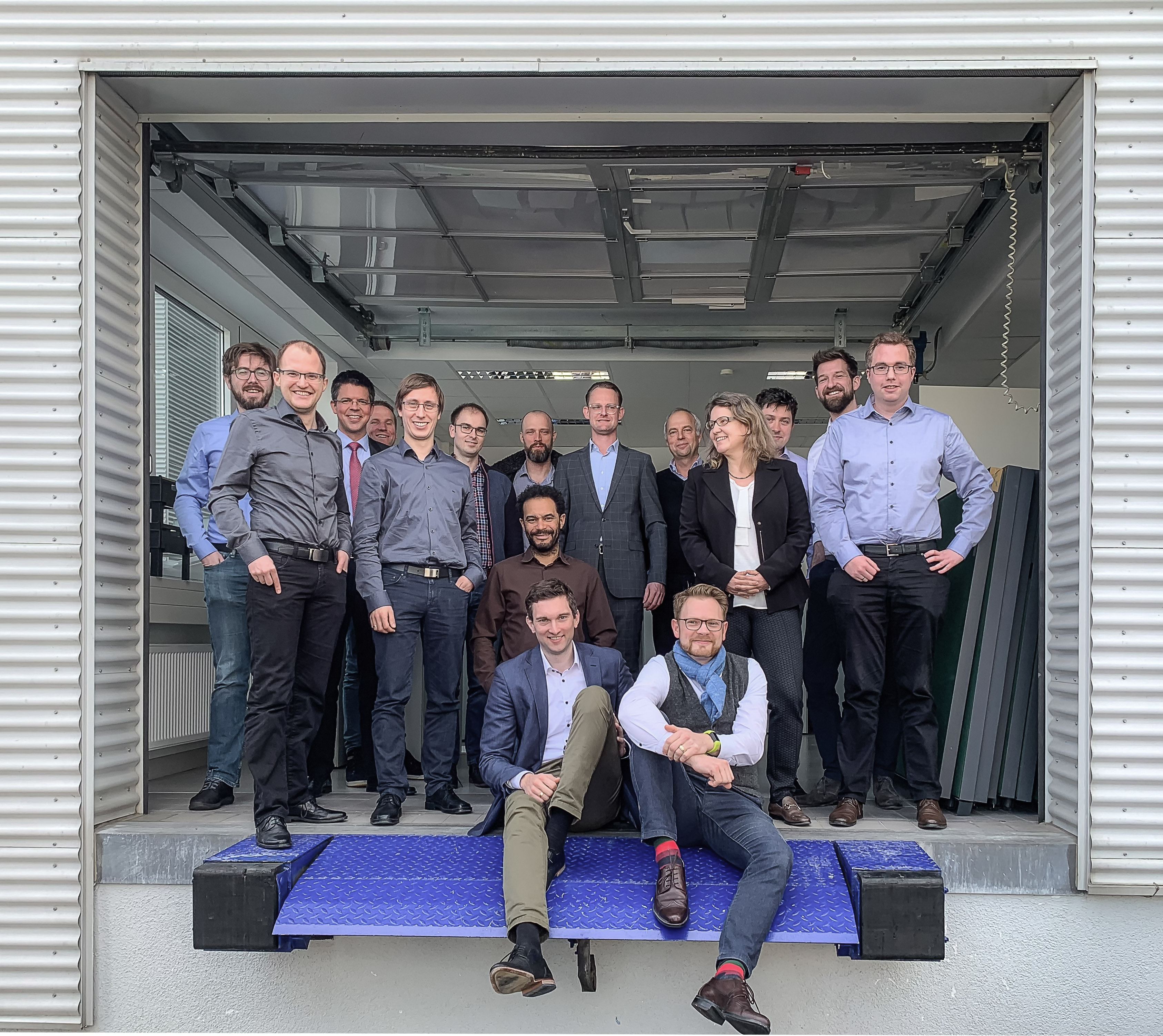
Kick-off meeting of the research project MiLiQuant (Photo credit: Q.ant)
Subscribe to Our Email Newsletter
Stay up-to-date on all the latest news from the 3D printing industry and receive information and offers from third party vendors.
Print Services
Upload your 3D Models and get them printed quickly and efficiently.











You May Also Like
“A More Complete End-to-End Solution”: Stratasys Launches Post-Processing Partnership Program
I think it’s safe to say that post-processing is no longer considered the “dirty little secret” of 3D printing that it once was, with users realizing that finishing is just...
Why SiC-Dedicated Additive Manufacturing Is Gaining Industrial Relevance
Silicon carbide is not a material problem—it’s a manufacturing one. Silicon carbide (SiC) has become a critical material across semiconductors, aerospace, energy, and defense. Its exceptional thermal stability, chemical resistance,...
Championing a Made-in-America Future for Additive Manufacturing
As the additive manufacturing industry continues its rapid global evolution, one theme has risen to the top of strategic conversations: the importance of strengthening domestic production to support national competitiveness...
Friendshoring and Additive Manufacturing: Turning Australia’s Research Strength into Commercial Impact
Global supply chains are being re-written. After decades of globalisation driven primarily by cost efficiency, geopolitical tensions, trade disputes and pandemic-era disruptions have exposed the risks of concentrating manufacturing and...