VA Takes On Shoulder Surgery Using 3D Printed Models

 The United States Department of Veterans Affairs (VA) has been one of the country’s biggest and busiest embracers of 3D printing.
Making headlines seemingly every few months for the steady expansion of their additive manufacturing programs and efforts, the VA has been busy printing artificial lungs, establishing a shared network across its many hospitals, and even training veterans themselves to master the technology.
This month, the agency is in the news again for expanding its efforts to a common problem area for many veterans: the shoulder.
Shoulder To Shoulder With The Latest In 3D Printing
Especially in the aged and well-worked, shoulders can require replacing for a number of reasons.
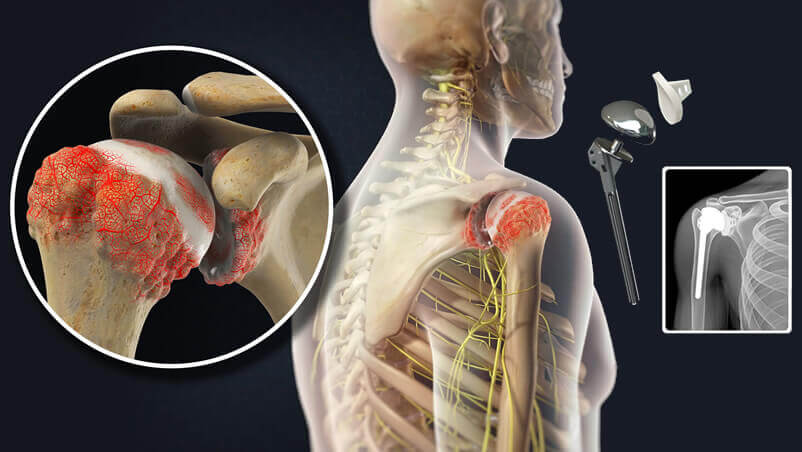
Ball and socket prosthetics used in shoulder replacement surgery [Image: Northeast Spine and Sports]
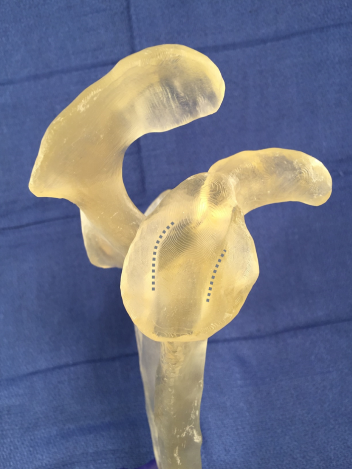
3D printed model of a patient’s shoulder blade [Image: Journal of Digital Imaging]
Despite being a common surgery, shoulder joint sockets are a notoriously difficult area to prepare for and operate on due to the involved bones’ small nature.
By utilizing 3D printing, VA orthopedic surgeons can now scan and print models of each individual patient’s affected shoulder. Looking at a printed 3D model instead of an on-screen rendering or 2D print allows surgeons to get a clearer understanding of a patient’s specific anatomy before operating. Not only does this reduce the likelihood of complications during the surgery, it ideally means more efficient operations and also higher recovery rates.
Beyond Just Shoulders
Shoulder surgery models and data, and the other medical uses the VA has been implementing are shared among a network used by 20 VA hospitals. In addition to better modeling for use in pre-surgery preparation, the robust network allows for same-day printing, fitting, and delivery to patients in need of specialized orthotics. The network is through a partnership with Stratasys, and is one of the first shared 3D printing hospital networks in the country.
“VA remains at the forefront of innovative work in 3D printing by expanding our expertise across VA,” says Agency secretary Robert Wilkie. “Through this growing virtual network, VA continues to help define how 3D printing technology will be used broadly in medicine for the benefit of patients.”
Across its 1,700 dedicated care centers, the VA sees and treats about 8.75 million veterans every year.
Sources: AllOnGeorgia | HospitalForSpecialSurgery | VeryWellHealth
Discuss this news, and other 3D printing topics, at 3DPrintBoard.com or share your thoughts in the Facebook comments below.
Subscribe to Our Email Newsletter
Stay up-to-date on all the latest news from the 3D printing industry and receive information and offers from third party vendors.
Print Services
Upload your 3D Models and get them printed quickly and efficiently.













You May Also Like
3D Printing News Briefs, August 22, 2026: Polymers for CubeSats, Animal Mobility Devices, & More
We’re starting with defense news in this weekend’s 3D Printing News Briefs, before moving on to polymers for CubeSats and 3D printed prosthetics. We’ll end with a story about engineering...
Pusan National University & ORNL Develop Elastomeric Liquid Crystal Actuators
Researchers from Korea’s Pusan National University and Oak Ridge National Laboratory (ORNL) have developed 3D printed elastomeric actuators. In a paper published in Nature, the team used elastomeric liquid crystal...
Scientists Use BMF to 3D Print Seal Whiskers That Track Prey Long After It’s Gone
Seals use their whiskers to hunt. Not Navy Seals, although they may in some way also, but this article is about lowercase seals. Not Seal the musician either; as far...
Harvard’s Jennifer Lewis Lab Is 3D Printing Artificial Muscles That Twist and Bend on Demand
Researchers at Harvard John A. Paulson School of Engineering and Applied Sciences (SEAS) have developed a new way to 3D print materials that can move on their own, bending, twisting,...