nScrypt Delivers 1 Meter Factory in a Tool to the US Army


Precision Micro-Dispensing and 3D printing manufacturer, nScrypt, based in Orlando, FL, whose bioprinter will travel to the International Space Station in 2019, has delivered a 3Dn-1000 multi-material Factory in a Tool (FiT) platform to the US Army’s Redstone Arsenal. According to nScrypt’s CEO, Ken Church,
“our line of FiTs are fully integrated systems capable of digitally fabricating anything from 2D and 3D printed circuit structures (PCS) to biological structures and can be used almost anywhere on the digital manufacturing floor. Our tools operate in series or parallel on a fast (up to 1 mps), high-precision (up to 10nm resolution, 500nm repeatability, 1 micron accuracy) linear motion gantry.”
The FiT delivered to the Army has 1 full meter of travel in the XY axis at a speed of up to 1 mps (meters per second) and can run 5 tool heads simultaneously, without tool changes. The 1 meter FiT can run nScrypt’s proprietary nFD™ tool head for Material Extrusion, SmartPump™ for Precision Micro-Dispensing, nMill™ for micro-milling, nPnP™360 for pick and place of electronic components and subassemblies, an automated PulseForge 1300 photonic curing system, and a femtosecond laser for cutting or sintering materials. The tool heads are monitored by multiple cameras for automated inspection and computer vision routines. The system also includes a point laser height sensor for Z-tracking and mapping for conformal printing onto objects of any surface shape.
According to nScrypt, the FiT’s SmartPump’s™ Micro-Dispensing tool head eliminates drooling with pico-liter volumetric control and boasts the widest range of materials available for any Micro-Dispensing system: more than 10,000 commercially available materials, ranging from a few centipoise (such as water) to millions of centipoise (much thicker than peanut butter). nScrypt claims the SmartPump’s™ pen tip has the smallest commercially available diameter, 10 microns.
nScrypt claims that the 3Dn-1000’s nFD™ extruder tool head can 3D print the widest range of thermoplastics, composites, and continuous carbon fiber. If a material is not available in a filament format, the FiT’s nFDh™ hopper option loads thermoplastic and composite injection molding pellets.
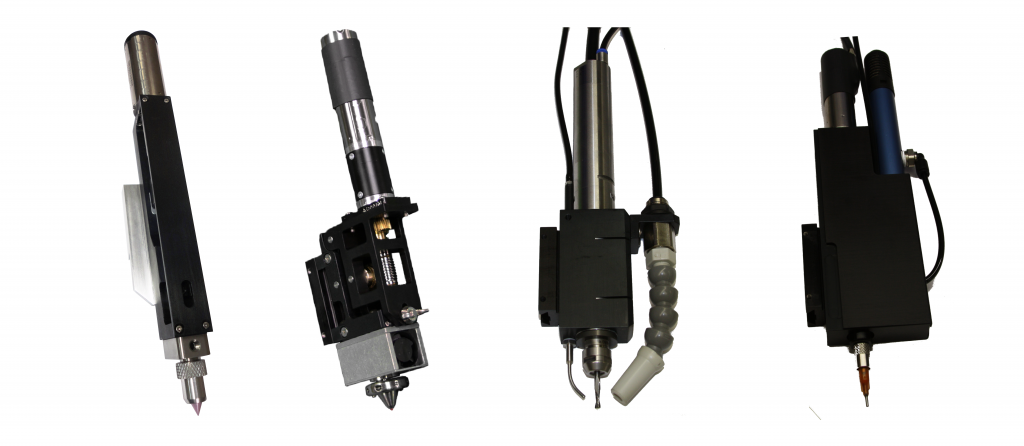
Precision microdispensing, material extrusion, micro milling and pick and place tool heads can all be run simultaneously.
nScrypt CEO Ken Church said:
“nScrypt is proud to work side by side with the Army to enable the warfighter. nScrypt has now delivered a total of 6 FiT systems to multiple Army bases and labs. This 1 meter tool continues to add fast, precision Direct Digital Manufacturing capabilities inside the DoD.”
Lance Hall from Army RDECOM AMRDEC stated:
“This system provides up to a meter of printing in X and Y directions while maintaining precision; this will touch many DoD products.”
The Army’s machine dimensions are 7’5” (2.28 m) wide by 7’4” (2.25 m) long by 6’9” (2.21 m) tall, weighing in at roughly 12,000 lbs. (6 tons or 5443 Kilos). Much of the weight comes from the base of the gantry, which is a precision ground granite block 8” (20 CM) thick and weighing 5,000 lbs. (2267 Kilos) , which provides a stable foundation for the FiT’s precision manufacturing.
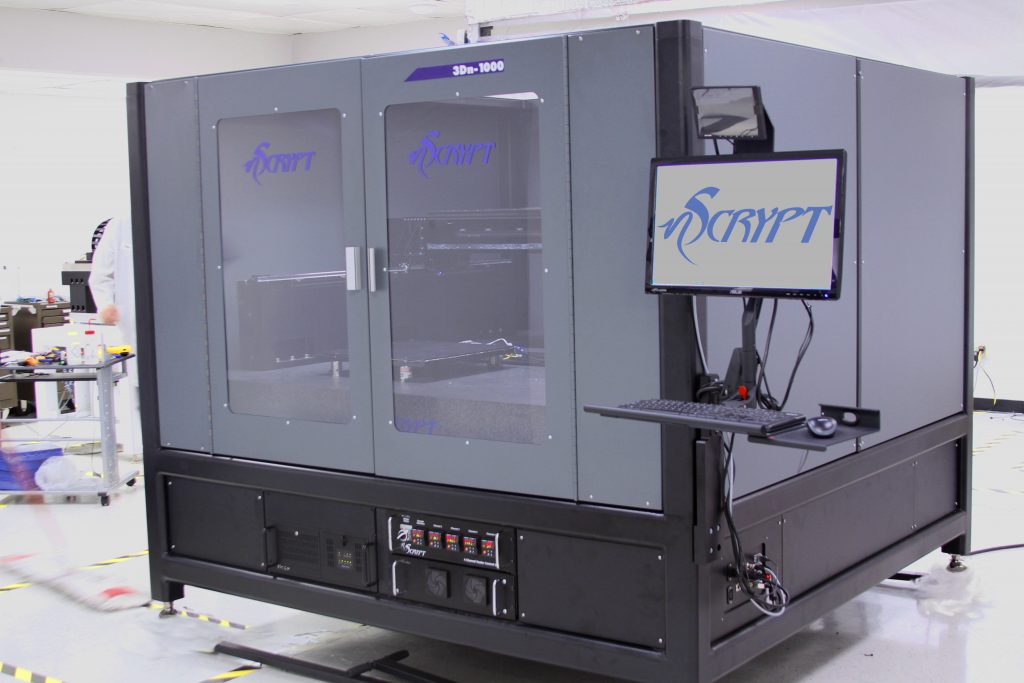
3Dn-1000 machine during final inspection before shipping.
The photo below shows the 3Dn-1000 being hoisted by crane for installation on an upper floor of one of the Redstone Arsenal buildings.
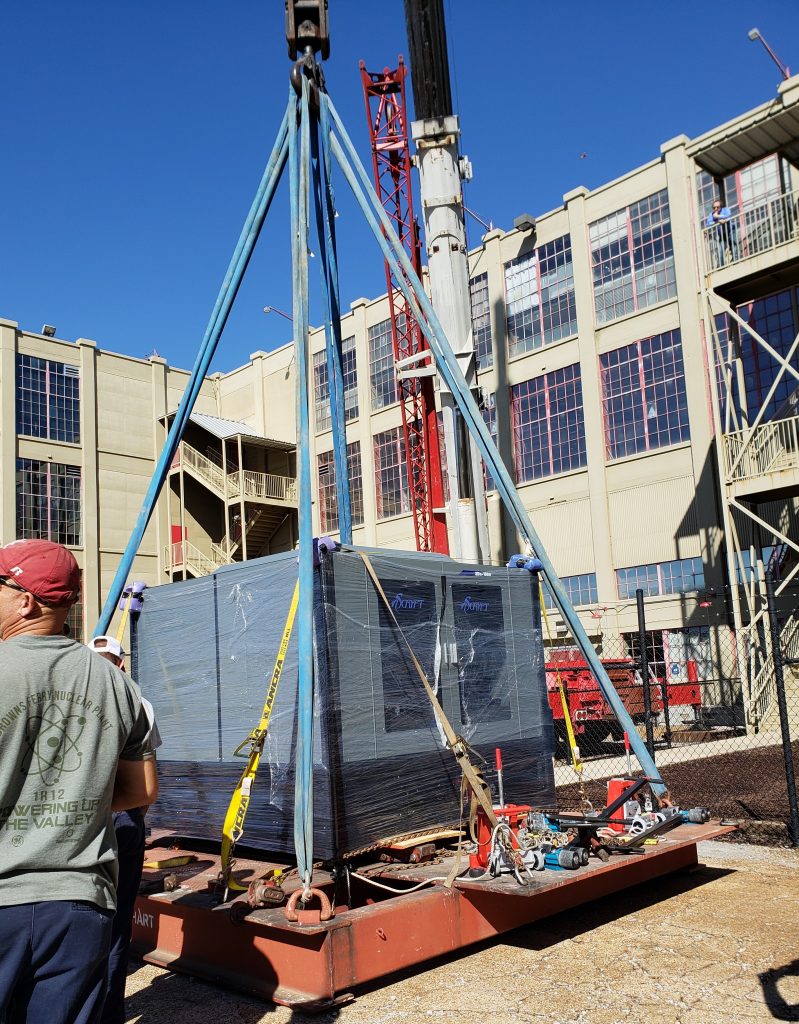
3Dn-1000 being hoisted for installation
nScrypt offers its FiT in 3 base models (based on size) and multiple configurations: 2 base models for solder, vias, and adhesives, 3 for Direct Digital Manufacturing, and bioprinting configurations. All of the FiT systems use one of two basic hardware configurations: the 3Dn-Tabletop is based on a precision ball screw motion platform and the 3Dn-300, 3Dn-500, and 3Dn-1000 systems are linear gantry systems. The 3Dn-300 has 300 millimeters of travel in the XY axis and the 3Dn-500 has 500 millimeters of travel in the XY axis. All of the tools and configurations share the same vision: a user-friendly and customizable GUI (Graphical User Interface), z-tracking/height sensing, precision motion control, and common software and electronic controllers, which simplify operation, maintenance, servicing, training, and reconfiguration. Lining up two or more systems creates what nScrypt calls its Factory in a Line. Contact nScrypt to learn more.
Subscribe to Our Email Newsletter
Stay up-to-date on all the latest news from the 3D printing industry and receive information and offers from third party vendors.
Print Services
Upload your 3D Models and get them printed quickly and efficiently.













You May Also Like
SWISSto12 Closes $70 Million Series C Round
Swiss satellite manufacturer SWISSto12 has closed a $70 million Series C round. This follows $84.8 million that the company received from ESA and ESA member states, and previous rounds that...
Rocket Lab Buys Iridium in $8 Billion Deal, Creating a New SpaceX Rival
Rocket Lab is buying Iridium for $8 billion in a cash-and-stock deal worth $54 per share. Shareholders will receive $27 in cash plus additional Rocket Lab common stock. The company...
SWISSto12 and HPS/LSS Build Unfurling Antenna for Next-Gen Satellite
SWISSto12 is to work with HPS/LSS. High Performance Space Structure Systems and Large Space Structures are two separate firms that work together on large antenna reflectors. The two will work...
Japan’s Space Compass Corporation Buys a SWISSto12 Satellite
Japanese firm Space Compass Corporation has agreed to buy a SWISSTo12 GEO optical data relay satellite. The compact Hummingsat will be used for Space Compass’ optical data relay service. Space...