BeAM and PFW Aerospace Work Together to Qualify 3D Printed Aerospace Component

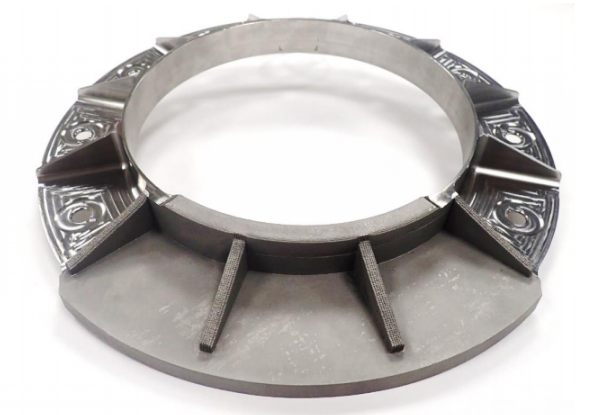
BeAM was founded in 2012 and is known for its Directed Energy Deposition (DED) technology. In the DED process, focused thermal energy is used to fuse materials by melting them as they are deposited. DED processes are typically less good at fine mechanical parts and need to be post-processed with CNC for example being used often to finish parts to make them smooth. On the positive side DED processes can add materials on top of other materials, rejuvenate worn down parts such as injection molds and build really large parts of several meters or more. In aerospace DED is used for wing spars for example. BeAM goes beyond standard layer-by-layer deposition technology, however – the company takes a freeform approach by mounting a nozzle on a DED-dedicated CNC machine, allowing 5-axis freedom of movement. This eliminates the need for support structures and allows for the production of near net shape components, which require less material and less machining once they’re finished. It can reduce material expense as well as scrap volume by more than 70 percent. The technology can also be used to repair and add on to pre-existing parts.
This week, BeAM announced a new partnership with PFW Aerospace, a German company that supplies systems and components for all civilian Airbus models as well as the Boeing 737 Dreamliner. The two companies will work together to qualify a 3D printed aerospace component for a large civil passenger aircraft using the Ti6Al4V alloy, which will fulfill typical aerospace requirements. The collaboration will also focus on industrializing the DED process to manufacture series components; the companies will work to test the applicability of the process to currently machined titanium components and complex welding designs.

PFW Aerospace has acquired a Modulo 400 machine, which BeAM introduced last year. The Modulo series is capable of performing research and development as well as industrial production, and offers a large build volume. The 5 continuous axis machine is equipped with Siemens 840D control. One of the advantages of the Modulo series is that the secondary equipment required for DED production, such as a laser, chiller, and fume extractor, is located inside the machine itself rather than outside as it is with most other DED 3D printers. This greatly reduces floor space, allowing the machine to maintain its large build envelope without taking up excessive amounts of space – in fact, it’s a highly portable machine that can fit inside a shipping container or box truck.
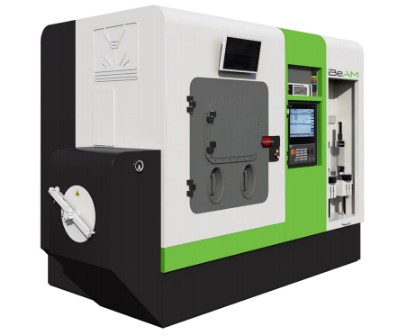
Modulo 400
The design of the Modulo 400 allows PFW Aerospace to fulfill aerospace requirements needed for overall atmospheric values for O2 and H20. The system technology and process management are being further developed to meet industrial production requirements.
Since its founding, BeAM has moved quickly with the development of its technology as well as with the expansion of the company. The France-based BeAM established a second location, its first in the US, in Cincinnati, Ohio in 2017, and also added a location in Singapore. Earlier this year, BeAM joined the AddUp Group, a joint venture dedicated to the manufacture of 3D printers and production lines. The partnership with PFW Aerospace further distinguishes BeAM as a company working towards the industrialization of additive manufacturing, and will expand its presence in the aerospace industry.
BeAM is currently at formnext, which is taking place in Frankfurt, Germany until tomorrow. If you’re at the show, you can stop by and visit BeAM at Booth D20, Hall 3.0 and find out more about the partnership, as well as the company’s always-developing technology.
Discuss this and other 3D printing topics at 3DPrintBoard.com or share your thoughts below.
Subscribe to Our Email Newsletter
Stay up-to-date on all the latest news from the 3D printing industry and receive information and offers from third party vendors.
Print Services
Upload your 3D Models and get them printed quickly and efficiently.











You May Also Like
Formnext 2026: A More Mature AM Landscape Takes Shape in Frankfurt
Formnext 2025 offered a clear view of where Additive Manufacturing currently stands: an industry that has moved well beyond its hype phase and is progressing at different speeds across technologies,...
Engineering Readiness for the Most Demanding Defense Programs
As additive manufacturing moves from innovation to execution, success is no longer defined by machine capability alone. For the most demanding U.S. defense programs, additive manufacturing must be engineered, qualified,...
From Monitoring to Measurement: Why Objective Inspection is Becoming Essential for Scalable Metal AM
Additive Manufacturing (AM) is no longer judged by its printing capabilities, but how it can print reliably, repeatedly, at scale. As metal AM continues its transition from prototyping to production,...
Cheap Printers Make Metal Powders Costly
Last year, on stage at AM Strategies, the argument was simple: additive manufacturing had to stop chasing elegance and start chasing economics. The 3D printing community had spent decades refining...