Ford Recognized for Work with Automotive 3D Printing


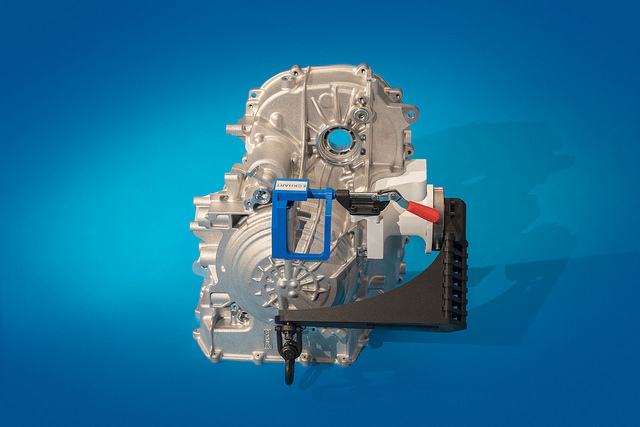
3D printed lift assist
Several major automotive manufacturers have been utilizing 3D printing, and Ford is one of them. Recently, the company has been recognized for its work in 3D printing. For the first time, the Automotive Innovation Awards Competition held by the Automotive Division of the Society of Plastics Engineers (SPE) is recognizing additive manufacturing as a separate category, and Ford was the winner of all three finalist spots.
The parts that won Ford the finalist spots include a 3D printed injection mold lifter action used in the new Ranger pickup, a window alignment feature used in the 2017 Mustang convertible, and an assembly lift assist used to make the Escape SUV and Fusion sedan. These aren’t production parts – two are used in assembly and one in a tool, but the technology was still integral in the development and manufacturing of the products.
“We really didn’t understand the potential of what the capabilities of this process were going to be,” said Roy Raymer, Ford’s Product Coordinator for Rapid Manufacturing. “It’s incredible.”

Vent
The mold insert was developed to solve a problem of inadequate venting; the 3D printed insert has integrated venting channels to allow gas to escape. The design features vents along the top and side of each vane, which, Ford says, improves venting by 100 percent. Manufacturing time was reduced by 70 percent, and the integrated design eliminates the need for a separate grill. The mold is made by Hi-Tech Mold and Engineering.
The window alignment fixture is 3D printed using FDM, with 35 percent short carbon fiber reinforced polyamide. It is 30 percent lighter and cheaper to produce than a traditional welded fixture – it took only 50 hours to build the integrated feature with handles and mounting brackets. The 3D printed fixture integrates pneumatic control, eyelets for a stowage rack, trigger switch housing, ergonomic handles, a gage protector deflector, pneumatic tubing retainers and switch mounts.
The lift assist was also 3D printed using FDM, and according to Ford, it can lift anything from a half shaft to an instrument panel. 3D printing the part allowed for more complex geometries to better interface with the casting, and it cost 50 percent less than a traditional fixture. It also reduced weight by 222 pounds, reducing repetitive motion injuries and making it easier to operate overall. The company also greatly reduced lead time.
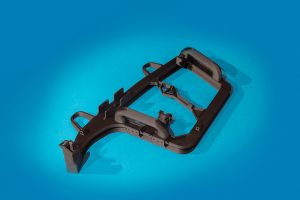
Window alignment tool
Ford began its 3D printing experimentation with an SLA 3D printer for making complex prototypes, and its work has since evolved to using FDM, SLS and 3D sand printing. Like many other automotive companies, Ford has discovered that 3D printing can save time, money, and material, and allow for the the creation of more complex and unique parts. While the examples above are parts used for tools and assembly, it won’t be surprising if Ford soon moves on to using 3D printing for actual production parts. Other companies, like Divergent 3D for example, are using 3D printing to build cars that are more lightweight and efficient, reducing both cost and environmental impact. As the benefits of 3D printing become more evident, we will likely see more and more manufacturers turn to using the technology for actual production, resulting in a significant change to the entire automotive industry.
The winners of the Automotive Innovation Awards Competition will be announced on November 7th.
Discuss this and other 3D printing topics at 3DPrintBoard.com or share your thoughts below.
Subscribe to Our Email Newsletter
Stay up-to-date on all the latest news from the 3D printing industry and receive information and offers from third party vendors.
Print Services
Upload your 3D Models and get them printed quickly and efficiently.













You May Also Like
Printing Money Episode 42: Q2 2026 Public Markets 3D Printing Earnings Analysis with Troy Jensen, Cantor
Welcome to Printing Money Episode 42. Troy Jensen (Managing Director, Cantor) returns, joining Danny Piper (Managing Partner, NewCap) to review Q2 2026 publicly traded 3DP/AM company earnings reports. Troy’s quarterly...
3DPOD 314: Debinding, Sintering, and Metal Binder Jetting with Stefan Joens, Elnik Systems and DSH Technologies
Stefan Joens of Elnik Systems sells ovens. Their debind and sintering equipment powers a lot of high-volume binder jet and MIM production. We learn about Elnik and its origins. But...
The Frankenservice Part 1: Print the Rainbow
So far, most service bureaus and manufacturing companies stick to what they know. Not only for OCD reasons, but gleaming lines of identical LPBF machines are also arrayed on impossibly...
3DPOD 313: Patient-Specific 3D Printing with Ruben Wauthle, Amnovis
Ruben Wauthle studied at Leuven University at a very serendipitous time. Through working with pioneering additive professors and surgeons, he entered into a specialty that was emerging. He joined pioneering...