Solukon and Siemens Develop New Advanced Depowdering System for Metal 3D Printed Parts


 It seems that we’ve entered the busy time of the year for 3D printing shows and trade fairs, though some may argue we’ve never left, as the 3D printing world really never seems to sleep. On the heels of IMTS in Chicago and the TCT Show in Birmingham, which both took place last month, formnext 2018 in Frankfurt is fast approaching, and will open in less than 30 days, on November 13th.
Naturally, we’ve already begun to hear about what new 3D printers, materials, and software will be introduced and showcased at formnext, as anticipation for the massive show begins to increase.
At last year’s formnext, additive manufacturing post processing solutions specialist Solukon Maschinenbau GmbH unveiled its line of automated powder removal systems, which rotate and vibrate the 3D printed parts to release any trapped powder granules from within. After introducing a new depowdering system, the SFM-AT200, at Rapid.Tech this summer, Solukon is returning to formnext next month to launch its latest product: an advanced depowdering system for metal powder bed fusion that it developed with fellow German company Siemens.
“Siemens analyses additive manufacturing technologies from a holistic point of view and understands the digital requirements of the complete manufacturing chain, especially on a shop floor level,” said Andreas Hartmann, the Co-Founder and Technical Director of Solukon. “This expertise makes Siemens a perfect partner for advancing this new technology.”
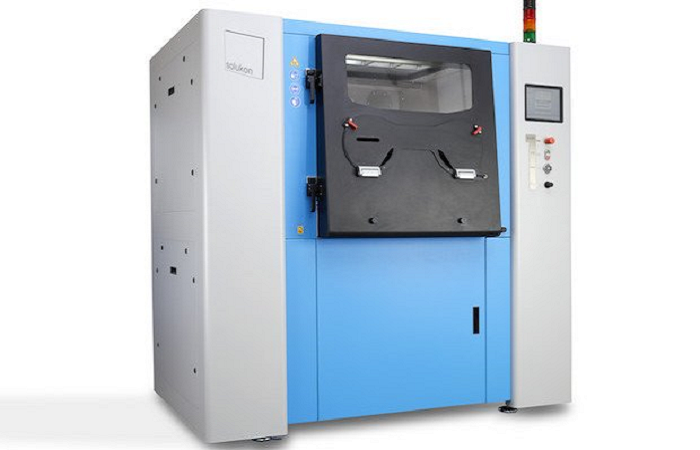
The new SFM-AT800S post processing system has the latest developments in smart technology, which help it achieve the effective removal of metal powder that’s been trapped in free designed, 3D printed parts that have complex internal channels.
 The new system builds on the company’s standard SFM-AT800, which can already move parts into any three-dimensional position. But the SFM-AT800S, which has two servo-motorized and endless rotating axes, has a new axis-system that enables the movement of 3D printed parts along any three-dimensional contour. This makes it possible to clean the powder from parts that have conformational, intricate internal structures, like the cooling channels found inside injection molding tools.
Siemens already uses Solukon’s systems for powder removal, so the company was familiar with the technology – making it an ideal partner. Solukon worked with Siemens to develop its new SFM-AT800-S so it could improve upon the cleaning results of highly complex 3D printed parts, like infusion nozzles and heat exchanges.
Siemens has been researching intelligent software that’s capable of detecting internal channels by using the original CAD file as a digital twin to automatically calculate, during the cleaning process, the optimal movement of the depowdering system. So, in order to optionally interface with these new software developments, Solukon’s new SFM-AT800S was engineered with Siemens Simatic controllers and Sinamics drive and motors solutions.
“We strongly support this improved powder removal system,” said Dr. Christoph Kiener, Principal Scientist at Siemens. “Powder-free, high-quality AM parts, occupational health and safety, as well as environmental topics regarding waste avoidance and powder reuse are very important for Siemens to process advanced designs also in our post-processing activities.”
You can see Solukon’s new SFM-AT800-S depowdering system for metal powder bed fusion for yourself at booth 3.0-E69 at formnext in Frankfurt next month.
Discuss this news and other 3D printing topics at 3DPrintBoard.com or share your thoughts below.
Subscribe to Our Email Newsletter
Stay up-to-date on all the latest news from the 3D printing industry and receive information and offers from third party vendors.
Print Services
Upload your 3D Models and get them printed quickly and efficiently.













You May Also Like
Apple’s 3D Printed Hinge Cover & the Inauguration of the Ternus Era
Marc Andreessen notwithstanding, it turns out that hardware is, in fact, eating the world. Perhaps after being starved for so long, the hardware side of tech innovation is now overcompensating,...
The Exploration Company Raises $450M to Rival SpaceX
The space industry is currently worth about $650 billion globally, growing nearly 50 percent since 2020, which is certainly impressive. But over the next decade, the total market opportunity in...
3D Printing News Briefs, September 10, 2026: Tax Credits, Polymer Research, Microneedles, & More
We’re starting off this week’s 3D Printing News Briefs with a little business from Axtra3D and Beehive Industries, before moving on to a scientific collaboration agreement between Roboze and a...
The Formlabs Shuffle
For the latest development on 8/31/26, please see an update at the end of this article. Formlabs is doing a management shuffle, pointing the firm even more surely towards an...