Interview with Alessandro Severini of the Felfil Filament Extrusion Machine to Make Your Own Filament at Home


The main thing that attracted me to 3D printing initially was this technology’s promise to let anyone make anything. On top of that once we’re bored with it we could then recycle it and make new things. With 3D printing, we could in a sustainable way have our cake and eat it too. We could grind up and extrude new filament made of old 3D prints or old PET bottles. At the same time this would make 3D printing energy efficient and very low cost. Many companies and projects have tried to make low cost, open source, and easy filament extruders. Most of these extruders are the kind of things that would take pleasure at burning your house down. Rickety, dangerous and difficult to use they’ve been nice representations of the idea but I shudder at the thought of using them again. Some are exceptions such as the high-end 3Devo device which is fine for your lab but too expensive for many of us. There really isn’t a product between the 3Devo and the rickety cheap extruders. The Felfill purports to be just such a device combining ease of use and desktop filament making inside of a relatively inexpensive device. An assembled Felfill costs 719 euros and promises to make a filament manufacturer out of you. We spoke to Alessandro Severini of Felfill to find out more.
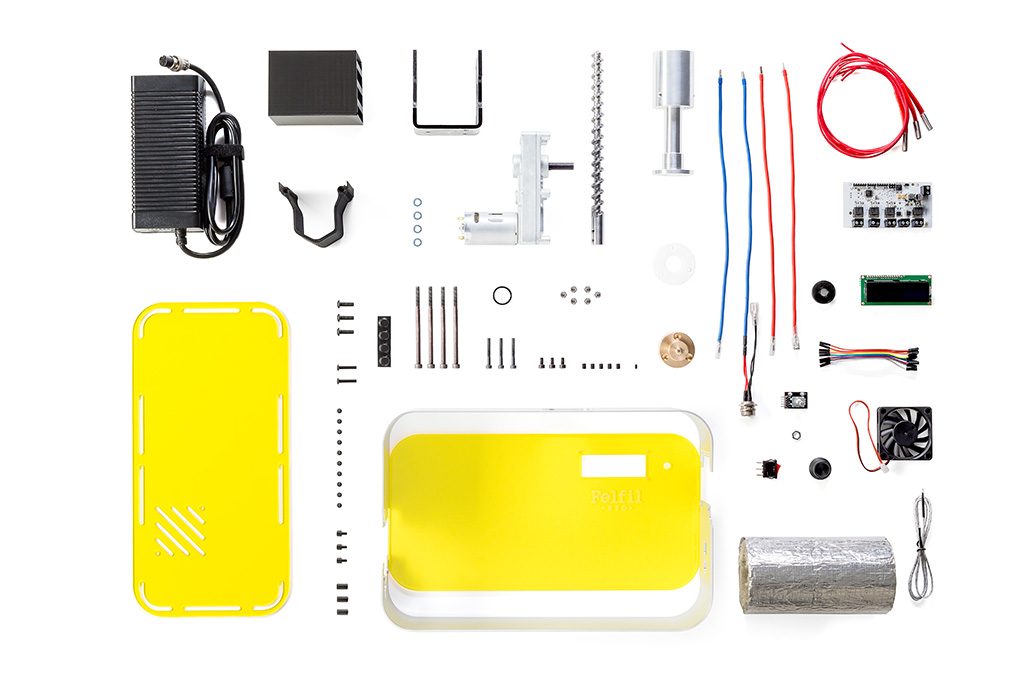
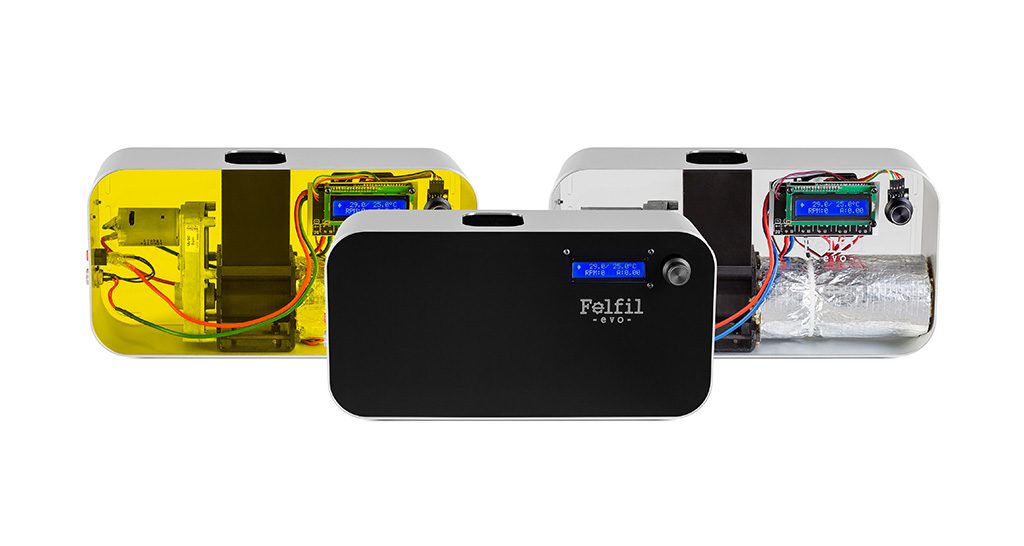
“Felfil is a 3d printer plastic extruder machine which allows anyone to make custom 3D printing filaments at home, starting from industrial pellet or chopping up wrong 3D prints, old models and plastic waste.
Using our desktop filament maker you will be able to choose your filament color, diameter and material, day by day, according to your creativity and your curiosity. In this way you can save over 80% of the price of filaments spools and help to protect the environment.”
What kinds of customers do you have?
“Our customers are many and really different from each other. However we can divide it in three different groups: those who are focused on recycling, those who are focused on research on new material types, such as medical applications, and those who just print a lot and want to save some money buying pellets instead of filament. We are seeking all of them in order to help them to reach their goals.”
What kind of materials can the Felfill make?
“We have tested the Felfil Evo with a wide range of materials, at the moment we can say that It can successfully process: PLA, ABS, HIPS, TPU, PA12, LDPE and HDPE, PETG, PP, PC/ABS, PCL and PMMA, and this list is in continuously updated.”
If I process HIPS and ABS won’t harmful fumes come from this?
“Ye,s It could happen. For this reason we strongly suggest our customers take every possible precaution about their own safety such as using it in a well ventilated area and under a fume hood.”
How well are you doing as a company?
“Never good enough! We are working hard in order to increase our business an improve our products quality, we are also developing some new interesting things and we will show them in next few months.”
Subscribe to Our Email Newsletter
Stay up-to-date on all the latest news from the 3D printing industry and receive information and offers from third party vendors.
Print Services
Upload your 3D Models and get them printed quickly and efficiently.













You May Also Like
10 Years of Multi Jet Fusion: Onsite at HP’s Vancouver, Washington Facility
At this year’s RAPID event in Boston, HP Additive Manufacturing Solutions celebrated ten years in the additive manufacturing (AM) market. The company ushered in the milestone with several innovations, including...
These 3D Printed Lattices Can Sense Damage Before Failure
A new paper, “Full-Field Damage Monitoring in Architected Lattices Using In situ Electrical Impedance Tomography,” points to lattices being able to detect damage. This could really help composites in critical...
3D Printing News Briefs, October 3, 2026: Hypersonics, Hotends, & More
We’re starting off with defense in this weekend’s 3D Printing News Briefs, as Titomic was awarded a $5 million U.S. defense contract, and VulcanForms announced a partnership with Specter Aerospace...
3D Printing News Briefs, October 1, 2026: Defense, Enclosures, & More
In today’s 3D Printing News Briefs, we’re starting with defense news, first from Massivit and then from AML3D. Then we’ll move on to U.S. manufacturing of a new large-format LPBF...