
3devo Launches Two New Industrial-Grade Desktop Filament Extruders

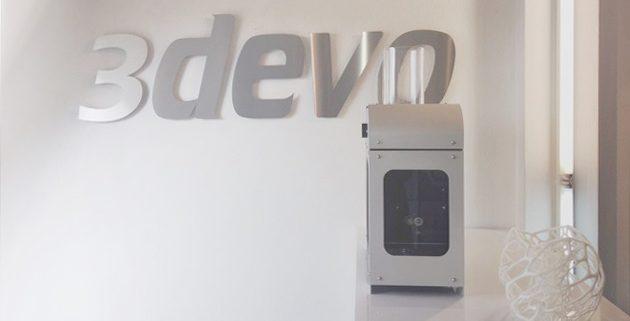 As 3D printing technology continues to become more functional, accessible, and affordable throughout the world, the industry is starting to realize that we don’t need industrial-sized printers to reach professional-grade quality. The desktop 3D printer market hasn’t exactly taken off as quickly as many have hoped, but that doesn’t mean that the technology itself isn’t improving at an impressive rate. Some companies, such as the Netherlands-based 3devo, a subsidiary of Devoteq, have focused on enhancing the filament production process in order to help desktop 3D printing users and manufacturers to improve the entire 3D printing process.
After launching a Kickstarter campaign in August of last year, 3devo is back with two new industrial desktop filament extruders, the 3devo NEXT 1.0 and the 3devo Advanced. Both were designed to increase the reliability, repeatability, and tolerances of the desktop 3D printer, offering users industrial-grade filament production capabilities from a consumer-priced system.
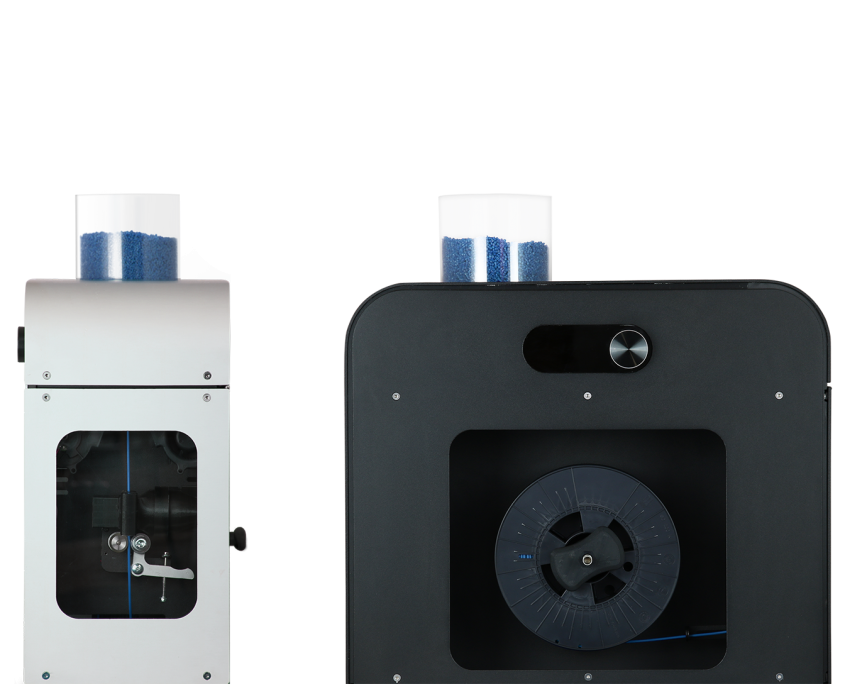
The Blank Anodized 3devo NEXT and Black powder coated 3devo Advanced.
The NEXT 1.0 is being marketed towards makers, 3D printing shops, and universities looking to lower the financial and environmental cost of the additive manufacturing, as the extruder allows you to easily recycle and reuse old 3D prints and filaments. The 3devo Advanced, on the other hand, was created for compounders, extrusion companies, researchers, plastics companies, universities, and 3D printing companies that want to accelerate their innovation rate for new plastics and create their own unique 3D printing filaments. The Advanced enables these companies and users to create small batch productions of new materials or variants in a cost-effective way.
 Both extruders are equipped with different heating zones that can be independently set to certain temperatures, as well as a dimeter sensor with 43 micron accuracy, an automated motor control, powerful cooling systems, and are designed with presets and other automatic functions for easy use. The main differences between the two is the number of independent heating zones (NEXT: 3; Advanced: 4) and the temperature capabilities (NEXT: 350°C; Advanced: 450°C). Additionally, the 3devo Advanced has a mixing section built into the extruder screw, and was designed for the extrusion of materials that require higher temperatures, such as PEEK.
With their new innovative industrial-grade extruder models, 3devo hopes to provide makers, researchers, and companies with access to higher-grade filaments. Additionally, their new devices will allow manufacturers and services to regrind and reuse virgin plastic granulate, thus lowering the overall cost for filament production and use. On top of that, they will also be able to develop advanced and unique materials in a much more convenient fashion. The 3devo NEXT 1.0 is priced at €3,100, while the 3devo Advanced costs €3,950 for the black powder coated variant and €4,150 for anodized variant. Both of their filament extruder models can be purchased directly from the 3devo online shop. Discuss in the 3devo forum at 3DPB.com.
[Source: 3devo]Subscribe to Our Email Newsletter
Stay up-to-date on all the latest news from the 3D printing industry and receive information and offers from third party vendors.
Print Services
Upload your 3D Models and get them printed quickly and efficiently.













You May Also Like
Why the AM Industry Should Pay Attention to Schneider Electric’s $22.6B PTC Acquisition
By late 2024, there was already enough signaling of the additive manufacturing (AM) industry opportunity in the data center infrastructure market for AM Research to write a report on the...
AM & National Competitive Advantage, Part One: the Real Problem with US Manufacturing
The problem with US manufacturing is the productivity growth rate. Depending on the source, US manufacturing productivity has either been flat or slightly declined since 2010. Before going any further...
Metal AM in a Multipolar World: Resilience, Regional Production and a Changing Market
Technology develops in response to forces driving change. That was the starting point for a keynote I presented with Mikael Schuisky at AM Meetup 2026, held in Karlstad, Sweden, on...
AM Demand Signals: Reshoring the Robotics Supply Chain
The Federal Communications Commission (FCC) recently banned the sale in the US of “almost all” new mobile robots sourced from foreign countries. IEEE Spectrum (the link in the first sentence)...
























































