Massivit 1800 3D Printer Used to Help Restore Balcony Capitals for Spada Palace in Italy

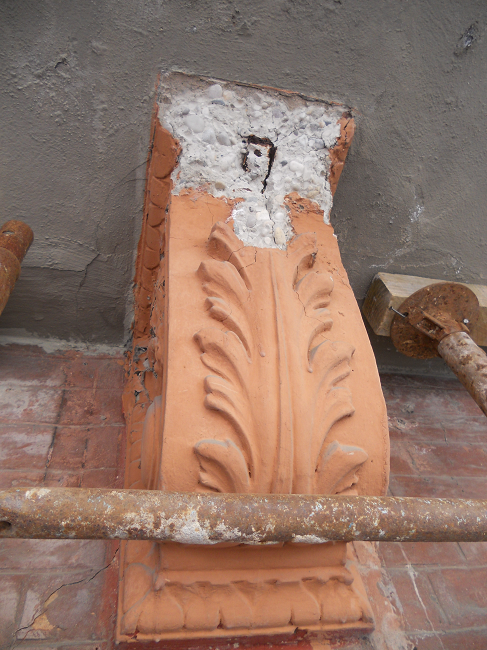
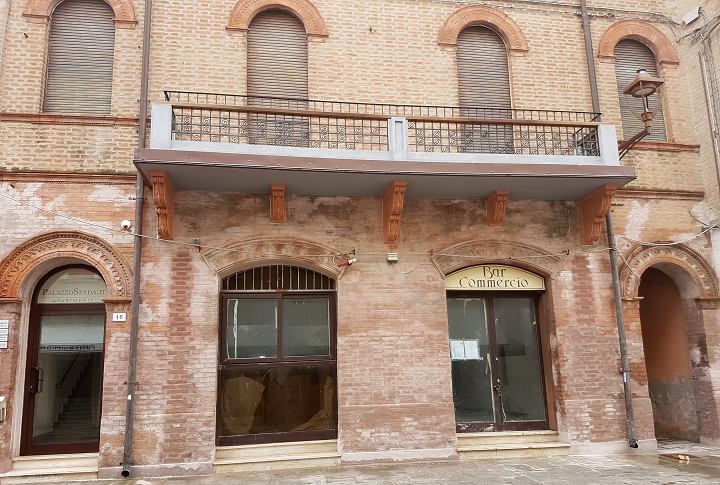
Original Spada Palace capitals.
3D printing is often used to help preserve and restore historic artifacts, monuments, and other objects like artwork. While there are beautiful, iconic landmarks and structures all over the world to mark history, many of them start to deteriorate, due to neglect, lack of investment, and sometimes even just from natural causes. In Italy, there are historical buildings almost everywhere you turn, and construction companies are often asked to help restore them, which is costly and time-consuming. But digital printing, interior design, and visual communication business Sismaitalia, recognized that large-format 3D printing could be used to help overcome the bottleneck.
The Spada Palace in Ferrara was built in the 1800s, and originally owned by the Spada family; later, other families inhabited the palace, which is now currently used as a hotel. But its main balcony is in need of some TLC.
“The owners noticed that the crumbling façade of the capitals had become weathered over the years,” said Federica Tisato, the Marketing and Communication Manager of Sismaitalia. “As they are an essential element to the French balcony, the owners required them to be restored urgently.”
The company was the first Italian business to purchase a Massivit 1800 3D printer, in order to help its customers achieve unique 3D printed solutions in interior design. But Sismaitalia soon realized that its giant 3D printer could also be used to help solve a large gap in the restoration market.
“With the capability to 3D print super-large objects, we can provide our customers with exact replicas within a fraction of the time and cost compared to traditional methods,” Tisato explained. “This capability has seen us expand our service offering to existing customers as well as target new markets.”
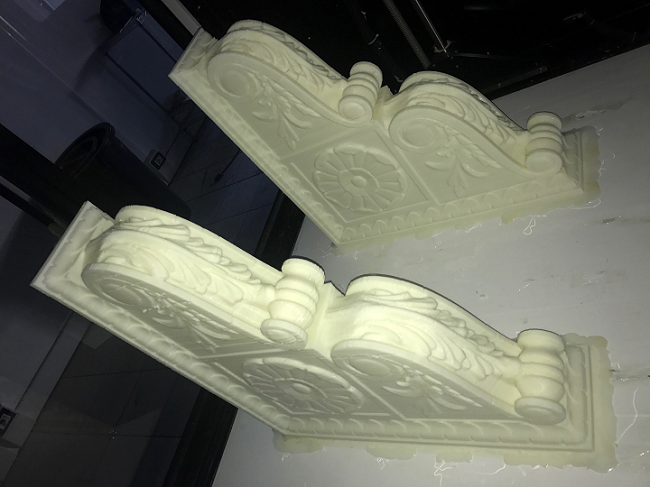
Mostly because of the necessary manual labor, traditional methods of restoration can take a long time to complete, and can also be expensive, due to the intricacy of the task. The current owners of the palace wanted a more cost-effective way to restore the capitals below its balcony, and first considered using temporary polystyrene replacements. But then they learned about the benefits of 3D printing, and Sismaitalia took on the massive task of producing five life-size capitals for the Spada Palace.
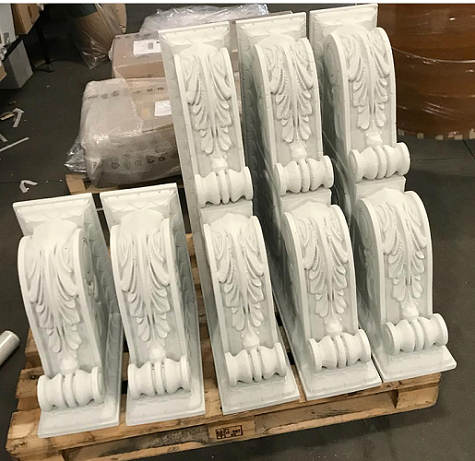 Because of the digital nature of 3D printing, historic artifacts are able to be precisely replicated. Sismaitalia 3D printed the five capitals in two sizes – the first measuring 480 x 430 x 215 mm, and a larger set of three compromising pieces, measuring 790 x 790 x 215 mm. Because the Massivit 1800 is equipped with a dual printhead, the company was able to 3D print a pair of capitals in less than one day.
“With the capability to produce each full-sized capital in one print, we could eliminate the lengthy turnaround times associated with traditional restoration methods,” Tisato said. “Beyond this, as the owners only required the 3D printed capitals for aesthetics, we could quickly produce the hollow structure and strengthen these with polyurethane foam to withstand the weight of the balcony. This ensured that manufacturing costs were kept to a minimum.”
Once each of the replacement capitals had been 3D printed and filled, they were then finished with plaster, before being painted the same color as the originals in order to obtain a look of authenticity.
“From a business perspective, projects like these demonstrate the growing adoption of 3D printing in a vast gamut of markets,” said Tisato. “We anticipate that this capability will continue to open the door to new markets. In fact, to date, our Massivit 1800 has played an integral role in securing projects within the interior design and architectural sectors and we have a handful of additional restoration projects in the pipeline!”
The new 3D printed, life-size capitals have since been installed under the balcony of the Spada Palace, and look nearly identical to the originals.
Discuss this story and other 3D printing topics at 3DPrintBoard.com or share your thoughts in the Facebook comments below.
Subscribe to Our Email Newsletter
Stay up-to-date on all the latest news from the 3D printing industry and receive information and offers from third party vendors.
You May Also Like
Further Understanding of 3D Printing Design at ADDITIV Design World
ADDITIV is back once again! This time, the virtual platform for additive manufacturing will be holding the first-ever edition of ADDITIV Design World on May 23rd from 9:00 AM –...
3D Printer Maker EVO-tech Reborn as NEVO3D — Once More With Feeling
EVO-tech was a 3D printing service and original equipment manufacturer established in 2013 and based in Schörfling am Attersee, Austria. The company produced high-quality material extrusion systems featuring linear bearings,...
3D Systems Brings 3D Printed PEEK Cranial Implant to the U.S. with FDA Clearance
For more than 10 years, 3D Systems (NYSE:DDD) has worked hand-in-hand with surgeons to plan over 150,000 patient-specific cases, and develop more than two million instruments and implants from its...
CDFAM Returns to Berlin for Second Annual Symposium
The second CDFAM Computational Design Symposium is scheduled for May 7-8, 2024, in Berlin, and will convene leading experts in computational design across all scales. Building upon the first event...