Sea Creatures Inspire Lilian van Daal’s Sustainably 3D Printed Chair


 Radiolaria are one-celled microorganisms that take their name from the radial symmetry of their spines; they are found in the ocean as zooplankton and while they may be tiny, they served as big inspiration for designer Lilian van Daal, who takes her inspiration from the intersection between nature and technology. Her latest work, Radiolaria #1, is a 1:1 3D printed scale model of a chair whose design was inspired by the structure of Radiolaria and Bryozoa, moss animals that live in both tropical and freshwater environments. Bryozoa’s lattice-like skeletons inspired van Daal to create a system of connection points for the chair’s assembly without the use of any extra materials like glue. She was inspired by Radiolaria to create the chair from one single material that offered flexibility, adaptability, firmness and stability.
“The intricate shapes of flowers. The mesh-networks of fungi. The perfect geometry of organisms. They have been crafted, remodelled and burnished during billions of years of biological trial and error,” says van Daal. “Implementing their unique and meticulous properties in design has been difficult, but recent technology has fuelled possibilities for new development of products and systems.”
Van Daal’s graduation project, Biomimicry Soft Seating, began her career in biomimicry design four years ago. Since then, she has managed to decrease production time and energy consumption by half, optimizing the design so that all elements of the chair can fit in one production run of the 3D printer. Van Daal has also begun using recyclable materials, Oceanz EcoPowder, to 3D print her designs.
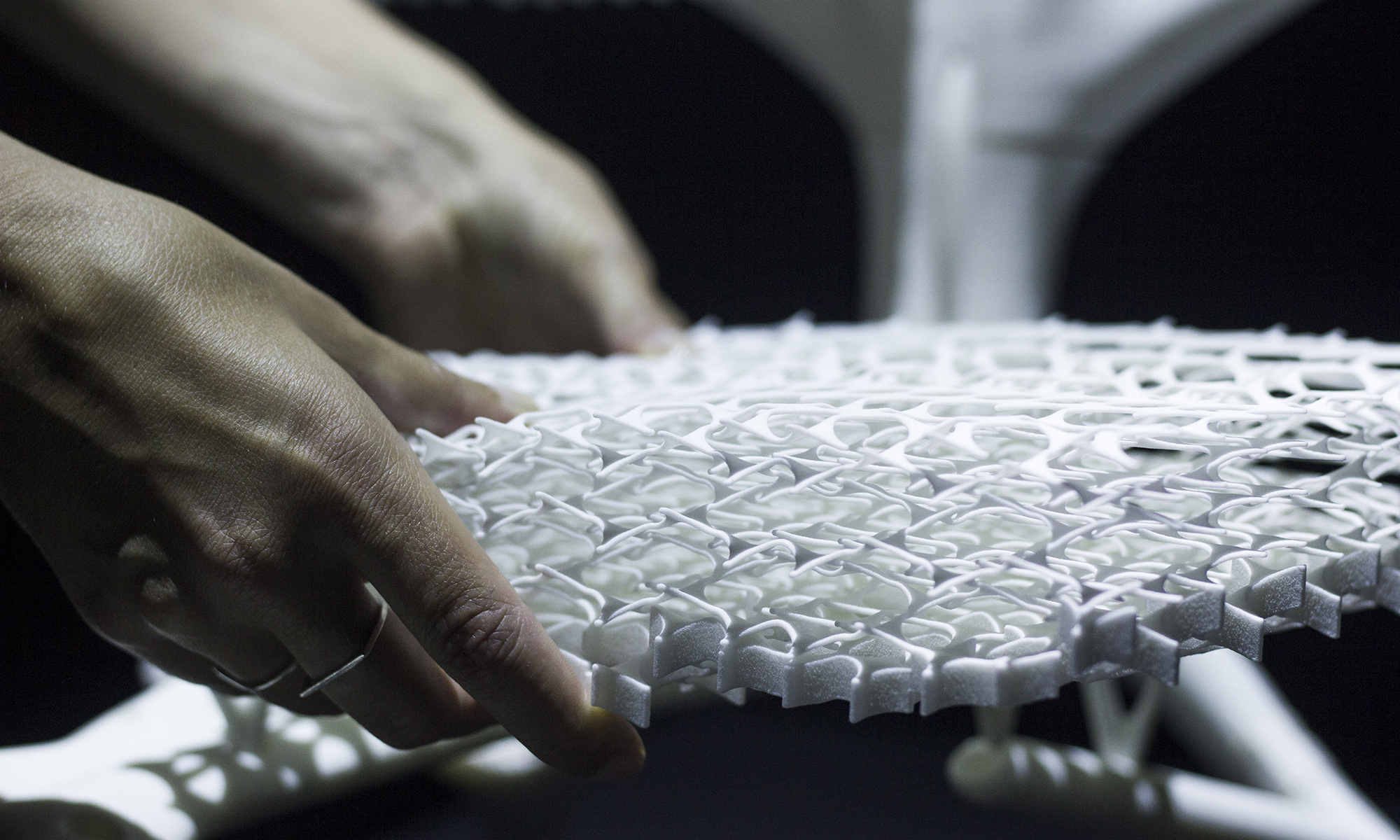
“Oceanz invests a lot in research to realize a sustainable production process,” says Oceanz CEO Erik van der Garde. “This has led to the introduction of Oceanz EcoPowder. This sustainable material has almost the same characteristics as the standard Oceanz PA12. By reusing the 3D printing material, we have virtually no waste stream from our old powder and we can process our material sustainably. This makes 3D printing/prototyping a very sustainable production technique. This doesn’t only give you a good feeling, but also the functional properties of the material remain the same. The zero-waste promise is also redeemed.”
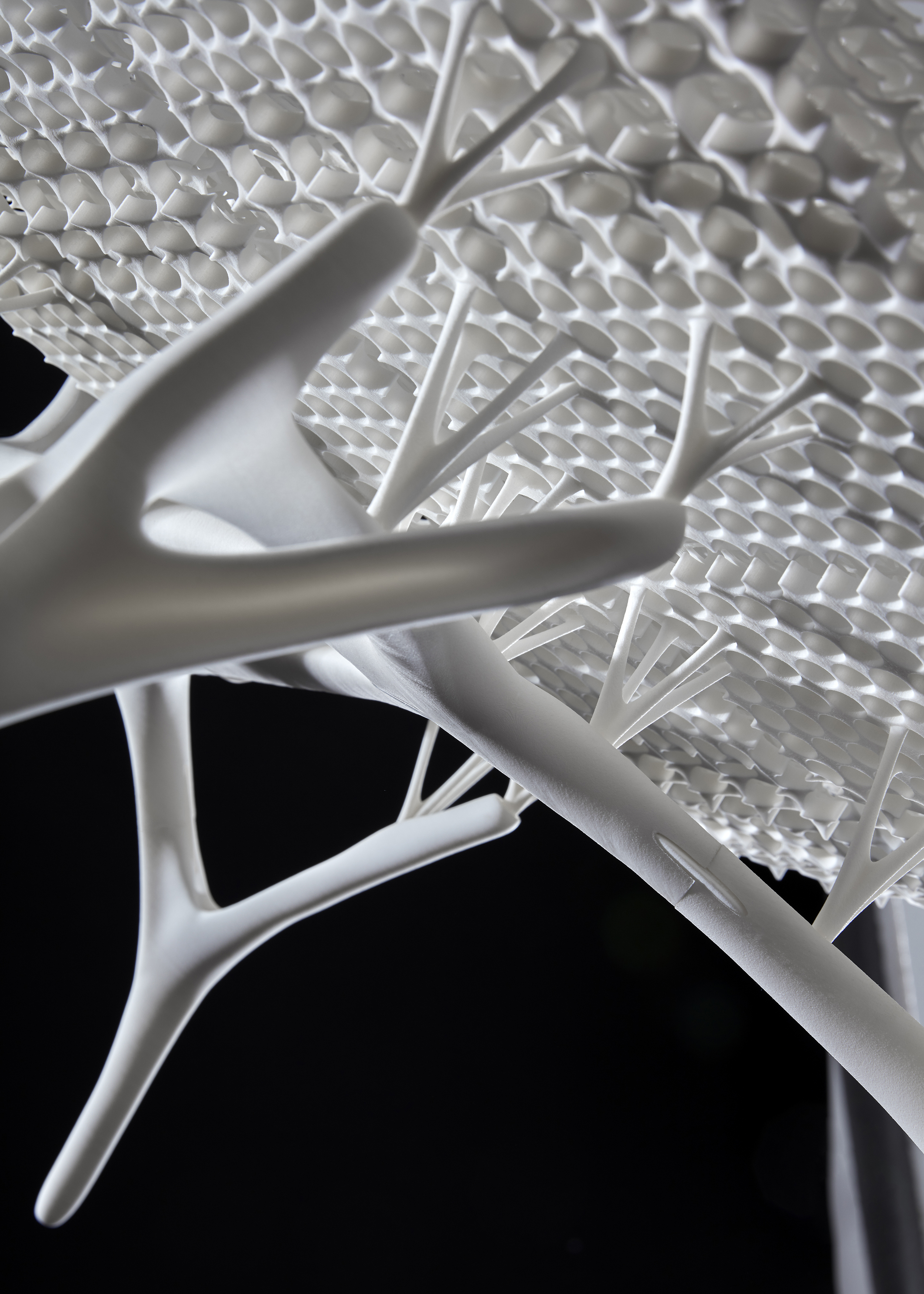 Radiolaria #1 definitely has the look of something that would be found in the sea; its base resembles smooth bone or driftwood while the material of the seat itself looks like something you might find while walking along the shore. The chair looks very fragile, but that’s deceptive; it has both strength and stability. It also maintains an attractive symmetry while still looking like something that emerged naturally – and that’s a big part of van Daal’s nature-inspired designs.
“Nature may seem at first glance random and free-flowing, but if you look on a microscopic level, you can find symmetry and geometry in almost all cell structures,” she says.
Symmetry and geometry can be found in van Daal’s other works, as well, which include a bio-inspired bicycle saddle, a Fibonacci series, and more. Van Daal is a 2010 graduate of HAN – Arnhem, where she studied Industrial Product Design, and a 2014 graduate of the Royal Academy of Art – The Hague, where she received a degree in Industrial Design.
Discuss this and other 3D printing topics at 3DPrintBoard.com or share your thoughts below.
[Images provided by Oceanz]
Subscribe to Our Email Newsletter
Stay up-to-date on all the latest news from the 3D printing industry and receive information and offers from third party vendors.
Print Services
Upload your 3D Models and get them printed quickly and efficiently.













You May Also Like
Advanced Manufacturing at IMTS 2026: 3D Printing and AI and Drones, Oh My!
Last week’s International Manufacturing Technology Snow (IMTS) in Chicago welcomed over 90,000 attendees to the jungle that is McCormick Place. With over 1.17 million square feet of exhibit space, and...
Caracol to Build Large-Format 3D Printing Hub in Milan With Designtech & LAMÁQUINA
In the 1990 classic in economic strategy, The Competitive Advantage of Nations, business theorist Michael Porter wrote, “Most commentators on the Italian economy have persistently underestimated Italy, because they have...
ETH Students 3D Print Experimental Rocket Engine
Students at the Swiss University ETH have built a Rotating Detonation Rocket Engine (RDRE). An RDRE burns propellant in a ring-shaped combustion chamber where a continuous supersonic wave detonation is...
Printing Money Episode 35: Notable VC and M&A Deals, with Arno Held and Alex Kingsbury
Welcome to Printing Money Episode 35 and let us be the last to wish you a happy new year. For this episode Danny is joined by Arno Held (Managing Partner,...