AFPALM: A New 3D Printing Technology Combines 3D Printing with Automated Fiber Placement

 Several methods have been developed for the creation of lightweight composite structures. Two of the most commonly used are automated fiber placement (AFP) and automated tape laying (ATL). These two techniques are well-suited for large and/or geometrically complex structures, and their advantages over manual laydown include productivity and reproducibility. These methods hold a lot of potential for the aerospace industry, where high tolerances are required. However, these methods have their weaknesses: particularly on complex or double-curved surfaces, gaps can appear, reducing the mechanical properties of the composite structure. To counteract this, several layers are laid on top of each other, but this makes the component heavier and more expensive to produce.
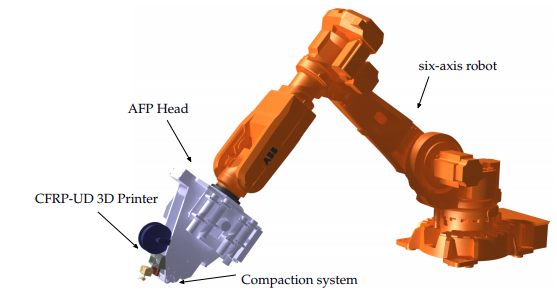 In a new paper entitled “A Novel Approach: Combination of Automated Fiber Placement (AFP) and Additive Layer Manufacturing (ALM),” which you can access here, the authors argue that combining 3D printing with AFP can avoid these problems. So what is AFPALM exactly?
“As the standard, the heads simultaneously lay 8, 16, 24, or 32 layers in the usual widths of 1/800 to 1/200 directly next to each other at the same time,” the researchers explain. “Thermoplastic or thermoset unidirectional (UD)-Prepregs are often used for the automated production of modern high-performance composite materials.”
Prepregs are strips of reinforcing fabric that already have resin, including the proper curing agent, within them.
“The challenge of automated fiber placement is to completely lay down the Prepregs with a defined fiber orientation without gaps or overlaps,” the researchers continue. “Successful fiber placement without gaps or overlaps is dependent on many parameters, such as mold geometry, tape width, and fiber orientation. The Prepregs must be laid down parallel to the flow of force in order to show their optimal properties.”
On a flat surface, prepregs can generally be placed without gaps or overlaps. With complex geometries, however, gaps or overlaps are common, and they can reduce the mechanical properties of the component, and lead to unnecessary material consumption, additional weight, and local thickening.
The researchers present the idea of combining 3D printing with AFP in order to fill in the gaps without adding extra weight. They created three samples: a laminate without gaps, a laminate with gaps, and a laminate in which the gaps were filled with 3D printed unidirectional carbon fiber-reinforced plastic (CFRP-UD).

Microscope images of the laminate structure. (a) Laminate without gaps; (b) Laminate with gaps; (c) Laminate with printed CFRP-UD.
“The tensile strength, interlaminar shear strength, and flexural strength of the laminate with gaps were reduced by about 13% compared to the laminate without gaps,” the researchers state. “Accordingly, the tensile strength of the laminate with printed CFRP-UD was approx. 2%, the interlaminar shear strength was approx. 4%, and the flexural strength was approx. 1% less than that of the laminate without gaps.”
Importantly, the CRFP-UD does not add significant weight to the component, unlike adding multiple layers of prepregs to fill in gaps. The carbon fiber was laid down after an integrated edge detector in the 3D printer head detected the gaps online between the fiber tapes. Another option, the researchers add, would be to have the gaps be detected with a thermal camera integrated in the AFP head.
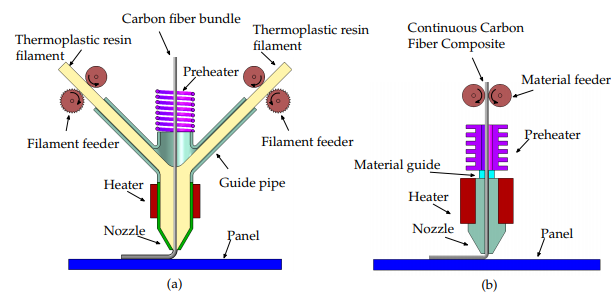
“By combining the 3D printing and AFP technology, composite parts can be manufactured in a more homogeneous manner,” they conclude. “Subsequently, the components are produced faster, cheaper and even lighter because of the avoidance of the additional layers.”
Authors of the paper include Mohammad Rakhshbahar and Michael Sinapius. AFPALM could be a highly automated process that is very advantageous in terms of costs and parts built for aerospace and other carbon fiber applications. AFPALM itself could be a labor-saving way to create very high strength carbon fiber components for industry. More industries looking at lightweight and lightweight components now have a possible alternative to handlayup and other methods of making carbon fiber parts with AFPALM.
Discuss this and other 3D printing topics at 3DPrintBoard.com or share your thoughts below.
Subscribe to Our Email Newsletter
Stay up-to-date on all the latest news from the 3D printing industry and receive information and offers from third party vendors.
Print Services
Upload your 3D Models and get them printed quickly and efficiently.











You May Also Like
Killer 3D Printing Applications: Car Seating
Bicycle seats are a 3D printing success story. Often made using Carbon’s technology, high-end road bike saddles are now on offer from most premium bike saddle brands. Retailing for over...
3D Printing News Briefs, November 22, 2025: Rebranding, Integration, Electronic Eyes, & More
We’ll start with a new software tool from AON3D in today’s 3D Printing News Briefs, and then we’ve got a lot of business, from Conflux Technology and Prima Additive to...
Formnext 2025: New Metal PBF 3D Printer, Serial Production Applications, & More
It’s Day 2 of Formnext 2025, where over 800 exhibitors from around the world have converged in Frankfurt for Europe’s premier additive manufacturing (AM) trade show. From exciting new printers...
Filtration System, AI-Driven Software, Photogrammetry, & More at Formnext 2025
Europe’s premier AM industry trade show, Formnext, began today in Frankfurt, Germany. From 3D printers to post-processing and more, we’re here to make sure you don’t miss a single announcement from...