3D Printing and Electrospinning PCL for Dressings and Wound Repair


 When the body is functioning as it should, wounds repair themselves naturally. Sometimes, however, wounds do not heal, due to conditions such as diabetes or other chronic diseases. This puts the patient at risk of infection and other complications, at worst even requiring amputation. Chronic wounds affect 37 million patients around the world, and there is a great need for better treatment of these wounds.
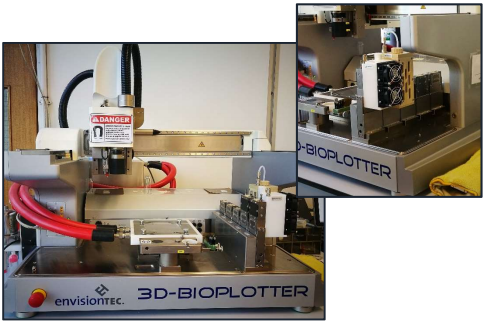
In her Master’s Degree thesis, Politecnico di Torino student Viola Sgarminato discusses how 3D bioprinting and electrospinning can create scaffolds that actually promote wound repair. Using a combination of electrospinning and 3D printing with an EnvisionTEC 3D-Bioplotter, Sgarminato developed scaffolds that would promote healing by electrically stimulating skin cells.
“To this aim hierarchical scaffolds of polycaprolactone (PCL) and piezoelectric barium titanate (BaTiO3) nanoparticles were fabricated using 3D-bioprinting and the electrospinning technique,” Sgarminato explains.
Electrospinning is a technique that has been used for decades, and it involves the use of an electric charge to spin nanometer threads from a polymer solution. Lately, it’s been frequently used in conjunction with 3D printing, particularly bioprinting. In one part of the study, Sgarminato used the technique to create fibrous patches. She also used a 3D-Bioplotter to 3D print scaffolds for skin regeneration.
“In this work the bio-plotting technique was used to produce polycaprolactone (PCL) scaffolds with and without barium titanate nanoparticles,” she says. “Several sample thicknesses, porosities and geometries were tested to obtain optimized scaffolds for skin regeneration. Low and high temperature processes were performed to produce piezoelectric and nonpiezoelectric scaffolds, respectively. Indeed, to print scaffolds with homogenously distributed BTNPs, a solution of PCL and consequently a low temperature process are needed.”
The scaffolds were seeded with cells, which were then evaluated 24 and 72 hours later.
For the electrospinning portion of the project, one solution, in particular, worked better at producing defect-free mats of fibers – PCL was the key ingredient. The 3D printed scaffolds were examined to test their porosity, and to compare those that were produced through high temperature and low-temperature 3D printing. The composite wound dressings were also examined using a scanning electron microscope to verify the adhesion of the fibers to the scaffold, and good results were shown: even if subjected to mechanical stretching, the fibers remained attached to the substrate.
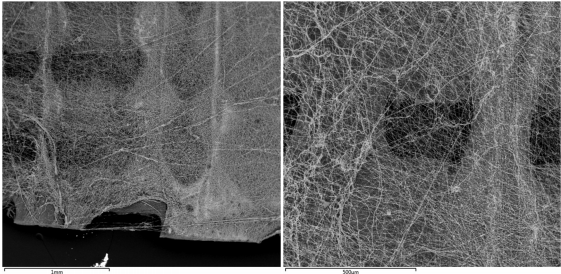
SEM images of electrospun fibers deposited onto a composite scaffold.
“The results that have been measured in 3T3 cells after 24h from seeding demonstrate that the cellular adhesion is comparable for each substrate,” says Sgarminato. “By considering the absorbance values after 72h, the highest increment of proliferation occurs for samples 4,5 and 6 that correspond to the PCL nanofibers…Indeed, PCL electrospun nanofibers represent a suitable substrate for growth and proliferation of NIH 3T3 cells. The small differences between PCL nanofibers and composites (samples 7 and 8) suggest a good cytocompatibility of the composite wound dressings. On the contrary, as expected, the printed scaffolds without nanofibers (samples 2 and 3) are not appropriate substrates for cell proliferation because of the limited culture surface.”
You can read the full thesis, entitled “Composite scaffolds with porosity over multiple length scale for skin regeneration,” here. The paper demonstrates that electrospinning and 3D bioprinting are effective methods of creating wound dressings that can treat chronic wounds and promote healing. This is an important application of bioprinting; while many people excitedly await the day that it’s possible to 3D print and transplant working human organs, it’s applications like these that are more immediate and can save lives just as effectively as a new heart.
Discuss this and other 3D printing topics at 3DPrintBoard.com or share your thoughts below.
Subscribe to Our Email Newsletter
Stay up-to-date on all the latest news from the 3D printing industry and receive information and offers from third party vendors.
Print Services
Upload your 3D Models and get them printed quickly and efficiently.













You May Also Like
3D Printing in Drones Could Reach $900 Million by 2034, AM Research Report Says
For years, additive manufacturing has searched for applications where its advantages clearly outweigh the limits of traditional production methods. Now, according to a new report from Additive Manufacturing Research (AM...
Largest Publicly Announced, Single Order in EOS History: Beehive Industries Spends $50M on M4 ONYX 3D Printers
Earlier this year, Beehive Industries received a $29.7 million contract to produce its Frenzy 6 and Frenzy 8 engines for the US Air Force. The metal additive manufacturing (AM) user...
3D Printing News Briefs, June 10, 2026: Grand Opening, Photoresins, Footwear, & More
We’re starting with some exciting news in today’s 3D Printing News Briefs: Stratasys just celebrated the opening of its new North American headquarters in Minnesota. Moving on, Nanoscribe is scaling...
Formlabs Launches the X1: Let’s Pack It In?
I’d like to share my disappointment. When Formlabs teased that something big was coming, I really hoped the firm would finally get around to making CNC machines, as it always...