Penn State Student Focuses Business Plan on Custom 3D Printed Shoes


 The world of fashion is a fantastic place for exploring the limitations and possibilities present in 3D printing technology. From burgeoning designers such as 13-year-old Ariel Swedroe to heavy hitters like Iris van Herpen, advanced manufacturing is becoming recognized for the pathways to sartorial expression that it is helping to create. Its integration into the workflow isn’t coming as a replacement for traditional methods of fabrication, but rather to expand possibilities in form, function, and feel. It’s also creating a stir in ideas about what fashion means and who has access to it, as well as disturbing the traditional divide between bespoke and off the rack.
One of the latest forays into the frontier of 3D printing and fashion is coming from a somewhat unexpected place: a junior accounting and finance student at Penn State University. Nicholas Unis is interested in the production of 3D printed shoes, although the connection is not as odd as it sounds, but rather has been a long time in the making. Unis worked in a shoe store while still in high school and heard countless complaints from customers who either love the look of the shoe but found it uncomfortable, or found the comfortable shoes to be unlikeable. His interest in shoes continued after high school when he would purchase shoes, customize them and then resell them, culminating in an experience in which he put the RiFF RAFF rapper pattern on a pair of Nike Air Jordans. Those shoes eventually reached the million dollar bid mark on eBay, but he was forced to remove them after receiving notice from Nike itself.
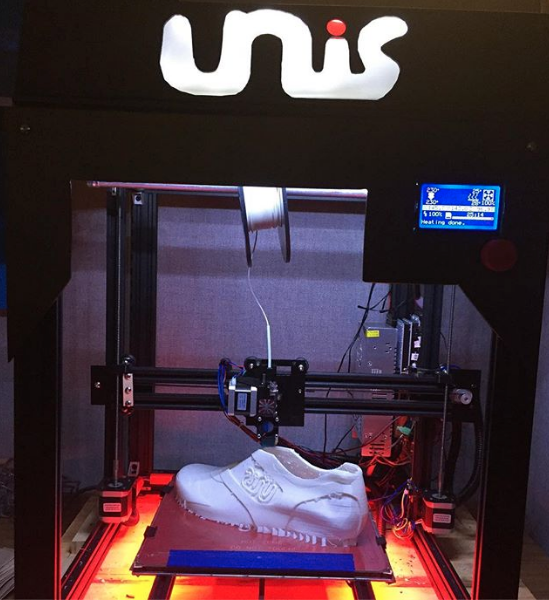
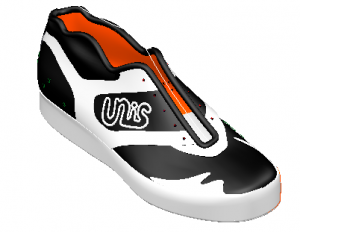
Putting two and two together, he quickly recognized the potential market for customized shoes and the breadth of the client base he could create by making such a product affordable.
Once he was introduced to 3D printing, the pathway seemed clear and Unis set about creating 3D printed shoes, using a flexible filament, that could be printed in three pieces, sole, upper, and tongue, based on measurements of the wearer’s feet. Unfortunately, the 3D printer he was using continually jammed when producing pieces out of the flexible material. Fortunately, Unis decided to design his own 3D printer, for which the patent is now pending, and having overcome that first barrier is well on his way to overcoming any others that throw themselves in his way.

January 2016 Shark Tank pitch [Image via Facebook]
What do you think of this news? Let us know your thoughts; join the discussion of this and other 3D printing topics at 3DPrintBoard.com or share your thoughts below.
[Source: The Daily Collegian / Images: Unis Brands]
Subscribe to Our Email Newsletter
Stay up-to-date on all the latest news from the 3D printing industry and receive information and offers from third party vendors.
Print Services
Upload your 3D Models and get them printed quickly and efficiently.













You May Also Like
Meltio Helps Grow Rubies Inside 3D Printed Platinum
At the University of the West of England (UWE Bristol), the Centre for Print Research (CFPR) is using metal 3D printing to help grow gemstones directly inside platinum structures. The...
3D Printing News Briefs, September 10, 2026: Tax Credits, Polymer Research, Microneedles, & More
We’re starting off this week’s 3D Printing News Briefs with a little business from Axtra3D and Beehive Industries, before moving on to a scientific collaboration agreement between Roboze and a...
3D Printing News Briefs, September 5, 2026: Electronic Skin, Cartilage, Cookies, & More
We’re starting with standards in this weekend’s 3D Printing News Briefs, as ASTM has re-launched its Advanced Manufacturing Division as the Critical and Emerging Technologies (CET) Division. Then we’ll move...
3D Printing News Briefs, August 29, 2026: Prosthetics, Pelvic Implants, Capillaries, & More
In this weekend’s 3D Printing News Briefs, America Makes announced the winner of its GOTHAAM Project Call. Then it’s all about healthcare 3D printing news, with Stratasys and Limbitless Solutions...