MineBridge Teams with Whiteclouds to 3D Print Topography Maps for Safer, More Efficient Mining Operations


 While, mining has been used for the extraction of valuable materials since the beginning of human civilization, the practice is still used today in order to acquire various earthly materials. Whether it is gold, silver, coal, oil shale, rock salt, gravel, limestone, gemstones, clay, or any other material located on or inside of the earth’s crust, the practice still remains both dangerous and complicated.
One company, named MineBridge Software, Inc., has come up with an innovative technique to aid in the visualization of both mining sites, as well as other geological locations. Typically when a company goes in to mine a particular site, they use comprehensive 2-dimensional topology maps, which include many contour lines telling miners and engineers the different elevations of a particular area. While this technique has been used for ages, in helping determine the most efficient and safe way to access a location on or beneath the earth’s surface, there are still flaws.
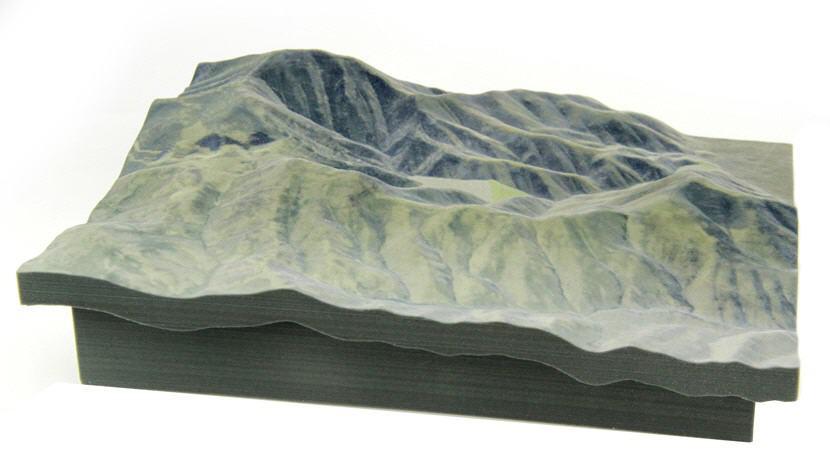
“It’s not always apparent from looking at a drawing how mine waste facilities integrate with their surrounding environment,” said MineBridge’s Carlo Cooper. “By using 3D printed models, it’s easier for stakeholders to see the visual impact of these structures.”
 So this is exactly what MineBridge Software decided to to do. They teamed with WhiteClouds, and utilized 3D Systems’ full-color ProJet® 660Pro to print out 3-dimensional maps of potential mining sites. MineBridge, using their own software package, Muck3D, was able to take survey data and aerial photographs, and then create 3D printable models. They then had Whiteclouds 3D print the model of a particular mining area located in Northern Nevada.
““We’re using this particular model just to show clients what we can do with their data—we are just starting to offer a service to turn their 3D datasets into 3D printed models,” said Cooper of MineBridge Software Inc. “The ones we’ve had printed up so far have been very well received and we’re hoping to do a lot more of them.”
The 3D print, which is pictured above and below, measures 203mm x 198mm x 52mm, and features an incredible 512 separate layers.
“The big benefit is the ease with which the 3D files and demo prints can be created,” explained Cooper. “We’re using this particular model to show clients what we can do with their data. The ones we’ve printed so far have looked great and been very well received. We plan to do a lot more of them as time goes on.”

Both Whiteclouds and MineBridge are already planning their next topographical 3D prints. If all goes as planned, this could become commonplace within an industry always looking to come up with the safest, most efficient ways of mining particular sites. Will 3D printing help them achieve this? It seems as though the technology is well on its way to doing so. What do you think about these prints? Discuss in the 3D Printed Mining sites forum thread on 3DPB.com.
[Source: Whiteclouds, via 3DSystems]Subscribe to Our Email Newsletter
Stay up-to-date on all the latest news from the 3D printing industry and receive information and offers from third party vendors.
Print Services
Upload your 3D Models and get them printed quickly and efficiently.











You May Also Like
AM Demand Signals: the Tungsten Harbinger
Most everyone who’s concerned with the scarcity of industrial materials is focused on rare earths, and rightfully so. But aside from the direct impact resulting from tighter supplies of rare...
WASP Mixes Earth and Plastic to Make Recyclable 3D Printed Composites
WASP has an eco-friendly ethos. Indeed, the firm wants to build houses and communities using local, environmentally friendly, and sustainable materials. WASP works with ceramics, biocement, and earth. The company...
3DPOD 318: 3D Printing at ORNL, Part II – Thomas Feldhausen
Thomas Feldhausen works at Oak Ridge National Laboratory (ORNL) on hybrid manufacturing, DED, digital twins, and new manufacturing solutions. For years, he’s tried to marry traditional subtractive manufacturing with additive...
The First Million’s the Hardest: Carbon’s Achievement with 3D Printed Bike Saddles
Last month I wrote an ode to 3D printed football helmet liners, as well as a brief overview of some of the biggest additive manufacturing (AM) success stories for the...