Formerly Conjoined Babies Doing Well After Surgery with Some 3D Printed Help from 3D Systems



Dr. Kevin Hopkins with a 3D printed model
Having triplets is rare, but what’s even more rare is for two of those triplets to be born conjoined. In fact, the odds of that particular situation happening are 50 million to one. Moreover, there’s only a six percent chance that siblings will be born conjoined near the hips, but Ximena and Scarlett Hernandez-Torres met all of those conditions, coming into the world as rare, special children indeed. The third triplet, Catalina, was born unattached to her sisters. Although Ximena and Scarlett each had their own set of legs, they were conjoined from the navel downward, sharing a colon and half a uterus on each side. Each baby’s kidney went to the other one’s bladder.
Separating the babies would require careful, complex surgery involving rerouting the kidneys and bladders, and in the spring of last year the girls were being prepared for that operation. The surgery required months of preparation, as the doctors would not only need to separate the girls and reroute their organs but also restructure and repair muscle, bone, skin and other tissue to make sure that each baby would be able to fully function on her own.
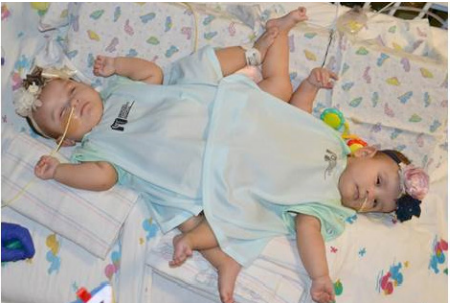
The surgical team that would work on Ximena and Scarlett had some help from 3D Systems, which took the CT scans and other data provided by the hospital and created a 3D digital representation of the babies’ anatomy. The 3D Systems team digitally enhanced vital parts of the anatomy, and 3D printed anatomical models from the data. They also digitally simulated the surgery that would take place.
“Every case of conjoined twins is unique and there is always significantly abnormal anatomy in these cases,” said Joe Fullerton, Team Lead for Medical Imaging and Modeling at 3D Systems. “In this case, some of the organs were difficult to identify because they were in unexpected locations or shared between the twins.”

They would have been even more difficult to identify without the 3D models and digital simulation created by the 3D Systems team, which they showed to the babies’ surgeons via a web meeting.
“There was a ‘wow’ moment when 3D Systems showed the cuts, separated the shared pelvis, and brought the individual pelvises back together,” said Dr. Kevin Hopkins, one of the plastic surgeons who would be working on Ximena and Scarlett. “The reaction was ‘holy cow, we can do this’! We also saw that Scarlett had one of her kidneys displaced much lower in her pelvis than originally thought, which only became readily apparent when we saw the 3D model.”

Dr. Haroon Patel with the other 3D printed model
It’s quite possible that the 3D models saved the babies’ lives, in that case. 3D Systems also sent the surgical team the 3D printed models that they had created from the scan data. The 3D prints were created with a ProX 800 SLA 3D printer. One model was 3D printed in a translucent plastic material so that the skeleton, major vasculature and organs would be clearly distinguishable, each printed in a different color. The other model was 3D printed in white plastic to show the surface of the skin.
“We chose that particular material because it is opaque, which is beneficial for incision planning because it clearly shows the contours of the skin,” said Fullerton.
The 3D printed models enabled the surgeons to further plan and practice the operations, and they could also be cleaned, sterilized and taken into the operating room for the doctors to reference during the procedure.
“The physical models were fantastic,” said Dr. Hopkins. “Unlike a two-dimensional x-ray or 3D visualization, you could hold these models in your hands. They were a great way to show team members exactly where the organs were located, where the cuts would be, and how to position the patient.”
According to Dr. Hopkins, the team allotted 20 hours for the operation. It ended up taking only 12, thanks to the digital and 3D printed models.

“If I had to use a cliché, it was like an orchestra,” said pediatric surgeon Dr. Haroon Patel, who led the team. “Everything just came together seamlessly.”
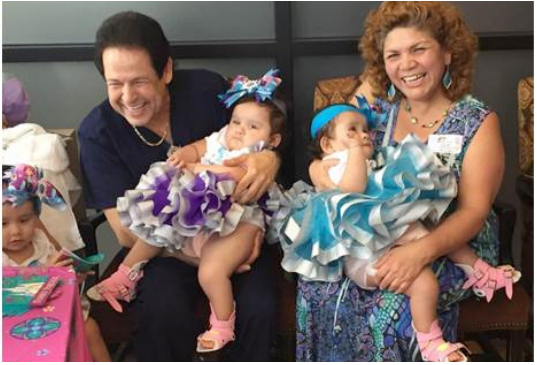
Ximena and Scarlett were released from the hospital in May 2016, near their first birthday. They’re currently undergoing physical therapy, and are doing well, according to Dr. Hopkins.
“They are improving all the time,” he said. “We expect that both of them will be able to walk and lead a normal life.”
Healthcare-focused technology from 3D Systems has been used in several successful surgeries to separate conjoined twins, including the high-profile case of the McDonald twins, as the dedicated team become involved throughout each step of complicated cases. Discuss in the Conjoined Babies forum at 3DPB.com.
[Images provided by 3D Systems]
Subscribe to Our Email Newsletter
Stay up-to-date on all the latest news from the 3D printing industry and receive information and offers from third party vendors.
Print Services
Upload your 3D Models and get them printed quickly and efficiently.












You May Also Like
Beyond Thermoplastics: Why JuggerBot Is Betting on Hybrid AM
For years, thermoplastics have been the workhorse of additive manufacturing (AM). They are pretty easy to process, available, and compatible with many of today’s industrial 3D printers. From prototypes to...
RIC Robotics Collaborates with K4k Construction on 3D Printed ADU in Sacramento
In 2024, RIC Robotics, the additive construction (AC) firm based in Denver, completed the build of an accessory dwelling unit (ADU) in Walnut, California, which was apparently an industry first....
Printing Money Episode 40: 3DP/AM Deal Analysis and More with Matthias Schmidt-Lehr, AMPOWER
Welcome to Printing Money Episode 40. Matthias Schmidt-Lehr (AMPOWER, Executive Partner) joins Danny for this episode and we are very thankful to have him back. In Episode 40, Danny and...
Additive Manufacturing at a Crossroads
Additive manufacturing is at a crossroads. Simultaneously, we find ourselves between certain very different modalities, applications, and industries. Rather than being able to explore them all, companies will now have...