3D Printed Syringe Pumps Cost a Mere Fraction of Traditional Pumps

Another day, another phenomenal addition to the list of practical, hype-less, real, tangible, 3D printable tools that are bound to bring on some welcome changes. This time, it’s the scientific community that can sing praises and raise their glasses as they’re about to reap the benefits – and save a bundle – on 3D printed syringe pumps.
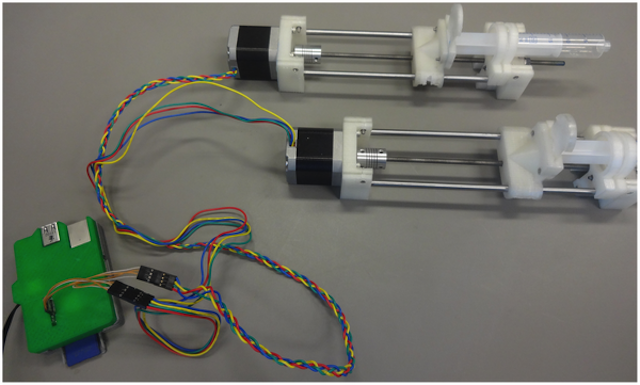
Two of Pearce Research Group’s 3D printed pumps hooked up to motors and a Raspberry Pi. Source: PLOS One
As essential lab tools used for delivering drug doses and all kinds of chemicals, these can cost thousands of dollars. Surely, the importance of scientific testing does not need to be explained and justified and so, the need to adjust the cost behind the tools necessary to make all that immensely important research happen is precisely the reason why a group of researchers from Michigan Technological University decided to release a library of open-source syringe pump designs that can be 3D printed. Yes, that is a collective sigh of relief from cash-strapped scientists around the world you just heard.
“Not only have we designed a single syringe pump,” said Joshua Pearce, the project’s lead researcher in a university statement, “we’ve designed all future syringe pumps. Scientists can customize the design of a pump to exactly what they are doing, just by changing a couple of numbers in the software.”

Lab work can become more cost-efficient for scientists Source: https://www.mysciencework.com
The group published a paper in PLOS One, that describes their approach in detail. What seems to be the core of design is an inexpensive Raspberry Pi which is wired to a single stepper motor controller and accompanying motor, which are in turn controlled by a local web server.
And here comes the best part: the open source design costs less than $100 for one syringe pump. Commercial kinds can cost up to $5000. At a 2% fraction of the cost, add the fact that the 3D printed pumps can also be customized to meet a lab’s specific needs and the benefit becomes virtually immeasurable.
Live lab tests have only confirmed that these syringes truly work – and work very well. Researchers tested the syringes for the amount of force and liquid they could deliver. The results showed that the 3D printed syringes were able to produce a maximum of 200 newtons worth of force and 2.4 milliliters of fluid per second, prompting the researchers to declare the effort as ‘admirable.’
This is only the latest effort from Pearce and his accomplished Michigan Tech team of researchers in an ongoing mission to make labs more low-cost and open source. In last year’s “Open Source Lab”, the team published a step-by-step guide for scientists on how to design and print a variety of lab tools for fractions of their traditional prices. Pearce and his team are firm believers that the ability to control and create the equipment in a lab allows scientists to act independently of vendors, sponsors and make their work environment more adaptive to their needs. The thought of allowing scientists to worry more about the actual work they’re set out to perform and less about the zeroes behind the tools they need, is incredibly encouraging, not only for those working in labs but the rest of us well. Let’s hear your thoughts on this story in the 3D printed syringe pump forum thread on 3DPB.com.
Chin-chin to another successful, 3D printing-boosted win!
Subscribe to Our Email Newsletter
Stay up-to-date on all the latest news from the 3D printing industry and receive information and offers from third party vendors.
You May Also Like
Profiling a Construction 3D Printing Pioneer: US Army Corps of Engineers’ Megan Kreiger
The world of construction 3D printing is still so new that the true experts can probably be counted on two hands. Among them is Megan Kreiger, Portfolio Manager of Additive...
US Army Corps of Engineers Taps Lincoln Electric & Eaton for Largest 3D Printed US Civil Works Part
The Soo Locks sit on the US-Canadian border, enabling maritime travel between Lake Superior and Lake Huron, from which ships can reach the rest of the Great Lakes. Crafts carrying...
Construction 3D Printing CEO Reflects on Being Female in Construction
Natalie Wadley, CEO of ChangeMaker3D, could hear the words of her daughter sitting next to her resounding in her head. “Mum, MUM, you’ve won!” Wadley had just won the prestigious...
1Print to Commercialize 3D Printed Coastal Resilience Solutions
1Print, a company that specializes in deploying additive construction (AC) for infrastructure projects, has entered an agreement with the University of Miami (UM) to accelerate commercialization of the SEAHIVE shoreline...