A New 3D Printable Gun, The ‘Imura Revolver’ is Being Designed

 Although it may strike a nerve with some of you out there, members of the Free Open Source Software & Computer Aided Design (FOSSCAD) group are at it again, creating yet another 3D printable firearm. If you recall, back in May a university official, named Yoshitomo Imura, was arrested in Kawasaki, Japan after he was found to be in possession of five 3D printed firearms. Although two of these weapons were able to be loaded with metal ammunition and fired, Imura claims to have only ever fired blanks with the weapons. The arrest took place after Japanese authorities found a video online with Imura firing one of his 3D printed guns, called a Zig-Zag Revolver.
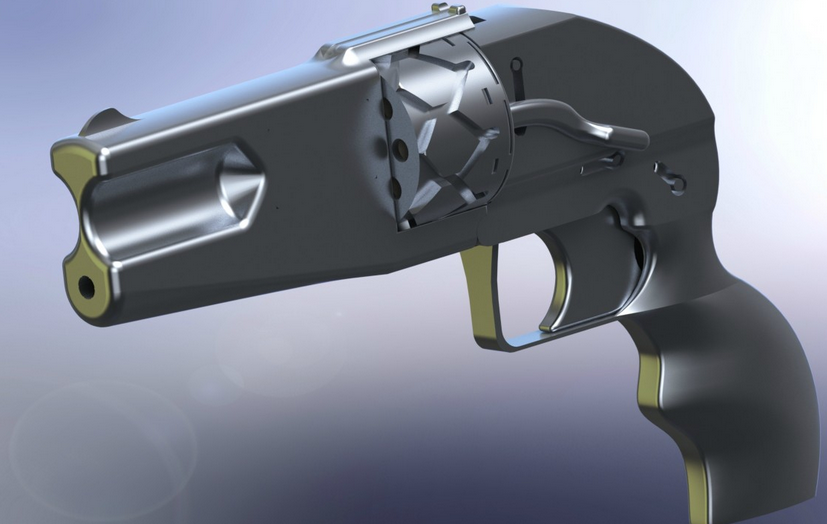
Since his arrest, several members of the FOSSCAD community have decided to use the basic design of the .38-caliber Zig-Zag, but make several key changes to the weapon prior to printing it out. To commemorate Imura’s accomplishments, the team has decided to name the firearm the ‘Imura Revolver’, at least for now. FOSSCAD members, Wayfairy, Frostbyte and others are leading this design push, which has already seen the basic CAD model completed. The team has since begun printing out test parts, and will certainly continue to improve some of the aspects of the design until they feel it is able to fire without blowing up in one’s face.
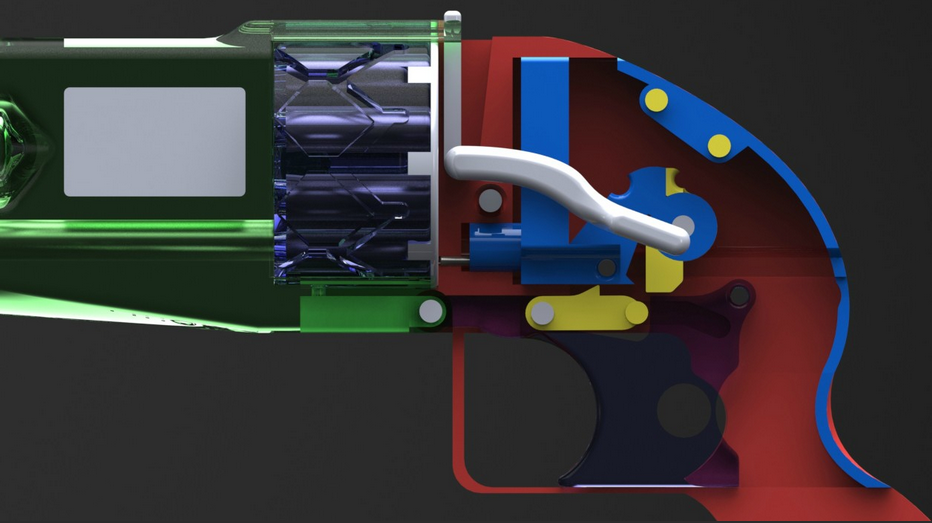
Like the Zig-Zag, the new gun will fire from the bottom of the cylinder, but include several hybrid features, such as a steel barrel liner, and chamber sleeves. Unlike the Zig-Zag, this weapon will be double action. For those of you unfamiliar with the workings of a gun, this means that one pull of the trigger does it all. It rotates the cylinder, and then cocks and releases the striker, firing the weapon. A gun like this can be repeatedly fired without major pause between shots.
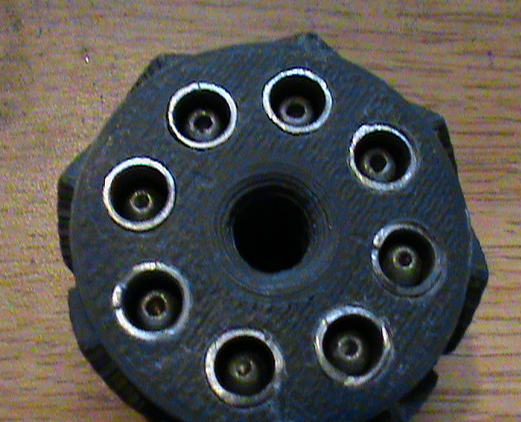
The 3D printed cylinder
The team has released several interesting photos, both of the design, as well as a prototype of the components of the gun, which have been printed apparently on a desktop 3D printer. As Dean Weingarten points out on Gun Watch, there may be a few flaws to the design, which need to be reexamined prior to ever attempting to fire this weapon. He writes:
“There is very little tensile strength in the proposed design. Convention revolvers use a metal frame to contain the forces generated by firing a charge. The chambers contain the pressure at right angles to the barrel, but the frame, chamber, and case, if one is used, must contain the pressure to the rear. The projectile contains the pressure to the front, where the force is used to propel it out the end of the barrel.”
It will be interesting to see how this design develops over the coming weeks ahead. Whether you feel that such production of firearms should be illegal or not, there is no denying that there is not much any regulatory authority can do to stop the development of these weapons.
Discuss this design, and whether or not you think it could be fired, in the Imura Revolver forum thread on 3DPB.com. More images of this 3D printed weapon can be found here.
Subscribe to Our Email Newsletter
Stay up-to-date on all the latest news from the 3D printing industry and receive information and offers from third party vendors.
Print Services
Upload your 3D Models and get them printed quickly and efficiently.












You May Also Like
U.S. Navy Lab Uses 3D Printing to Reduce Tooling Lead Time By Over 90%
The F-35 Lightning II Joint Program Office (JPO), responsible for life-cycle management of the key fifth-generation joint strike fighter (JSF) system used by the U.S., its allies, and its partners,...
Etsy Design Rule Change Reduces Selection of 3D Printed Goods
Online marketplace Etsy has implemented a rule change requiring all 3D printed goods on the site to be original designs. The update to the site’s Creativity Standards states, ¨Items produced using...
Honeywell Qualifies 6K Additive’s Nickel 718 for 3D Printed Aerospace & Defense Parts
6K Additive is renowned for manufacturing sustainable additive manufacturing (AM) powder, and offers a wide portfolio of premium metal and alloy powders that include titanium, copper, stainless steel, and nickel,...
MetalWorm Sells WAAM Systems to Research Institutes in Brazil and Malaysia
Turkish WAAM firm MetalWorm has sold a system in Malaysia and another in Brazil. This is an excellent example of a few emerging trends in additive. Firstly, WAAM was experimented...